Why modern due diligence tools matter now
Selecting the right due diligence tools in 2026 requires moving past passive document storage toward platforms that actively extract, cross-reference, and evaluate transaction risks. Modern private equity investors, M&A advisors, and corporate development leads evaluate targets against compressed timelines, fragmented multi-format data rooms, and heightened regulatory standards. Legacy workflows that rely on disconnected spreadsheets and manual document sampling create severe information blind spots. To preserve deal velocity without sacrificing analytical rigor, deal teams must deploy specialized software architectures that unify data room ingestion, automated risk registration, and traceable investment committee reporting.
The cost of diligence oversights has escalated sharply across global M&A markets. Antitrust agencies and sector regulators have intensified their scrutiny of deal rationale, foreign direct investment disclosures, and competitive overlap. In 2022 and 2023 alone, regulators across the globe challenged at least $361 billion in announced transactions. When regulatory reviews lengthen and transaction terms require complex remedies, deal teams need instant auditability across every underlying contract, regulatory filing, and historical governance document.
Beyond regulatory headwinds, transaction volume and data complexity have overwhelmed manual review models. A mid-market acquisition typically involves thousands of unstructured files, ranging from scanned legacy leases and customer agreements to financial models. When deal teams rely solely on manual sampling, critical liabilities such as customer concentration clauses, intellectual property assignment gaps, and change-of-control penalties are easily missed, driving up risk profiles for PE deal teams and advisors.
- Escalating regulatory scrutiny: Higher clearance hurdles demand verified, document-level evidence for antitrust and foreign investment filings.
- Exponential data growth: Mid-market data rooms now hold thousands of unstructured files, making comprehensive manual review impractical within short diligence windows.
- Compressed exclusivity periods: Competitive bidding environments force deal teams to surface valuation adjustments and red flags within days rather than weeks.
- Cross-advisor fragmentation: Siloed workstreams between commercial, legal, and financial advisors lead to duplicated effort and uncoordinated risk registers.
The main practical framework for deal evaluation
To evaluate targets thoroughly, modern deal teams organize their diligence stack around a multi-dimensional framework. Rather than assessing documents in isolation, high-performing investment teams evaluate transaction materials across three interconnected pillars: financial integrity, legal compliance, and operational or technical resilience. Each pillar requires specific analytical capabilities to convert raw source data into defensible findings.
Despite the growing strategic importance of digital infrastructure, operational and technical due diligence often suffers from severe under-resourcing. Buyout teams routinely commission comprehensive technology assessments for pure-play software targets, yet apply far lighter technical scrutiny to non-software deals where proprietary systems still underpin the investment thesis. In an era where every modern enterprise relies on proprietary software, cloud architectures, and digital customer pipelines, failing to systematically evaluate technical debt and software architecture introduces substantial post-acquisition risk.
| Diligence Dimension | Core Analytical Objectives | Primary Data Inputs | Key Output Deliverables |
|---|---|---|---|
| Financial Diligence | Validate Quality of Earnings (QoE), bridge EBITDA adjustments, and verify working capital baselines | Audited accounts, general ledgers, revenue schedules, customer billing logs | Bridge charts, revenue churn tables, normalized margin models |
| Legal & Governance Diligence | Identify change-of-control liabilities, IP ownership gaps, litigation exposure, and regulatory compliance | Commercial contracts, corporate bylaws, patent filings, employment agreements | Material contract summary, liability exposure register, red-flag list |
| Operational & Technical Diligence | Assess software architecture, data security, technical debt, and scalability limits | Architecture diagrams, SOC 2 reports, vendor SLAs, infrastructure billing | Tech stack audit, integration roadmap, technical debt risk score |
Aligning the software stack around these three pillars ensures that deal leads can trace every risk back to primary source documentation. Applying structured workflow automation across these dimensions allows teams to synthesize cross-functional insights into a unified risk view rather than maintaining disconnected advisor spreadsheets.
Comparing VDRs, project trackers, and AI analysis engines
The M&A technology landscape contains several distinct categories of tools, each designed to address a different stage of the transaction lifecycle. Choosing an effective tool stack requires understanding the functional boundaries between Virtual Data Rooms (VDRs), general-purpose project management trackers, and specialized AI analysis engines.
Virtual Data Rooms serve primarily as secure storage vaults and access gatekeepers. While essential for permissioning, watermarking, and hosting files during live bidding, legacy VDRs are fundamentally passive: they hold documents but cannot interpret or synthesize their contents. General project trackers and checklist tools offer workflow coordination across task lists and advisor assignments, yet they remain disconnected from the actual text of uploaded files, forcing analysts to manually re-enter findings into separate tracking spreadsheets.
| Tool Category | Primary Function | Core Strengths | Operational Limitations |
|---|---|---|---|
| Virtual Data Rooms (VDRs) | Secure document hosting and role-based access control | Granular permissioning, dynamic watermarking, audit logs for compliance | Passive repository; lacks automated data extraction and semantic reasoning |
| Project Trackers & Checklists | Workflow orchestration and milestone monitoring | Task assignment, deadline tracking, cross-team status visibility | No native connection to document contents; requires manual data entry |
| AI Analysis Engines | Automated document reading, reasoning, and synthesis | Instant semantic cross-referencing, automated risk detection, source tracing | Requires secure data ingestion from VDRs; needs human verification for final conclusions |
Modern investment teams increasingly deploy AI analysis engines as an intelligence layer on top of their secure VDR repositories. This architecture pairs the security and access controls of traditional data rooms with automated extraction capabilities that read, cross-reference, and structure thousands of unstructured documents in minutes. Evaluating platforms using a dedicated software buyer guide helps teams select platforms that integrate smoothly across their existing document repositories without compromising data sovereignty.
15 due diligence tool capabilities to compare
When selecting diligence software for private equity transactions, corporate development projects, or M&A advisory mandates, teams should systematically compare vendors across 15 core technical capabilities. These features distinguish modern, intelligence-driven platforms from passive file viewers.
Data ingestion, parsing, and search
- 1. Multi-format data room ingestion: Seamlessly connects to external VDRs to ingest PDFs, scanned TIFFs, spreadsheets, presentations, and raw text files within minutes without requiring manual conversion.
- 2. High-accuracy OCR and table parsing: Accurately extracts structured tables, footnotes, and handwritten text from scanned contracts and financial exhibits without losing row-column relationships.
- 3. Semantic search and natural language querying: Enables deal teams to search across the entire data repository using conceptual queries (such as 'uncapped indemnity clauses' or 'non-solicitation terms') rather than relying purely on exact keyword matching.
- 4. Cross-document entity reconciliation: Automatically detects and normalizes inconsistent company names, subsidiary entities, and counterparty references across thousands of independent agreements.
- 5. Automated redaction and PII protection: Detects and redacts sensitive personal data, customer names, and protected health information to maintain strict regulatory compliance during early bidding rounds.
Risk intelligence and analysis
- 6. Automated risk detection and materiality scoring: Scans commercial contracts, employment agreements, and board minutes to identify non-standard clauses, assign liability weights, and highlight potential deal breakers.
- 7. Dynamic risk register generation: Automatically aggregates individual red flags into a centralized risk register automation table with severity rankings, financial impact estimates, and clear remediation pathways.
- 8. Disclosure gap and omission identification: Cross-references standard diligence request lists against uploaded data room contents to detect missing exhibits, unsigned annexes, or unprovided historical audits.
- 9. Change-of-control and covenant extraction: Extracts precise notification windows, consent triggers, and termination penalties across all supplier, customer, and debt contracts to calculate closing friction.
- 10. Multi-document reconciliation and contradiction detection: Compares historical board minutes, management presentations, and audited accounts to identify conflicting revenue statements or undisclosed litigation.
Reporting, collaboration, and governance
- 11. Investment committee memo generation: Automatically structures verified findings, executive summaries, and risk tables into comprehensive drafts to accelerate IC memo automation workflows.
- 12. End-to-end source traceability: Provides clickable, sentence-level citations that link every extracted figure or finding directly to the exact page and highlight in the source file.
- 13. Real-time multi-advisor collaboration: Facilitates shared workspaces where legal, financial, and technical specialists can annotate findings, assign follow-up tasks, and share observations simultaneously.
- 14. Integrated Q&A management and tracker: Structures buyer inquiries, drafts suggested answers from verified data room files, and routes formal questions to vendor advisors with full audit trails.
- 15. Enterprise-grade security and data isolation: Enforces strict data encryption in transit and at rest, zero data retention for public model training, and role-based access control matching institutional compliance standards.
Red flags and common mistakes in tool selection
Investing in diligence software without clear technical benchmarks often leads deal teams to adopt tools that create additional friction rather than efficiency. One of the most prevalent mistakes is treating due diligence purely as a document storage problem. Procurement teams frequently over-index on raw storage capacity and user interface aesthetics while overlooking whether the software can parse complex financial tables or trace claims back to source text.
Another critical error is deploying fragmented, disconnected point solutions. When legal advisors use one document review tool, financial teams maintain standalone spreadsheets, and commercial leads manage separate interview trackers, critical insights remain trapped in silos. This fragmentation directly harms post-acquisition execution and synergy capture. An analysis of more than 3,000 public-to-public deals above US$100 million between 2012 and 2022 found that 57.2 percent of acquirers ultimately destroyed shareholder value, while roughly 42.8 percent succeeded in unlocking meaningful synergies, in large part because integration and execution complexity was underestimated.
- Black-box AI without source links: Deploying generative tools that summarize text without verifiable page-level citations exposes the investment team to hallucinations and unverified assumptions.
- Fragmented software stacks: Using separate, non-integrated tools for legal, financial, and technical workstreams prevents unified risk scoring and delays report assembly.
- Ignoring data sovereignty and security: Using consumer-grade tools that retain client data for model training violates non-disclosure agreements and institutional compliance mandates.
- Neglecting disclosure gap detection: Relying on systems that only analyze what is uploaded, without identifying what documents are missing from standard disclosure lists.
How Plausity supports the workflow
Plausity is built specifically to serve as the AI-native intelligence layer for private equity investors, M&A advisors, and corporate development leads. Rather than replacing trusted professional advisors or offering automated legal opinions, the platform structures, accelerates, and organizes complex document reviews to give human teams complete confidence in their findings.
At the foundation of the platform, Data Room Ingestion connects directly to existing data rooms, rapidly processing thousands of multi-format files including contracts, scanned records, and financial exhibits. The core AI-Analysis Engine then reads and cross-references these documents in minutes, surfacing hidden liabilities, inconsistent disclosures, and commercial trends across the entire dataset.
To streamline risk evaluation, the built-in Risk Radar evaluates findings based on financial exposure, materiality, and deal context, automatically assembling a prioritized overview of critical anomalies. Teams seeking structured risk intelligence can explore the dedicated Findings & Risk Intelligence system to evaluate how automated materiality scoring accelerates triage.
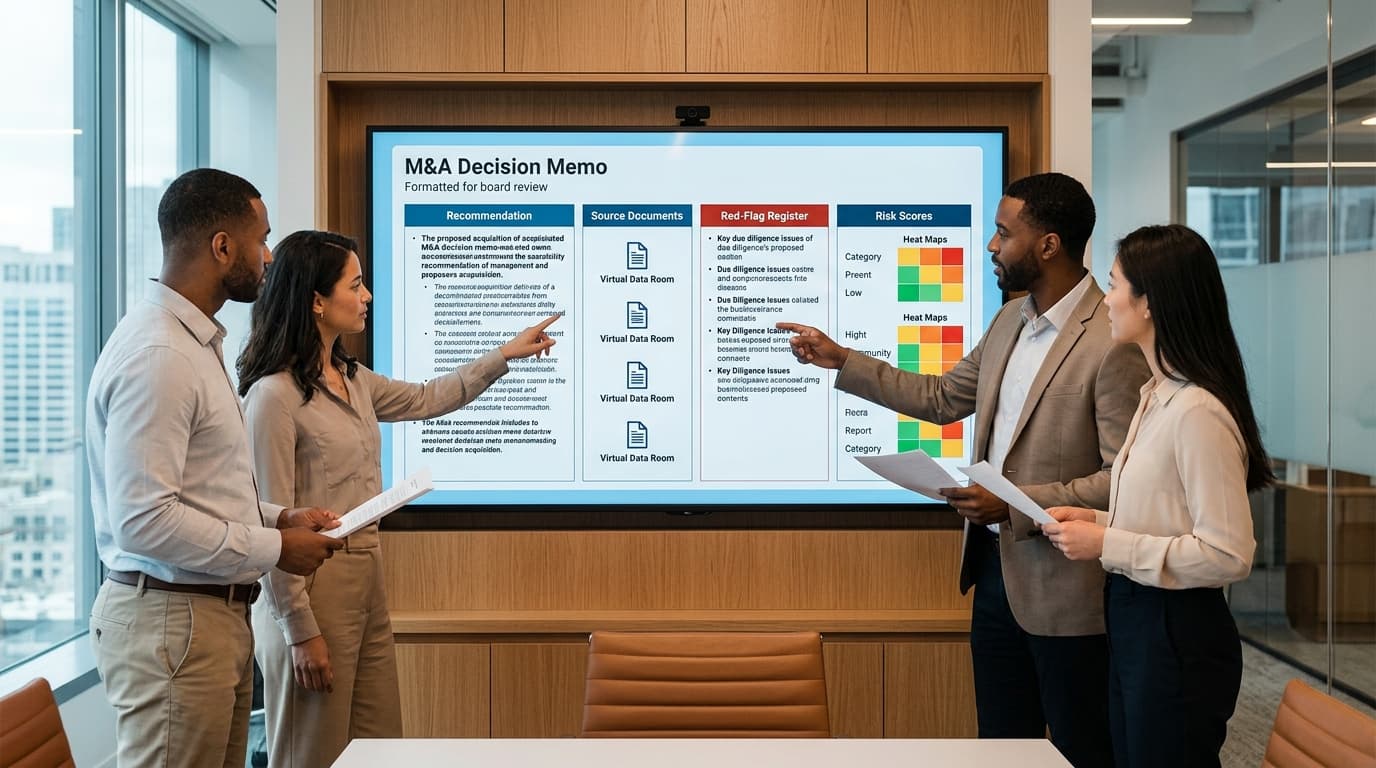
Finally, the platform bridges the gap between raw analysis and final decision-making. The Report Builder converts verified findings into structured, professional due diligence reports and investment memos with full source traceability, while the Collaboration Hub coordinates deal team workstreams in real time. This unified workflow enables deal teams to eliminate manual administrative bottlenecks while keeping human judgment firmly at the center of every investment decision.
How to use this in your next diligence workflow
To operationalize these 15 capabilities on upcoming transactions, private equity deal leads and corporate development managers should establish a structured, phased evaluation framework before their next live bidding process begins. Moving from ad-hoc manual reviews to an AI-native diligence workflow requires establishing clear software benchmarks and testing them against real transaction constraints.
- Audit existing workflow bottlenecks: Map the hours currently spent across your team on data room sorting, manual red-flag indexing, and initial IC memo drafting to establish baseline productivity metrics.
- Standardize your risk criteria: Define organizational materiality thresholds, key red-flag clauses, and compliance checklists so your intelligence tooling can be configured around consistent underwriting standards.
- Test multi-format document ingestion: Pilot candidate platforms using complex historical data rooms containing scanned PDFs, dense financial schedules, and legacy contracts to verify table parsing and OCR precision.
- Enforce strict source traceability: Ensure every automated finding, extracted covenant, and summarized data point links directly to verified source documentation before incorporating it into final investment decisions.
- Integrate reporting and team collaboration: Connect your document intelligence layer with collaborative workspaces and automated report builders to deliver cohesive, audit-ready deliverables to investment committees on schedule.