What is Tech-Enabled Services Due Diligence?
Tech-enabled services due diligence is a specialized underwriting process for private equity investors, independent sponsors, and M&A advisors evaluating companies that combine human service delivery with proprietary software. Rather than treating software as a standalone product or relying on superficial labels, this diligence methodology tests how technology fundamentally transforms the operating model, delivery leverage, gross margin trajectory, and client retention. Technology diligence advisers frame the test as three questions: whether the tech is real and differentiated, whether the organisation is set up to manage and scale that technology as a product with a roadmap and release cycle, and whether the tech clearly improves business performance rather than being technology looking for a problem to solve. In practice, that means testing whether the business can grow revenue without adding delivery headcount at the same rate, or whether it remains a traditional professional services firm behind an expensive client portal.
When lower-middle-market deal teams evaluate targets positioning themselves as technology-enabled, standard software diligence frameworks often fail to capture the underlying operational reality. Evaluating a hybrid provider requires a dual lens that examines both software architecture and human delivery mechanics in parallel. Understanding this distinction is essential before deploying capital, as outlined in our analysis of what an AI-native diligence platform changes for modern investment workflows.
Key Takeaways for Deal Teams
- Underwrite Operating Mechanics, Not Software Labels: Software ARR multiples apply only when technology generates delivery leverage and margin expansion; otherwise, the target must be valued as a tech-assisted service business.
- Delivery Leverage Dictates Margin Trajectory: True tech-enabled businesses exhibit non-linear unit economics where headcount grows at a fraction of revenue growth.
- Data Exhaust Creates Customer Defensibility: Proprietary workflows that capture operational data build high switching costs and sticky client retention.
- AI Enablement Differs from AI Substitution: Investors must separate target workflows enhanced by machine learning from legacy services at risk of complete automated disintermediation.
Why This Matters Now
The rapid expansion of lower-middle-market private equity transactions has accelerated the convergence of traditional professional services and technology platforms. Analysis of technology M&A transactions completed between 2015 and mid-2025 shows software businesses trading at a median 3.0x EV/Revenue and 15.2x EV/EBITDA, while IT services companies traded at a median 1.3x EV/Revenue and 10.2x EV/EBITDA. That gap pushes deal teams toward tech-enabled services targets, where entry multiples look more attractive. However, traditional service businesses digitalizing their client interfaces or adopting third-party SaaS tools often claim software-like characteristics without achieving software-like economics.
At the same time, rising labor costs and talent shortages have made operational productivity the central driver of EBITDA expansion. Digitalizing delivery workflows allows service providers to expand gross margins, lower customer acquisition costs, and deepen client engagement. Evaluating these dynamics requires deal teams to update their private equity workflows to bridge the gap between commercial growth claims and technical execution capability.
- Valuation Multiple Compression Risk: Paying software-level multiples for headcount-constrained delivery models creates severe exit valuation risk.
- Labor Cost Pressures: Wage inflation in professional services makes automated task execution a mandatory lever for margin expansion.
- Transition to Value Creation Playbooks: Diligence is shifting from a defensive risk audit into an integrated blueprint for post-close operational value creation.
The Core Framework: Underwriting the Operating Model
To determine whether a target possesses genuine technology enablement, deal teams must look beyond marketing decks and scrutinize the underlying operating mechanics. Treating commercial due diligence and technical due diligence as isolated workstreams leaves critical blind spots that surface after closing. Modern investment teams apply a comprehensive technical due diligence framework that tests software scalability, human delivery intensity, data ownership, and pricing alignment.
Human Involvement vs. Automation Depth
Every tech-enabled service operates along a spectrum between fully manual execution and pure software automation. Diligence must map every core workflow to determine where human intervention is required for domain judgment versus routine execution. High-performing tech-enabled targets establish a structured human-in-the-loop business model where proprietary software absorbs the bulk of low-complexity, repeatable tasks, reserving human experts for final quality assurance and client relationship management. What matters is not the headline automation claim but the workflow-level evidence behind it: which steps run without a person, which still require one, and whether automating a process has actually translated into higher resource utilization or operating leverage, the question technology diligence providers put to any automation story.
Reusable Data Exhaust and Switching Costs
A primary indicator of long-term defensibility in tech-enabled services is the accumulation of reusable data exhaust. As the company executes services for clients, proprietary software should automatically collect, structure, and store transactional data. Over time, this aggregated dataset powers internal benchmark tools, predictive algorithms, and automated reporting engines that competitors cannot replicate. Evaluating these data assets requires evaluating data exclusivity and proprietary domain logic across client accounts.
AI Enablement vs. AI Substitution
The rapid emergence of generative artificial intelligence introduces both upside opportunities and existential substitution risks for tech-enabled service providers. Investors must distinguish between AI enablement, where internal artificial intelligence tools boost employee throughput, and AI substitution, where client-side software renders the underlying service obsolete. Diligence teams must evaluate how evolving pricing structures impact revenue sustainability, referencing our research on pricing model diligence and applying a robust software defensibility framework to test market threats.
What Investors Are Really Testing
When private equity deal teams conduct tech-enabled services diligence, the ultimate objective is validating whether technology creates measurable operating leverage. Investors must verify that the target can expand its customer base and total revenue without requiring a linear, proportional increase in delivery personnel. Conducting rigorous value creation due diligence ensures that gross margin expansion assumptions in the underwriting model are grounded in proven operational metrics rather than optimistic management projections.
In pure services companies, incremental revenue typically requires a proportional increase in consultants, analysts, or field technicians, which keeps gross margins broadly flat as the business grows. In a truly tech-enabled service business, proprietary software automates data ingestion, document processing, and report drafting, enabling existing staff to handle significantly higher transaction volumes. Services margin diligence should therefore test whether gross margin has actually widened as revenue scaled, using the target's own cohort-level financials rather than a benchmark range, an exercise that sits alongside the standard financial due diligence checklist.
Investors test this leverage by calculating historical capacity utilization, throughput per employee, and marginal delivery cost per unit of revenue. Verifying these operational metrics bridges the gap between pre-deal underwriting and post-close execution, as detailed in our guide on operational alpha due diligence.
What Management is Expected to Show
Target management teams claiming technology-enabled status must present concrete, empirical evidence during data room reviews. Asserting that the business utilizes proprietary tools is insufficient; leadership must demonstrate how internal platforms directly reduce labor hours, improve accuracy, and accelerate client delivery. Utilizing a structured AI due diligence checklist allows deal teams to audit management claims systematically.
- Workflow Telemetry & Audit Logs: Empirical data tracking time spent by human staff per project before and after software implementation.
- Automation Rate Analysis: Quantitative breakdown of client deliverables generated automatically versus manual custom authoring.
- Product Roadmap & Capital Allocation: Historical and projected software R&D expenditures showing continuous platform iteration.
- Client Interface Engagement Metrics: Active monthly user logs showing client adoption of proprietary software portals.
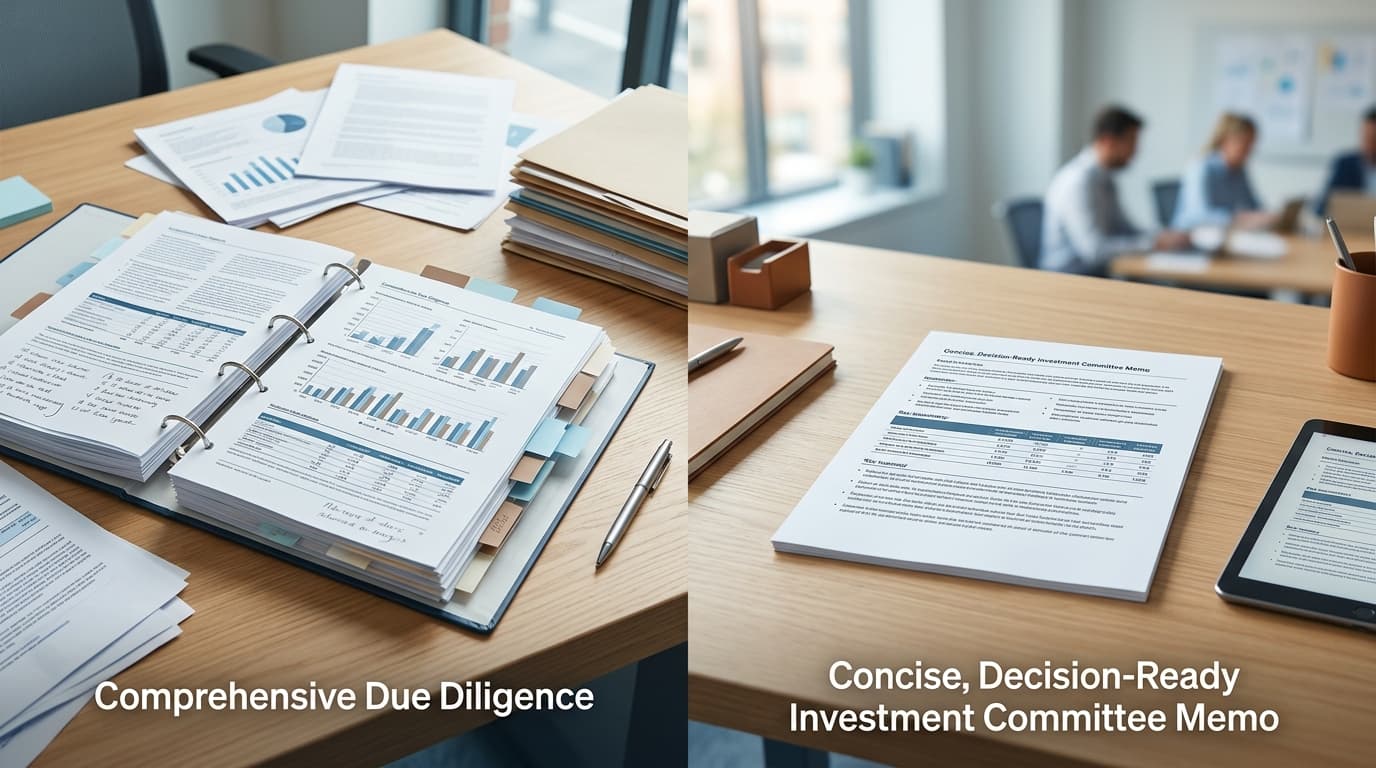
When target leadership provides verified telemetry and clear delivery metrics, investment committees can underwrite growth projections with high conviction, facilitating seamless drafting of investment committee memos.
Red Flags and Data Room Evidence Checklist
Identifying operational friction early prevents deal teams from overpaying for pseudo-technology platforms. Below is the red-flag matrix and data room checklist for underwriting tech-enabled service targets.
Tech-Enabled Services Red Flag Matrix
| Diligence Area | Red Flag Warning Sign | Underlying Operational Risk | Underwriting Impact |
|---|---|---|---|
| Gross Margin Profile | Gross margins remain flat at services-like levels despite revenue growth | Technology is not creating delivery leverage; costs scale linearly | Reclassify company as pure services; lower exit multiple |
| Software Integration | Core software operates as an isolated portal requiring manual re-entry | High technical debt and reliance on human double-data entry | Depress gross margin forecasts; budget major capex for re-architecture |
| Client Adoption | Low client portal login rates with preference for email exchanges | Software features lack market relevance or user-friendly design | Higher churn risk and lower customer lifetime value |
| R&D Spend & Team | Software maintained by offshore contractors with no internal CTO | Lack of technical governance and high key-person dependency | High post-close hiring costs to build in-house engineering |
| Data Architecture | Client data stored in disconnected spreadsheets and isolated silos | Data exhaust is unorganized and unusable for algorithmic tools | Inability to build proprietary AI moats or automated benchmarks |
| Pricing Realization | Service priced purely on hourly billing without technology fee | Clients perceive value from human hours rather than platform software | Inability to capture value creation gains through value-based pricing |
Data Room & Evidence Checklist
- Unit Economics by Account Cohort: Historical revenue, direct labor cost, and gross margin broken down by client tenure.
- Time-Tracking & Telemetry Reports: Detailed breakdown of hours spent by job role per project deliverable.
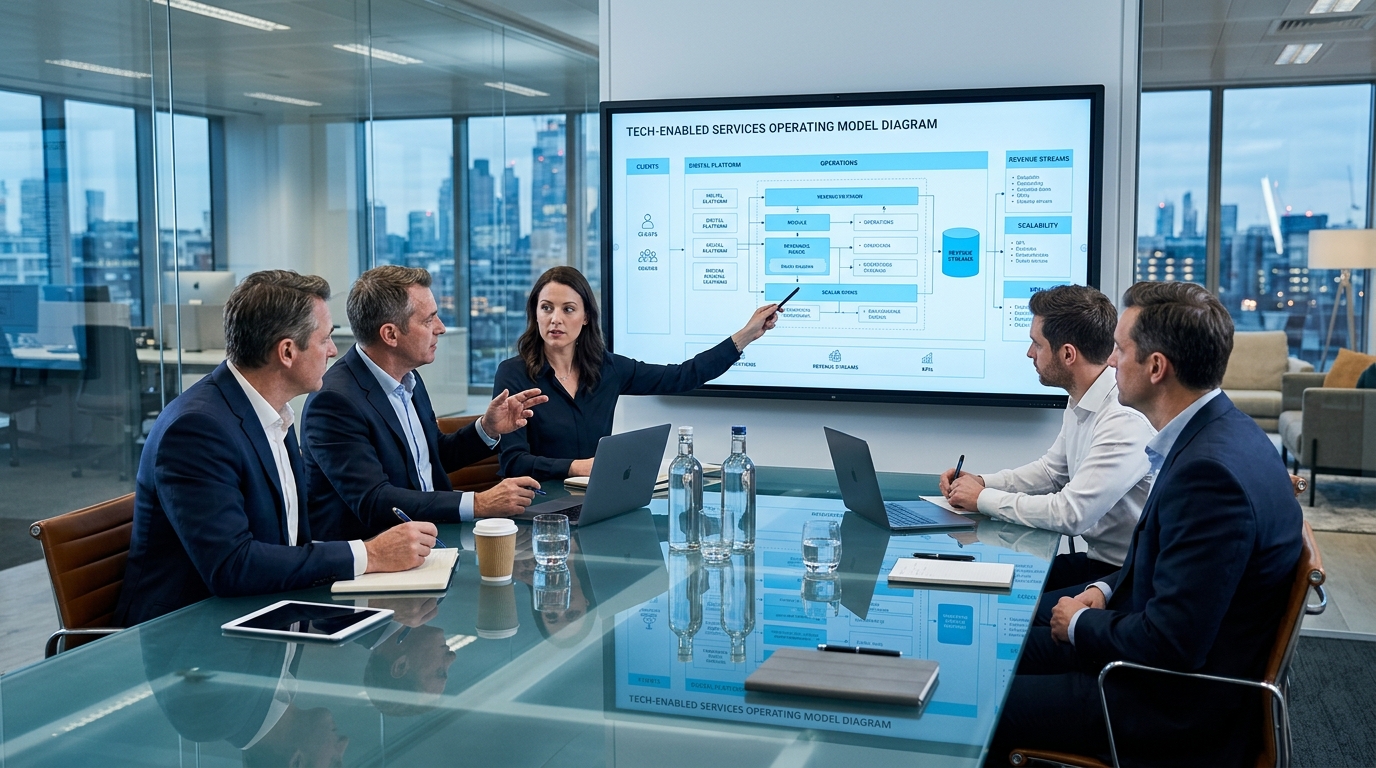
- Software Architecture Diagram: Complete mapping of frontend client interfaces, backend databases, API integrations, and data pipelines.
- Source Code & IP Audit: Verification of code repository ownership, third-party library licenses, and proprietary patent filings.
- R&D Budget & Engineer Headcount: Historical multi-year spend on internal software development versus third-party IT maintenance.
- Client Portal Telemetry Logs: User login frequency, feature utilization rates, and self-service transaction counts per account.
- Service Level Agreement (SLA) & Error Logs: Tracking delivery turnaround times, rework requests, and quality control error rates.
- Customer Churn & Expansion Data: Net revenue retention rates segmented by clients actively using software features versus offline clients.
Practical Implications for Investors and Operating Partners
For private equity investors, independent sponsors, and operating partners, underwriting tech-enabled services requires a structured post-close operating plan. Value creation in these assets comes from systematically automating remaining manual delivery steps, shifting pricing from hourly rates to value-based software tiers, and institutionalizing reusable data assets across portfolio companies.
How to use this in your next diligence workflow
Deal teams should sequence tech-enabled service diligence into three actionable phases. During screening, review gross margin trends and staff-to-revenue ratios. During deep-dive diligence, audit workflow telemetry and technical architecture to test delivery leverage. Post-close, execute the top automation priorities within the first 100 days to accelerate margin expansion.
How an AI diligence platform supports this workflow
Plausity streamlines this rigorous due diligence process through its integrated AI platform. Its core AI-Analysis Engine lets deal teams cross-reference, interpret, and reason over thousands of virtual data room documents within minutes. The Data Room Ingestion module connects to external data repositories, ingesting financial models, service contracts, and technology audit logs. Meanwhile, Risk Radar automatically identifies and evaluates findings based on materiality, legal exposure, and deal relevance, surfacing operational anomalies before signing. Deal teams can configure custom workflows to accelerate document review and convert findings into an actionable post-close value creation roadmap.
Frequently Asked Questions
- What gross margin range defines a true tech-enabled service business? There is no universal threshold. What matters is that gross margin sits meaningfully above comparable labour-based service peers and widens as revenue scales, evidenced in the target's own cohort-level financials rather than a benchmark range.
- How do deal teams test if technology is deeply integrated versus a superficial wrapper? Investors inspect client portal telemetry, automated task execution logs, and API data flows. If human staff must manually transfer data from the client interface into internal tools, the technology is merely a superficial frontend.
- Why is headcount growth relative to revenue growth the ultimate test of delivery leverage? In pure services, revenue growth requires broadly linear headcount growth. In tech-enabled services, proprietary software automates core tasks, allowing existing staff to service higher volume and supporting non-linear margin expansion.
- How should investors value a tech-enabled service business compared to pure software? Median technology M&A multiples from 2015 to mid-2025 put software at 3.0x EV/Revenue and 15.2x EV/EBITDA against 1.3x and 10.2x for IT services, so tech-enabled targets are usually underwritten on earnings multiples that reflect their growth and margin trajectory rather than on software revenue multiples.
- What is human-in-the-loop and why is it valuable in tech-enabled models? Human-in-the-loop combines automated task execution with expert human oversight. This structure supports speed and efficiency while maintaining quality control on complex, high-stakes client deliverables.
- How does generative AI impact tech-enabled services due diligence? Generative AI enables rapid automation of text and data workflows, expanding margin upside for tech-enabled providers while increasing disintermediation risks for legacy services that fail to adopt modern AI tooling.