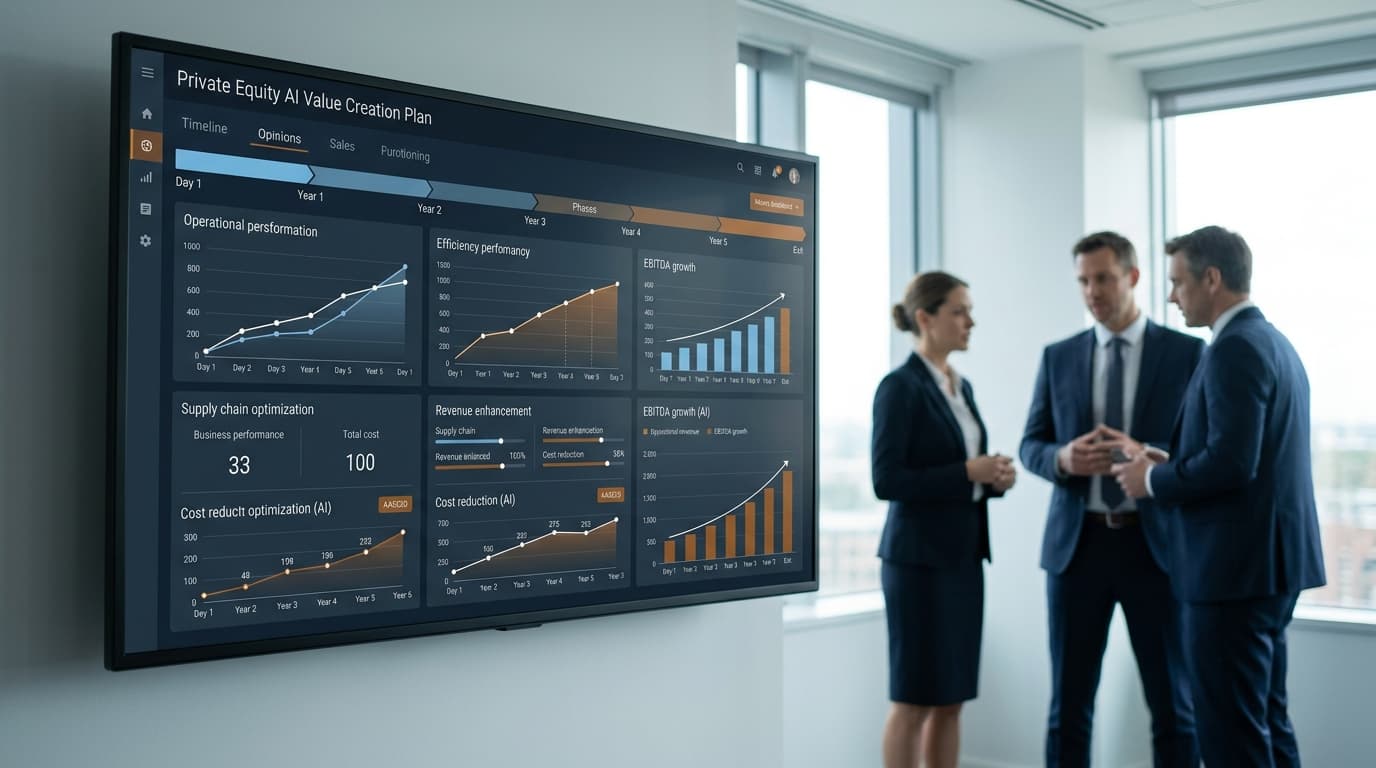
What determines whether a software deal captures its underwritten value
Whether a software acquisition captures the value assumed in underwriting is decided by the speed and quality of post-close decisions, not by the deal thesis itself. The acquirer's handling of seven workstreams in the first year - product, pricing, customers, go-to-market, data and technology, people, and AI - determines whether the model in the investment committee memo survives contact with the market. Deals that defer those decisions watch value quietly leak through churn, attrition and stalled synergies. Deals that make them early, with clear owners and measurable gates, convert the thesis into realized EBITDA and growth.
The evidence for this is uncomfortable. In a 2018 survey by industry research, 96% of participants in software deals rated their merger as very or mostly successful, yet a industry research analysis of 32 software deals from 2013 through 2017 found that one year after closing, 59% of acquirers had experienced a decline in operating margin and 65% had lower year-over-year revenue growth. Perception and value capture are clearly not the same thing.
Why software integrations are different
- Renewals are discretionary: software purchases and renewals can be paused the moment customers doubt the combined product roadmap, so uncertainty converts directly into revenue risk.
- Talent is the core asset: engineering and product people can leave with the very knowledge the acquirer paid for, and competitors poach aggressively during the uncertainty window.
- Products overlap: two portfolios built independently almost always collide, and every month without an explicit keep, merge or sunset decision compounds technical debt and customer confusion.
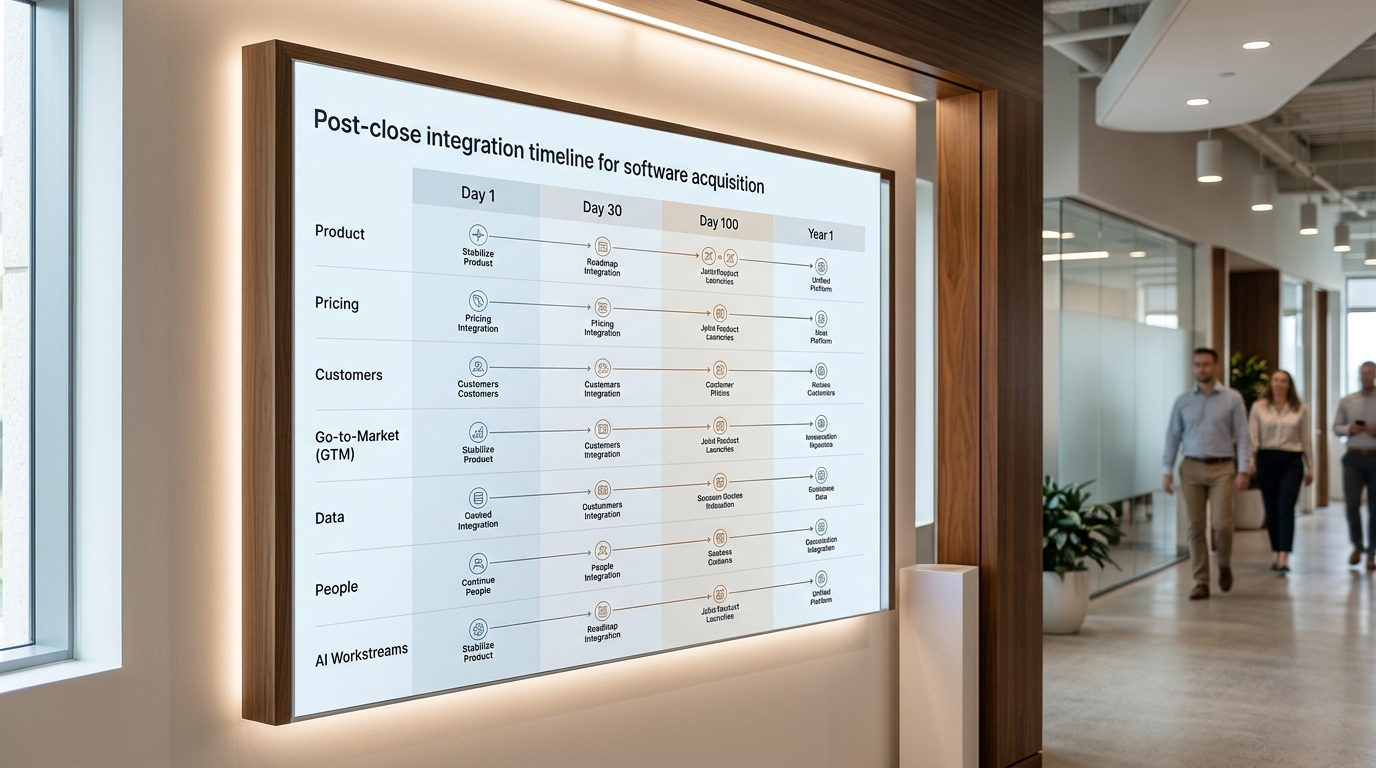
This playbook picks up where diligence ends. It deliberately does not repeat pre-close diligence content; it starts at Day 1 and runs to Year 1, organized as four gates: Day 1, Day 30, Day 100 and Year 1. Each gate carries specific decisions, owners and evidence, because that is the cadence on which software value capture is actually won or lost.
Day 1: continuity, control and credibility with customers and talent
The first 24 to 72 hours set the ceiling on everything that follows. Deloitte notes that integrations often require 200 to 350 tasks at this stage, ranging from logistical activities like changing bank accounts and aligning branding to strategic efforts like renegotiating customer contracts and implementing a communication plan. The workstream leaders who will run the integration should be named before close, so that Day 1 is execution rather than improvisation.
- Publish Day 1 communications to customers and staff in the same news cycle, so neither group learns about the deal from a competitor or a LinkedIn feed.
- Lock authority limits for spend, pricing exceptions and credits on day one; an uncontrolled discounting window during handover is pure margin leakage.
- Confirm escalation and on-call paths for support, security and infrastructure so service continuity is never in question.
- Clarify customer ownership so no account is orphaned; every account needs one named owner from the combined sales organization.
- Secure systems access, identity and security controls immediately, including credential rotation and audit logging across both environments.
- Announce retention packages for key technical and product leadership early, because competitors poach top talent and customers precisely when the acquirer is most vulnerable.
industry research's research points to the mechanism behind the post-close revenue dip: customer uncertainty about a product's future. Software purchases and renewals are often discretionary, and customers may pause purchases until the air clears. Day 1 communication is therefore not a formality; it is the first revenue-synergy lever.
Day 30: product and pricing decisions you cannot defer
The first month is where software integrations win or lose value. industry research warns that a failure to make explicit product decisions early on can lead to years of indecision and inefficiency, and that a decade after merging, many companies still have overlapping products because they never had the will to make hard choices. Day 30 exists to prevent exactly that outcome.
Product rationalization with migration paths
Map product and feature overlap across the two portfolios and make explicit keep, merge or sunset calls, each with a defined migration path and timeline. A sunset decision without a funded migration plan is not a decision; it is a deferral with worse optics. Publish a transparent combined roadmap at the same time so customers and the sales force stop guessing about what will live and what will die.
Pricing architecture and discounting discipline
Design the target package architecture and the pricing harmonization approach in the same window. That includes discounting discipline under tightened approval limits, and explicit grandfathering rules that cap migration-triggered churn. The pricing model choices involved, seat-based versus usage-based versus hybrid, carry their own diligence and migration risks, which we treat in depth in our article on AI software pricing due diligence.
The stakes are measurable. industry research found that one-third of merged software companies experienced a revenue drop greater than 10% in the three months after closing, with customer uncertainty about product futures a likely contributor. The Day 30 product and pricing decisions are what stand between that pattern and your deal.
Day 100: GTM alignment, customer migration and the data backbone
By Day 100 the commercial and technical spine of the combined company must be standing. This is execution, not strategy: territories drawn, incentives harmonized, contracts migrated, and the data migration plan resourced.
- Set territories and resolve channel overlap so two sales organizations stop competing for the same accounts.
- Harmonize sales incentives so cross-sell is compensated irrespective of which legacy organization originated the relationship.
- Launch the first cross-sell motion now rather than waiting for full systems integration; industry research's survey found companies often did not take up cross-selling until long after closing, one of the most proven ways to spark revenue synergies.
- Migrate customer contracts and communications with a named owner per account and a tracked completion status.
- Stand up the data migration and integration plan, including the technical architecture decisions that pre-close tech due diligence should have already framed.
Prioritizing revenue early beats the consolidation-first default. industry analysis's integration research stresses identifying pivotal decisions early and mobilizing the combined company around them, rather than spending a year or more integrating teams and systems before the first revenue-synergy motion goes live. The best integrators treat integration as a repeatable skill, not a check-the-box process, and they do not defer cross-selling until the organizations are fully merged.
On the technical side, expect friction. PwC's survey work finds that systems and process integration commonly tops respondents' lists in difficulty and is the least likely workstream to achieve complete integration, yet successful M&A integrations were 57% higher than others at fully integrating systems and processes. Security posture belongs in the same gate: access consolidation, identity management and audit logging should be reviewed against the standards described on our integrations and security page before any customer data moves.
Year 1: AI roadmap, talent retention and the combined platform
The Year 1 horizon is where durable value is built, and AI is now central to it. The combined company's data assets, not either portfolio alone, are the raw material for the next product cycle. Consolidate them deliberately: ingested source systems feed a unified data layer, which powers shared AI services and the end-user workflows of the combined platform, as the diagram below illustrates.
Define a joint AI product roadmap rather than running two AI strategies in parallel. industry analysis's survey of more than 300 M&A practitioners found that 22% already use generative AI for integration planning, including matching and comparing data across companies and flagging risks for leadership attention. The same discipline applies to the product itself: the defensibility of the combined platform rests on workflow embeddedness and proprietary data loops, the factors we examine in our analysis of AI-native software moats.
People decide whether any of this ships. industry research's software-deal survey found that companies frequently experienced problems with talent retention during the integration process, so attrition cannot be assumed to stay at normal levels. Retention through Year 1 requires clear roles, real accountability and incentives that reward building the combined platform rather than protecting a legacy fiefdom. Consolidate workflows and infrastructure in the same pass: every duplicated tool removed is cost synergy banked and complexity retired.
Integration KPIs and the workstream framework table
Value capture needs instrumentation. The KPI set for a software integration should cover gross and net revenue retention, cross-sell attach rate, product adoption of the combined offerings, synergy realization versus plan, integration cost versus budget, and roadmap delivery against the published combined roadmap. Retention metrics deserve particular weight in software, where the post-2021 repricing made ARR quality the currency of exit valuations, as we discuss in our article on SaaS exit risk and valuation reset.
| Workstream | Day 1 owner | Day 100 milestone | Year 1 KPI |
|---|---|---|---|
| Product | Chief Product Officer | Keep, merge and sunset decisions logged with migration paths | Roadmap delivery rate against published combined roadmap |
| Pricing | VP Pricing / CFO | Target package architecture and grandfathering rules approved | Realized price and discount leakage versus baseline |
| Customers | Chief Customer Officer | Every account has a named owner and a communication record | Gross and net revenue retention |
| GTM | Chief Revenue Officer | Territories set, incentives harmonized, first cross-sell motion live | Cross-sell attach rate and revenue synergies versus plan |
| Data and tech | CTO / CIO | Data migration plan resourced; security and access consolidation signed off | Systems integration completion and integration cost versus budget |
| People | CHRO | Retention packages signed for key technical and product talent | Attrition of key talent versus normal levels |
| AI | Chief Product Officer with CTO | Joint AI roadmap approved; shared infrastructure plan agreed | AI product adoption and shared infrastructure consolidation |
Run synergy tracking with stage gates against a revenue baseline that models what the business would have done absent the deal, so the integration gets credit only for incremental performance. industry research's approach is to pursue revenue synergies as rigorously as cost synergies, with specific goals, senior-level visibility and named accountability, rather than a general revenue target nobody owns. PwC's survey work points the same way: successful dealmakers build a value creation plan early that includes synergy targets, ownership assignment, a detailed execution plan, and tracking process and tools.
Failure patterns, the steering committee checklist and getting support
The failure patterns to design against
The base rate is sobering: among M&A executives who have experienced failed acquisitions, industry analysis found that integration was pointed to as a primary problem 83% of the time. industry research's software-specific research adds recurring traps: unaddressed cultural differences between the two organizations, weak top-management engagement in the integration, and deferred product decisions that leave overlapping products in market for years. Each of these is a design choice, not an accident of fate.
The steering committee evidence checklist
- A synergy register with named owners, stage gates and a revenue baseline absent the deal
- A product rationalization decision log covering every keep, merge and sunset call with its migration path
- A customer migration plan with per-account ownership and communication status
- A talent retention dashboard tracking signed retention packages and attrition of key technical staff
- A security review sign-off covering access consolidation, identity and audit logging before data migration
Getting support
How Plausity accelerates this workflow
Plausity is an AI-native due diligence and deal intelligence workspace that helps M&A advisory firms, VC and PE funds, corporate development teams and investment-banking teams structure evidence, findings and questions across a data room. Plausity supports evidence extraction, source grounding, findings management and IC preparation — it does not replace human analysts, advisers or investment professionals, does not provide legal, tax, audit, regulatory or investment advice, and does not make autonomous investment decisions. All findings require human review. Built for today's investment and deal teams. Trusted by >200 firms.
To explore the underlying capabilities, see the Plausity AI analysis engine, findings and risk intelligence and evidence gap detection product pages, plus the IC memo and AI Q&A Assistant product pages. For team-level workflows, see how VC and PE funds and M&A advisory firms use Plausity across live deals, and how AI Impact due diligence, value creation, Tech DD and Commercial DD workstreams support the analysis.