The New AI Value Creation Mandate
How should PE firms drive AI value creation? Not by deploying tools, but by redesigning the operating model around a small number of workflows that move the P&L. The winning pattern documented across the industry is consistent: anchor AI initiatives to the value-creation plan, rewrite two or three core workflows end to end, and hold them to financial metrics rather than adoption statistics. Portfolio companies that broadly embrace AI have median revenue multiples more than twice those of companies focused solely on productivity initiatives, which is precisely why operating-model redesign, not tool deployment, is the mandate.
The discipline requirement is strict: differentiate theoretical productivity from measurable financial value. Most AI activity today fails this test. industry research's latest research finds that roughly 60% of companies report hardly any material value from AI despite substantial investment, and only about one in twenty has built the capabilities to capture value at scale. In PwC's Global CEO Survey, just 14% of PE-backed CEOs say AI has contributed to both higher revenues and lower costs, while more than half report no upside at all. The gap is not between believers and sceptics; it is between firms that track saved minutes and firms that track EBITDA, cash contribution, and working capital. Operational alpha, in KPMG's framing, is systematic EBITDA uplift delivered quickly and at scale, built on data-driven management rather than one-off cost cuts.
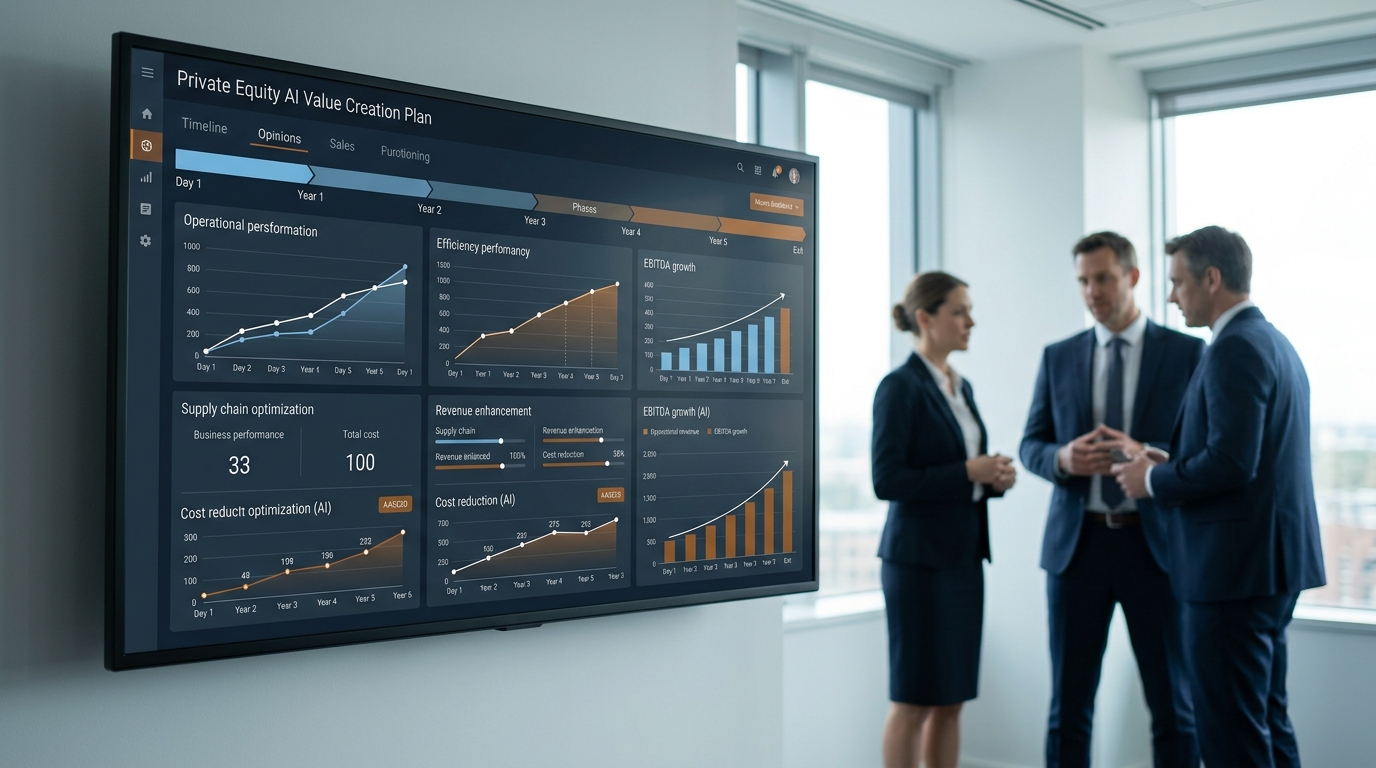
The stakes are structural. industry analysis's Global Private Equity Report argues that '12 is the new 5': today's deals require roughly 10% to 12% annual EBITDA growth to deliver a 2.5x return over five years, against the 5% a 2015 vintage needed, because leverage is lower, borrowing costs are higher, and multiple expansion is largely gone. The playbook below is organised by ownership period, from Day 0 to exit, and every stage carries one non-negotiable rule: if an initiative cannot be tied to a measurable financial metric, it is a pilot, not a value-creation play.
| Period | Focus | Measurable metric | Typical failure mode | What to show buyers |
|---|---|---|---|---|
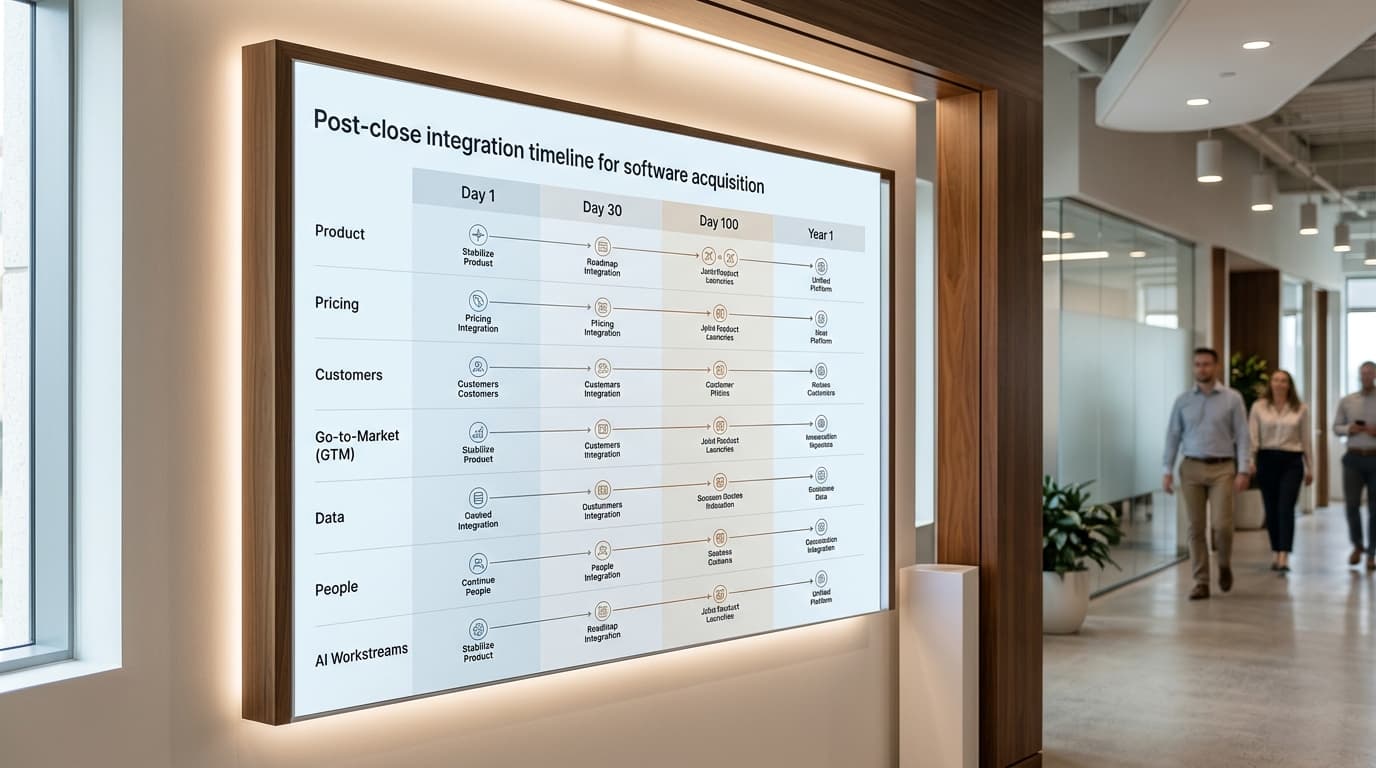
| Day 0-30 | Baseline models, data, workflows; prioritise hypotheses tied to the thesis | Documented baseline: cost per transaction, cycle time, headcount per function | Use-case swirl: hundreds of ideas, no prioritisation | A quantified, thesis-linked AI value-creation plan |
| Day 30-100 | Deploy 2-3 high-value workflows with change management | Operating metrics: cycle time, conversion rate, cost per case | The micro-productivity trap: employees save minutes, the P&L does not move | A working workflow with tracked cost-to-benefit, not a pilot slide |
| Year 1 | Redesign functions and the operating model | ROI on redesigned functions; data-readiness scores | Pilots without production paths; capability programs that never prove value | A functioning data platform and a governance model with named owners |
| Hold period | Scale proven use cases; retire failures | EBITDA and cash contribution per use case | Spreading resources across too many experiments | A portfolio of measured, repeatable use cases with audited P&L linkage |
| Pre-exit | Evidence a repeatable AI-enabled improvement | Documented uplift versus pre-AI baseline | Unverifiable promises that invite diligence haircuts | An evidence pack: metrics, methodology, and source-grounded claims |
DAY 0-30: Baseline and prioritize
The first thirty days produce no AI output, and they should not. They produce the baseline against which every later claim is measured. That means three inventories conducted in parallel: a model and tool inventory (what is already in use, under which licences, with what data access), a data inventory (which datasets exist, their quality, ownership, and accessibility), and a workflow map for the functions that carry the most P&L weight. Alongside these sits a governance baseline: who approves AI use, what data may be processed by which tools, and what review standards apply before any AI-assisted output reaches a customer or a regulator. industry analysis finds that most stalled AI programs share the same root cause, a lack of focus and diffuse accountability, with organisations generating hundreds of theoretical use cases and spreading resources so thin that none move the P&L.
Prioritisation runs through the investment thesis. Isolate the three to five opportunities embedded in the value-creation plan and map the workflows behind them before any tool is selected. The discipline matters because tools-first adoption, in industry analysis's words, layers a copilot onto an existing process instead of redesigning the process with AI capability in mind. Each candidate hypothesis should be written as a financial statement before work begins: which line item, which baseline, what target, and who owns it.
Functional playbooks: Finance and Procurement set the baseline
Finance is the natural starting function because its metrics are already audited. The Day 0-30 playbook is to instrument the baseline: days sales outstanding, days payable outstanding, forecast accuracy, close-cycle days, and cost per invoice. AI deployment comes later; the point now is that forecasting and reporting baselines exist so post-close gains are provable. PwC cites a PE-backed electric vehicle manufacturer where AI-enabled tools in finance cut the time required for forecasting and reporting from weeks to less than a minute before spreading into procurement and operations, an example of the sequence working in practice.
Procurement follows the same logic on cost of goods sold. Baseline spend under management, price variance across suppliers, maverick spend, and contract coverage. The typical failure mode here is generic functional optimisation: one-off SG&A and procurement savings that rarely shift valuations in a high-rate environment. The quick-win pipeline for the back office should therefore be ranked not by ease but by financial materiality, and every quick win should carry a named business owner, not an IT sponsor.
- Complete model, data, and workflow inventories, and record the governance baseline with named owners.
- Write three to five value-creation hypotheses as financial statements tied to the investment thesis.
- Instrument finance and procurement baselines: cycle times, working capital, cost per transaction, forecast accuracy.
- Rank the quick-win pipeline by financial materiality and assign a business owner to each candidate.
- Agree the cost and benefit tracking template that every later workflow must use.
DAY 30-100: Deploy high-value workflows
Days 30 to 100 convert the plan into two or three production deployments, each with a measurable operating metric and a baseline recorded in the previous period. The canonical example comes from industry analysis: a large parts distributor used AI to replace manual research across parts catalogs and OEM manuals, cutting average order-inquiry turnaround from more than an hour to less than five minutes, and its conversion rate doubled as the function scaled without added headcount. Note what made it work: four months of use-case assessment, an end-to-end workflow redesign, and CEO-level sponsorship, not a tool rollout.
Functional playbooks: Sales and Customer service drive early top-line impact
Sales deployments should target the stages where AI demonstrably changes outcomes: lead prioritisation, initial outreach, and proposal assembly, freeing representatives for relationship work. Customer service is the clearest automation candidate; industry research ranks it a high-priority function where AI replaces Tier 1 support and augments higher tiers with deeper inquiry context. Its case evidence is specific: an asset manager that reimagined customer service with generative AI cut operating expenditure by 30%, reduced call volume by 30%, and decreased average handle time by 25%. Where a portfolio company runs a roll-up strategy, these wins can be standardised across acquisitions, as the playbook for AI transformation across deal teams and portfolio companies describes.
Execution in this window is mostly change management. industry research's work with a technology company found that roughly 70% of the productivity uplift from AI came from people, organisation, and process changes, with technology and algorithms contributing far less. The adoption plan therefore needs executive sponsorship, role-level training, and redesigned incentives from week one. The tracking cadence is weekly during deployment and monthly thereafter, pairing every cost line (licences, implementation, training time) against the operating metric it is meant to move, so the team can see within one cycle whether value is arriving or the initiative belongs in the failure pile. Firms structuring this window around a formal execution plan can draw on the 100-day plan approach to sequencing quick wins and KPI baselines.
- Deploy two to three workflows, never more, each with one operating metric and a recorded baseline.
- Prioritise sales and customer service workflows where third-party tool maturity is highest.
- Run role-level change management: sponsorship, training, and redesigned incentives, not optional training.
- Track costs and benefits weekly during deployment against the metric, not against usage statistics.
- Kill anything that saves minutes without moving the P&L; name the micro-productivity trap explicitly in governance reviews.
YEAR 1: Redesign functions and operating model
Year 1 moves from deploying workflows to re-architecting functions. Three carry the most durable value. In marketing, the playbook is to shift from content production to targeting and measurement: AI-generated assets are table stakes, but the financial value sits in campaign allocation, conversion attribution, and customer lifetime value modelling. In pricing, the playbook is dynamic and differential pricing built on transaction data, which requires clean historical pricing records first; a function whose data lives in spreadsheets cannot be priced algorithmically. In software development, the playbook is engineering throughput with quality gates, where industry research reports roughly 60% developer productivity gains from generative AI once change management and restructuring levers are applied, against minimal uplift when tools alone were deployed.
None of this scales without the data platform underneath it. industry research's survey of senior PE investors finds that portfolio companies which systematically build AI capabilities across functions have nearly twice the return on invested capital of those that do not, and that firms which modernise core systems first report 40% faster AI deployment, because AI requires clean, structured, accessible data that legacy stacks cannot provide. The Year 1 agenda therefore includes ERP and CRM modernisation as the structured-data backbone, enterprise-wide data governance with named stewards, and API and integration layers that future workflows can build on. Survey evidence reinforces the urgency: while 82% of firms track ROI and 72% track cost savings from digital initiatives, only 11% explicitly link digital progress to exit narratives, which is the linkage buyers will eventually demand.
The talent operating model changes in parallel. The design that works blends a lean internal digital core with external specialists for specific initiatives, and only about 45% of successful firms systematically transfer knowledge from external partners to internal teams, which is the difference between institutional capability and permanent dependency. Every functional lead should be AI fluent, not just a head of AI, and the operating model should make clear which decisions remain human-led, notably high-value vendor negotiations and strategic planning.
HOLD PERIOD: Measure and scale proven use cases
The hold period is where discipline separates leaders from the field. The first governance act is retirement: use cases that missed their business case get switched off, and the capital and attention go to the proven ones. Deloitte's State of Generative AI survey found that more than two-thirds of respondents report 30% or fewer of their experiments will be fully scaled in the next three to six months, a signal of how much experiment inventory accumulates without ever reaching production. deal databases's reporting draws the same line in PE: only 8% of surveyed executives described themselves as leading, meaning AI is materially impacting EBITDA or moving exit narratives, while the bulk remain in pilots.
Scaling means extending proven models across business units, product lines, and geographies, and the back office and operations function is where this compounding is most reliable. Accounts payable automation rolled out across entities, shared-service knowledge bases, and demand forecasting are all examples of workflows whose unit economics improve with each additional site. For sponsors pursuing buy-and-build strategies, this is the mechanism that turns individual integrations into platform economics rather than a collection of standalone improvements.
Track EBITDA and cash contribution, not activity
The measurement standard is financial: EBITDA contribution and cash contribution per use case, audited against the baselines set on Day 0. industry analysis Capital's experience with an industrial distributor illustrates the scale available: it expects AI to lift margins by two percentage points and grow revenue 200 to 300 basis points faster than peers, compounding to roughly 30% more EBITDA over a five-year hold than the company would otherwise have produced. Teams designing these tracking frameworks can draw on a structured approach to EBITDA uplift verification, which tests whether projected gains survive architectural and workflow scrutiny before they are counted.
- Retire failed pilots formally and reallocate their budget; document the lessons learned.
- Double down on the two or three use cases with audited EBITDA or cash contribution.
- Extend proven workflows across business units, geographies, and add-on acquisitions.
- Report AI contribution in the same pack as financial performance, with the same audit standard.
- Refresh the value-creation plan annually against what the metrics, not the roadmaps, show.
PRE-EXIT: Demonstrate repeatable AI performance
At exit, the asset is sold on the quality of its evidence. Buyers discount narratives they cannot verify, and AI claims attract particular scrutiny. The preparation starts 12 to 24 months before a sale with an evidence pack: the original baseline, the workflows redesigned, the metrics tracked, the audited EBITDA and cash contribution, and the governance model that produced them. This is not a marketing document; it is a diligence-grade record that lets a buyer underwrite the improvement themselves. industry research's PE survey makes the commercial case: nearly 40% of investors say they have experienced a valuation haircut of 5% or more where digital maturity lagged, and sponsors that benchmark maturity and link initiatives to business performance endure fewer exit discounts.
The repeatability narrative, with guarded claims
The narrative buyers pay a premium for is repeatability: proof that performance improvement is a system, not a one-off. A customer service automation that cut cost per case and held quality for eight quarters is evidence; a pilot demo is not. Portfolio companies that broadly embrace AI have achieved median revenue multiples more than twice those of productivity-only adopters, but that premium attaches to demonstrated operating-model change. Teams assembling this record will find a practical framework in the approach to value creation evidence packs, which bridge pre-close diligence and post-close execution.
Every claim must be guarded. State the baseline, the measurement period, and the methodology; avoid forward promises the data cannot support; and separate audited results from management estimates. A single unverifiable claim in an evidence pack invites a diligence pass over all of them. The linkage to exit value is direct: repeatable, evidenced AI-enabled improvement shifts the buyer's underwriting from hope to track record, and that is what commands the multiple.
AI Impact Due Diligence and Value Creation
Executing this playbook starts before Day 1, in diligence. Plausity is built for that moment: its Value Creation DD and AI Impact DD solutions assess how AI may disrupt a target's business model, defensibility, and margins, while identifying the AI-driven value creation opportunities a new owner can execute post-close, and inform diligence rather than operate as a portfolio management tool.
The mechanics are source-grounded. Data Room Ingestion connects to virtual data rooms and processes PDFs, spreadsheets, contracts, and financial models within minutes, and the AI-Analysis Engine reads, interprets, cross-references, and reasons over thousands of documents to generate diligence analysis with full traceability. Report Builder drafts investor-ready deliverables with source traceability, Risk Radar evaluates findings on materiality, financial impact, legal exposure, and deal relevance, and Collaboration Hub keeps deal team workstreams aligned in real time. The output is a value-creation scorecard where every finding traces to its source, which is exactly the evidence standard the pre-exit section demands. To see how evidence-backed diligence findings turn into value-creation plans with opportunity mapping and quantified upside analysis, explore Plausity's Value Creation solutions and custom workflows for M&A and private equity teams.
How Plausity accelerates this workflow
Plausity is an AI-native due diligence and deal intelligence workspace that helps M&A advisory firms, VC and PE funds, corporate development teams and investment-banking teams structure evidence, findings and questions across a data room. Plausity supports evidence extraction, source grounding, findings management and IC preparation — it does not replace human analysts, advisers or investment professionals, does not provide legal, tax, audit, regulatory or investment advice, and does not make autonomous investment decisions. All findings require human review. Built for today's investment and deal teams. Trusted by >200 firms.
To explore the underlying capabilities, see the Plausity AI analysis engine, the findings and risk intelligence and evidence gap detection product pages, and the IC memo product page. For team-level workflows, see how VC and PE funds and M&A advisory firms use Plausity across live deals, and how AI Impact due diligence and value creation workstreams support the analysis.