Why most value-creation plans underperform their diligence promise
How do buyers make sure the value creation case that justified an acquisition becomes an executable operating plan after signing? The answer is to force every value lever through a fixed chain of discipline before the deal closes: evidence, quantification, ownership, KPI baselines, Day 1 decisions and Day 100 proof points. A thesis that cannot name the evidence behind each lever, the executive who owns it and the measure that proves it is a narrative, not a plan. The playbook below walks that chain from the growth thesis through the first 100 days to the exit narrative.
The starting point is uncomfortable. PwC's 2026 M&A Integration Survey attributes the shortfall not to bad deal selection but to a decision gap: the distance between the deal thesis and the explicit, owned choices required to make it real. Broader measures are harsher still. Just 14% of respondents in PwC's integration research reported significant success across strategic, financial and operational measures at the same time.
The gap is widest exactly where the ambition is highest. In revenue-acceleration transactions, 71% of successful acquirers defined the relevant operating-model elements before close, against 44% of limited-success acquirers. Two commercial organisations that meet the market before their own commercial design is settled compete with each other as well as with rivals.
- Unresolved commercial choices: customer ownership, pricing authority and sales-force design left open until after close, when they become expensive to reverse.
- Unassigned levers: value initiatives that exist as model line items but have no named owner, timeline or funding.
- Unmeasured baselines: KPIs that were never locked pre-close, so post-close performance cannot be attributed to any lever.
Each of these leaks is preventable, and each is addressed by a specific step in the framework that follows. The discipline is the same whether the buyer is a corporate development team or a sponsor: treat the thesis as a set of decisions that must be made, not a story that must be told.
The value lever set: decomposing the thesis into named levers
A thesis is only as strong as its decomposition. The first task of a value creation playbook is to break the headline ambition into named levers, and to attach the diligence evidence that supports each one. A lever without evidence is an assumption wearing a label.
Growth thesis: pricing, cross-sell, sales productivity, geographic and product expansion
- Pricing: supported by price realisation data, discount leakage analysis and contract-level evidence from the data room, not by a benchmark percentage.
- Cross-sell: supported by pipeline coverage, overlap analysis of customer bases and churn cohorts that show whether acquired customers stay and expand.
- Sales productivity: supported by quota attainment, ramp curves and coverage ratios across the two organisations.
- Geographic expansion: supported by channel economics, regulatory posture and local competitive evidence per market.
- Product expansion: supported by roadmap evidence, R&D capacity and attach-rate data from adjacent products.
Cost base: procurement, organisation and technology
Cost levers deserve the same bottom-up treatment. Procurement, organisation and technology savings should be sized per site and per function from contract files, org charts and licence data, rather than imported as an industry benchmark percentage. A benchmark can frame a question; it cannot support a commitment that finance will later have to validate.
AI-enabled productivity as a distinct lever
AI-enabled productivity should be treated as a distinct lever, not a sub-item of the cost programme. industry analysis's survey of more than 300 M&A executives found that adoption of AI tools more than doubled in 2025, with 45% of respondents now relying on the technology. That matters for the value case: a lever sized from documented workflow and effort baselines can be committed to the model, owned by an executive and measured quarterly like any other.
Working capital and cash discipline
Cash levers rarely headline a deal thesis, but they fund it. Receivables, inventory, payables and capex phasing determine how much of the value case converts into usable cash in the first years of ownership. The working-capital peg negotiated at signing, and the post-close adjustment mechanism behind it, are the bridge between the model and the operating plan: they set the baseline the business must beat, and they force an early, evidence-based view of seasonality and cash conversion.
Synergy validation: separating diligence-tested from theoretical
Synergies require stricter labelling. Before any number enters the investment committee model, it should carry an evidence tier that states plainly how it was built.
- Diligence-tested value: documented in the data room, quantified bottom-up from contracts, invoices, org data or system extracts, and traceable to a source document.
- Theoretical value: derived from benchmarks, management assertions or analogue deals, useful for framing but not yet a commitment.
- Hybrid value: partially evidenced levers where the mechanism is confirmed but the sizing rests on assumptions that post-close data must test.
Label each tier explicitly in the IC memo, and hold the line under pressure: a synergy that cannot show its workings should not be presented alongside one that can. industry research's clean-team practice points the way for the pre-close window. With the median sign-to-close period now stretched to about 6.4 months, a 25 percent increase compared with roughly 20 years ago, clean teams working under confidentiality protocols can build granular, per-site synergy cases before Day 1, owned by the leadership who will deliver them and grounded in execution reality rather than benchmarks. The output of that work is not a slide; it is the first draft of the post-close operating plan.
Management ownership and RACI for every lever
The framework table is the spine of the playbook. One row per value lever; columns for the thesis claim, the lever, the diligence evidence, the owner, the KPI baseline, the Day 1 action, the Day 100 proof point and the hold-period target. Built properly, it converts a thesis document into a management contract, and it gives the investment committee a single artefact to interrogate.
| Lever | Thesis claim | Diligence evidence | Owner | KPI baseline | Day 1 action | Day 100 proof point | Hold-period target |
|---|---|---|---|---|---|---|---|
| Pricing | Close the price realisation gap versus peers | Price realisation and discount leakage analysis from contract files | Chief Commercial Officer | Locked pre-close price realisation rate | Pricing authority assigned and guardrails issued | First repricing wave executed against baseline | Full price realisation uplift sustained in quarterly reporting |
| Cross-sell | Expand share of wallet in overlapping accounts | Pipeline coverage and customer overlap cohorts | Regional sales leads | Locked pre-close cross-sell attach rate | Joint account plans issued for top overlap accounts | First cross-sell bookings recorded against baseline | Attach-rate uplift tracked each quarter to exit |
| Procurement | Capture vendor consolidation savings | Bottom-up spend cube per site and vendor | Procurement lead | Locked pre-close unit costs | Top vendor renegotiation mandate issued | First renegotiated terms signed | Run-rate savings banked and re-forecast quarterly |
| AI-enabled productivity | Automate priority workflows to lift capacity | Documented workflow and effort baselines per function | COO | Locked pre-close cycle-time and FTE baseline | Two priority workflows selected and resourced | Automation live in one workflow with measured cycle time | Productivity gains redeployed into growth roles |
| Working capital | Convert the value case into usable cash | Receivables, inventory and payables analysis; peg agreed | CFO | Working-capital peg fixed at signing | Cash discipline cadence and DSO/DPO targets set | First monthly cash report against peg | Cash conversion held at or above peg through the hold |
KPI baselines, timing and dependencies
Two rules make the table work. First, every lever has a single named owner with a RACI, and that owner sits in the business that must deliver the result, not in the deal team that priced it. Second, KPI baselines are locked pre-close, with timing and dependencies made explicit, because a lever without a baseline cannot be measured, only narrated. PwC's research underlines the payoff: successful acquirers assign an owner, timeline and funding to every value initiative at 59%, versus 28% for limited-success acquirers, and only 46% of all respondents fully translated value drivers into executable initiatives before integration began.
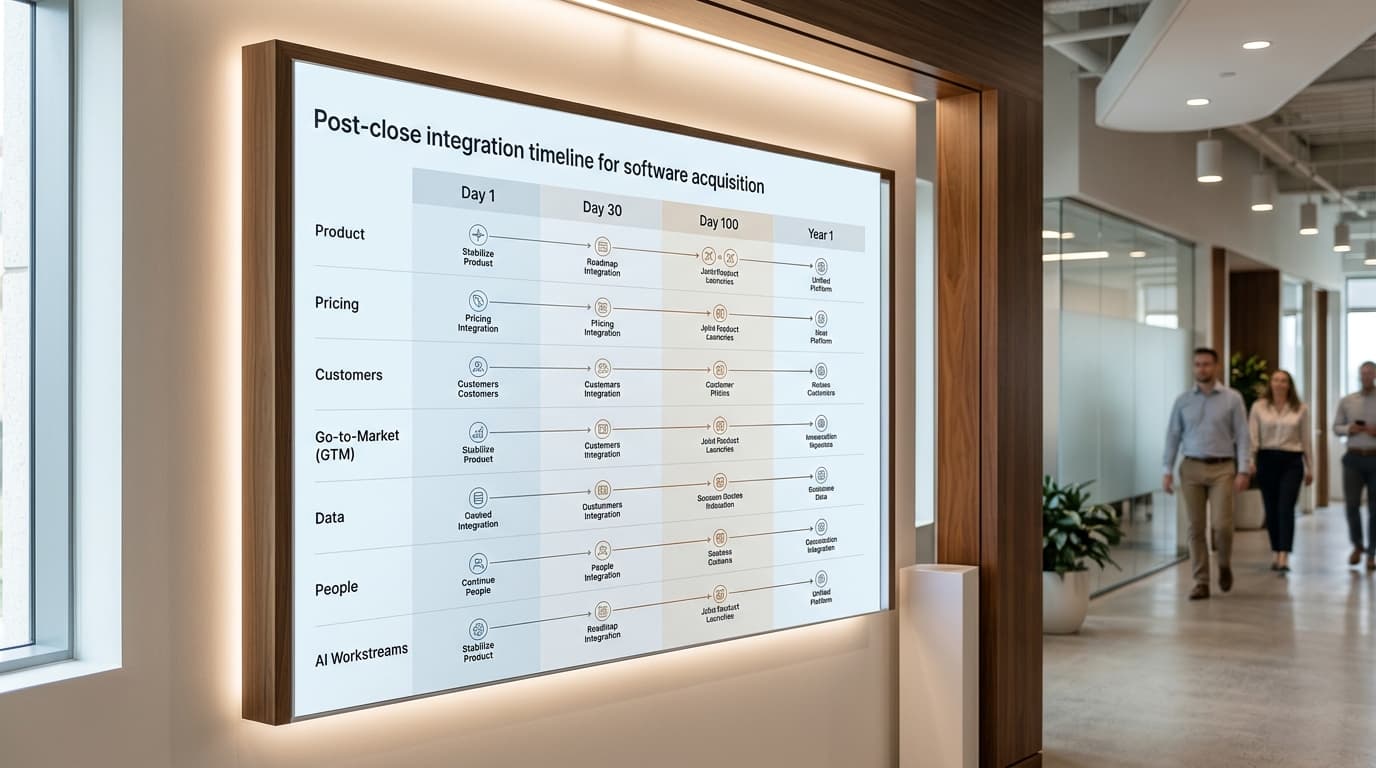
Day 1: decisions that must be made before close
The execution window splits into two different kinds of work: decisions that must be made before close because they become expensive to defer, and proof points that must be demonstrable shortly after. The Day 1 list is short and consequential: customer ownership, pricing authority, sales-force design, leadership selection and talent retention. PwC notes that despite seven in ten acquirers historically naming talent a top deal objective, only 16% actually assess leadership and talent pre-sign. A value plan that depends on people who have not been selected, retained or briefed is a plan with a hole in it.
Day 100: measurable proof points
Day 100 is the first honest test of the plan. By then, the following should be demonstrable rather than aspirational:
- KPI baselines locked and the reporting cadence live, so every lever has a number and a rhythm.
- First levers in execution, with owners reporting against funded plans rather than intentions.
- The synergy case revalidated against actuals, with diligence-tested value confirmed or corrected and theoretical value re-tiered.
- Day 1 decisions holding: customers know their owners, the sales force knows its design, and key talent is still in seat.
The cost of waiting is permanent. PwC's integration research is blunt on this point: there is no value in delay, because prolonged transitions slow growth, reduce profits, destroy morale and productivity, and lead to missed opportunities and loss of market share. That asymmetry is the whole argument for making the hard calls before close.
Hold-period discipline and the pre-exit repeatability narrative
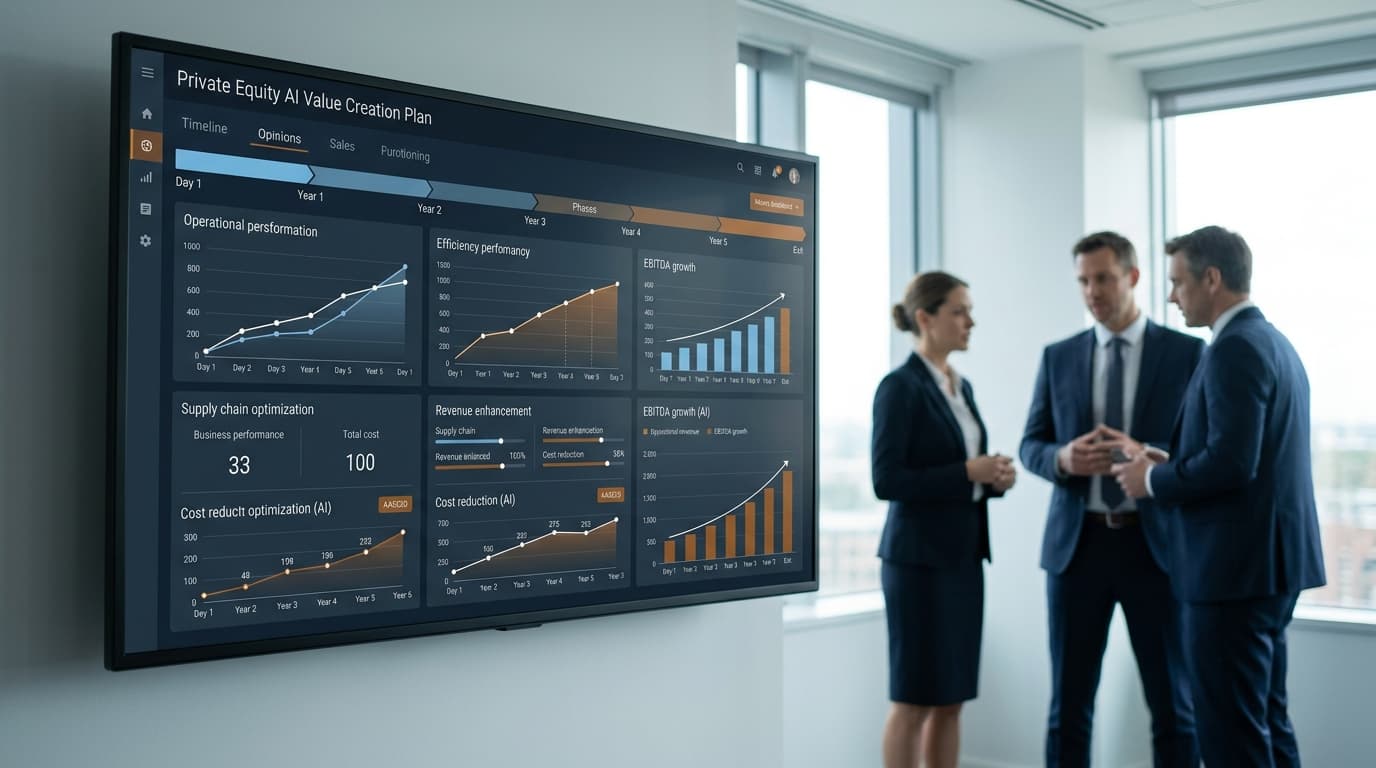
The playbook does not end at Day 100. Hold-period discipline means a quarterly reconciliation of lever performance against the model the deal was priced on, with the same evidence tiers applied to reported results as were applied to forecasts. The pressure to maintain that discipline is structural. KPMG reports that median private equity holding periods now exceed six years, with trillions of dollars of assets stuck in the exit pipeline. industry analysis's Global Private Equity Report 2026 argues that typical deals now require roughly 10% to 12% average annual EBITDA growth to deliver the same competitive return, its rule of thumb that 12 is the new 5. Slower exits and higher required growth leave no room for unowned levers.
Downside risks and mitigants
- Customer churn from pricing moves: mitigant is a staged repricing plan with churn triggers and win-back offers, reviewed monthly against the locked baseline.
- Talent flight: mitigant is pre-close leadership assessment with retention packages signed at close and a trigger tied to regretted attrition in the first two quarters.
- Integration cost creep: mitigant is a funded integration budget per initiative with a variance trigger that escalates to the value governance forum.
- Thesis decay: mitigant is a semi-annual thesis review that re-tests each lever's market evidence and retires or replaces levers that no longer hold.
Every risk should be paired with a pre-agreed mitigant and a trigger, so that escalation is a mechanism rather than a debate. And the discipline compounds into an asset: a documented, lever-by-lever track record of what was evidenced, quantified, owned and delivered becomes the repeatability narrative that underpins the equity story at exit. Sponsors who build that record from Day 1 arrive at the sale process with proof rather than promises, a discipline explored further in exit readiness and value creation planning.
Evidence checklist for IC and board
The investment committee and board do not need to manage the integration; they need to hold the deal team to a standard. The checklist is deliberately short, and every item is binary:
- Every value lever has documented diligence evidence, traceable to a source in the data room.
- Every lever has a quantified range, with diligence-tested and theoretical value clearly separated.
- Every lever has a single named owner with a RACI, sitting in the operating business.
- Every lever has a KPI baseline locked pre-close, with timing and dependencies stated.
- Every lever has a Day 1 decision that has actually been made, and a Day 100 proof point that can be verified.
- Every material risk has a pre-agreed mitigant and trigger, reviewed on a fixed cadence.
Assembling that evidence manually across thousands of data-room documents is where most teams lose the discipline, and it is the problem Plausity was built to solve. Value Creation DD value creation due diligence turns the data room into a lever-by-lever evidence base, grounding every finding in its source document. The IC Memo assembles that evidence into the investment committee pack, with diligence-tested and theoretical value clearly separated and each lever tied to an owner and a KPI baseline. Findings & Risk Intelligence surfaces the risks that matter by materiality, financial impact and deal relevance, so the committee sees the deal's weak points first. Together they carry the playbook from thesis decomposition to Day 100 proof points, the same chain described in our 100-day plan framework. Plausity's demo booking page shows the full chain applied to a live deal.
Frequently asked questions
What is an M&A value creation playbook?
It is the structured bridge between the deal thesis and the post-close operating plan. It decomposes the thesis into named value levers, attaches diligence evidence and quantification to each, assigns a single owner, locks KPI baselines pre-close, and specifies the Day 1 decisions and Day 100 proof points that make progress verifiable.
Why do most acquisitions fail to deliver their value case?
PwC's 2026 M&A Integration Survey attributes the shortfall to a decision gap rather than poor deal selection: the thesis never becomes the explicit, owned choices that determine how the combined company operates.
What is the difference between diligence-tested and theoretical synergies?
Diligence-tested synergies are documented and quantified bottom-up from data-room evidence such as contracts, spend data and org files. Theoretical synergies rest on benchmarks or management assertions. Both can appear in the model, but they should be labelled separately in the IC memo and re-tiered as post-close actuals arrive.
When should KPI baselines be locked?
Before close. A lever without a pre-close baseline cannot be measured afterwards, because the buyer loses the ability to attribute post-close performance to any specific initiative. Baselines should be locked alongside the working-capital peg and the Day 1 decision set.
What must be decided before Day 1 in an integration?
The decisions set out in the Day 1 section above: the commercial and organisational choices that become expensive to defer once the deal is signed. PwC's survey shows the discipline is rare in practice: despite most acquirers naming talent a top deal objective, only a small minority actually assess leadership and talent before signing.
What should be provable by Day 100?
The proof points set out in the Day 100 section above: a live KPI cadence against locked baselines, levers in funded execution, and a synergy case that has been tested against post-close actuals. What separates a working plan from a well-written one is that these can be shown rather than asserted.
How does AI improve value creation in M&A?
AI compresses the mechanical work of diligence and integration planning, and it improves forecast quality. industry analysis found that adoption of AI tools among M&A executives more than doubled in 2025, with 45% of respondents now relying on the technology.
How Plausity accelerates this workflow
Plausity is an AI-native due diligence and deal intelligence workspace that helps M&A advisory firms, VC and PE funds, corporate development teams and investment-banking teams structure evidence, findings and questions across a data room. Plausity supports evidence extraction, source grounding, findings management and IC preparation — it does not replace human analysts, advisers or investment professionals, does not provide legal, tax, audit, regulatory or investment advice, and does not make autonomous investment decisions. All findings require human review. Built for today's investment and deal teams. Trusted by >200 firms.
To explore the underlying capabilities, see the Plausity AI analysis engine, findings and risk intelligence and evidence gap detection product pages, plus the IC memo and AI Q&A Assistant product pages. For team-level workflows, see how VC and PE funds and M&A advisory firms use Plausity across live deals, and how AI Impact due diligence, value creation, Tech DD and Commercial DD workstreams support the analysis.