The Rise of Mega Secondaries and Liquidity Pressures
Private equity institutional investors face an unprecedented liquidity squeeze driven by sluggish exit markets, depressed distribution to paid-in capital (DPI) multiples, and an aging inventory of unrealized net asset value. As traditional merger and acquisition exits and initial public offerings remain muted relative to historical peaks, general partners (GPs) and limited partners (LPs) increasingly rely on secondary transactions to generate liquidity and rebalance institutional portfolios. Global secondary market transaction volume reached a record $240 billion in 2025, marking a 48 percent increase year over year, while dedicated secondary market capital expanded to $327 billion.
This rapid expansion of mega secondaries vehicles has altered how institutional investors approach fund diligence. Rather than merely assessing broad manager track records across ten-year fund cycles, LPs evaluating mega secondaries funds must scrutinize underlying portfolio quality, pricing discipline, and structural exposure across both LP-led portfolio acquisitions and GP-led continuation vehicles. Compounding this challenge, LPs participating directly in continuation vehicle transactions often face compressed decision windows of 20 to 30 calendar days to evaluate complex multi-asset or single-asset roll-or-sell proposals.
Macro Drivers Reshaping Secondary Allocations
To allocate capital intelligently to secondaries managers, investment teams must recognize the core market dynamics governing transaction volume and vehicle performance across current vintages:
- Capital overhang dynamics: Secondary capital overhang multiples contracted as transaction volume accelerated, intensifying competition among buyers for high-quality buyout portfolios.
- Shift toward structured solutions: Structured mechanisms such as deferred payments and preferred equity structures were incorporated into roughly 29 percent of GP-led volume in 2025, altering downstream cash-flow timing.
- Concentration in mega vehicles: The emergence of multi-billion-dollar secondaries funds enables managers to underwrite large transactions but creates deployment pressure that can test pricing discipline.
- Evergreen vehicle expansion: Evergreen vehicles accounted for an estimated $113 billion of total capital inflows in 2025, with roughly 41 percent allocated to secondaries, providing persistent liquidity that interacts directly with institutional pricing levels.
Understanding these macro pressures provides the essential context for evaluating how secondaries fund managers construct their portfolios and manage risk across differing transaction types.
Assessing the GP-Led and LP-Led Strategy Mix
A primary diligence mandate for institutional LPs is evaluating the targeted balance between LP-led portfolio acquisitions and GP-led continuation vehicles within a secondaries manager's strategy. In 2025, LP-led transactions accounted for $125 billion (52 percent) of total secondary market activity, while GP-led transactions reached $115 billion (48 percent). Each strategy involves fundamentally distinct risk profiles, underwriting requirements, and return distributions.
LP-led transactions provide natural vintage, sector, and sponsor diversification by acquiring diversified LP fund interests at a discount to reported net asset value (NAV). In contrast, GP-led continuation vehicles, particularly single-asset transactions, which exceeded 50 percent of total continuation vehicle volume for the first time in 2025, represent concentrated direct equity bets on mature portfolio companies. Diligence teams must test whether a secondary manager possesses the operational underwriting capabilities required for single-asset direct exposure rather than relying solely on statistical portfolio modeling.
| Diligence Dimension | LP-Led Portfolio Acquisitions | GP-Led Continuation Vehicles |
|---|---|---|
| Underwriting Scope | Statistical portfolio modeling, vintage spread, and historical cash-flow pacing across fund interests. | Fundamental direct company diligence, unit economics, customer retention, and debt covenants. |
| Asset Concentration | Broadly diversified across 20 to 100+ underlying portfolio assets and multiple sponsors. | Concentrated exposure in 1 to 5 assets; single-asset continuation vehicles exceeded 50 percent of total CV volume in 2025. |
| Pricing Dynamics | Priced at discounts to reported NAV; average LP portfolio pricing was 87 percent of NAV in 2025. | Priced closer to par or at premium valuations, dependent on competitive auction dynamics and fairness opinions. |
| Conflict Exposure | 0 GP conflict waivers required: the buyer and the selling LP are unaffiliated third parties. | 1 LPAC conflict-waiver vote required, with at least 10 business days of LPAC review and no less than 30 calendar days (or 20 business days) for LP roll-or-sell elections. |
LPs must verify that secondaries funds maintain strict portfolio concentration limits in their limited partnership agreements (LPAs) to prevent single-asset continuation vehicles from disproportionately dictating total fund performance.
Testing Pricing Discipline and NAV Mark Quality
Valuation hygiene is the linchpin of secondaries diligence. In a shifting macroeconomic environment, reported NAV marks provided by selling sponsors often lag real-time public market multiples and operational performance changes. In 2025, buyout portfolios priced at roughly 92 percent of NAV while venture and growth portfolios priced near 78 percent of NAV, illustrating substantial variance in valuation quality across asset classes.
When evaluating a secondaries manager's track record, LPs must test whether historical returns were driven by buying at genuine discounts or by aggressive baseline valuation markups. Rigorous financial model due diligence requires deal teams to look past headline NAV discounts and independently audit the fundamental unit economics supporting the target company's forward projections.
Core Valuation Validation Tests
- Independent revenue durability: Verify organic growth rates versus acquisition-driven growth, isolating customer concentration risks and gross margin stability across underlying companies.
- Multiple expansion vs EBITDA growth: Decompose historical asset returns to confirm whether past performance stemmed from operational earnings growth or unsustainable valuation multiple expansion.
- Debt structure and interest coverage: Audit capital structure maturities, debt covenants, and floating-rate exposure within underlying assets to identify refinancing risks before committing capital.
- Discount sustainability: Test whether the manager's sourcing pipeline relies on off-market proprietary deal flow or highly competitive broad auctions that compress entry discounts.
Without independent validation of financial models and underlying cash flows, institutional buyers risk underwriting continuation vehicles at inflated entry multiples that jeopardize long-term net returns.
Critical Red Flags in Secondaries Vehicle Commitments
Evaluating secondaries commitments requires identifying structural conflicts and operational vulnerabilities before signing commitment documents. The inherent nature of GP-led transactions introduces unique governance and alignment challenges because the sponsor acts simultaneously as the seller on behalf of existing fund investors and as the manager of the acquiring continuation fund, a conflict ILPA guidance describes as inherent to these deals.
Furthermore, diligence teams should employ systematic risk register automation to track recurring red flags across fund documentation, side letters, and financial exhibits. Failing to identify aggressive fee structures or asymmetric information sharing early can significantly impair LP net returns.
| Risk Category | Observable Red Flag | Impact & Required LP Action |
|---|---|---|
| Governance & Alignment | GP crystallizing carried interest on selling LP interests rather than reinvesting it into the continuation vehicle. | Rejects core alignment; ILPA principles state all carried interest accruing to the GP on selling LP interests should be rolled into the new continuation vehicle, with no crystallization for rolling LPs. |
| Fee Architecture | Tiered management fees charged on committed capital rather than invested capital or net asset value. | Increases drag on net returns; demand fee basis on post-transaction NAV with fee discounts for rolling LPs. |
| Process Transparency | Compressed election windows under 20 business days without full virtual data room access. | Limits independent analysis; ILPA recommends LPs be afforded no less than 30 calendar days or 20 business days for roll-or-sell decisions. |
| Valuation Integrity | Reliance solely on GP-provided management decks without independent fairness opinions or third-party audits. | Risks overpaying for trophy assets; mandate independent fairness opinions and raw financial model access. |
Identifying these warning signs allows LP investment committees to negotiate protective side letter provisions, adjust return hurdles, or decline sub-optimal vehicle allocations altogether.
The Essential LP Data Room Request Checklist
To conduct thorough due diligence, institutional investors cannot rely on standardized pitch decks and curated summary teasers. LPs require unhindered access to granular asset-level records and governance documentation to build independent value creation evidence packs. Institutional Limited Partners Association (ILPA) best practices emphasize that GPs should provide the documentation, models, and materials LPs need to be fully informed, with symmetry of information between prospective new buyers and existing fund LPs.
- Underlying asset financial models: Dynamic, fully integrated three-statement financial models with historic monthly actuals and operational key performance indicators.
- Waterfall calculations and carried interest schedules: Transparent breakdown showing exact carry crystallization amounts, GP commitment rollover percentages, and net distribution waterfalls.
- Independent third-party fairness opinions: Complete, unredacted fairness opinions prepared by qualified independent financial advisors evaluating transaction pricing fairness.
- LPAC minutes and conflict waiver records: Minutes of Limited Partner Advisory Committee meetings documenting conflict discussions, voting outcomes, and rationale for vehicle creation.
- Historical cash-flow and pacing data: Fund-level quarterly contribution and distribution histories detailing gross and net DPI, TVPI, and IRR across prior fund vintages.
- Debt and credit facility agreements: Credit agreements, covenant compliance certificates, and debt maturity schedules for all debt instruments at the asset and fund levels.
Securing these essential diligence assets ensures that investment teams possess the verifiable evidence necessary to conduct rigorous quantitative and legal evaluations under strict deadlines.
Accelerating Secondaries Diligence with Automation
The sheer volume of documentation in modern mega secondaries data rooms, often spanning hundreds of financial files, contracts, side letters, and LPAC disclosures, presents a severe bottleneck during tight election windows of 20 business days to 30 calendar days. AI-native diligence tooling can accelerate and structure these complex institutional workflows while preserving complete auditability.
Using Data Room Ingestion, Plausity rapidly scans and structures disparate data-room formats, including dynamic spreadsheets, LPAs, valuation reports, and audit statements within minutes. The core AI-Analysis Engine then cross-references financial exhibits against narrative claims in GP disclosures, verifying whether reported historical growth rates, margins, and churn rates match underlying financial data.
To assist deal teams in prioritizing material concerns, Risk Radar automatically identifies valuation anomalies, covenant triggers, and structural governance conflicts. By applying modern AI diligence workflows, investment professionals eliminate mechanical data extraction tasks, allowing human analysts to focus on qualitative judgment, partner interviews, and negotiation strategy without ever replacing human fiduciary review.
How to use this in your next diligence workflow
For private equity investment professionals, family offices, and fund-of-funds teams preparing to evaluate an upcoming secondaries commitment or continuation vehicle proposal, executing a structured workflow is critical for meeting investment committee deadlines with defensible evidence.
- Establish immediate data room connectivity: Ingest all GP disclosure documents, LPAC waivers, and underlying asset models via Data Room Ingestion to establish a single source of verified evidence.
- Coordinate multi-track workstreams: Utilize Collaboration Hub to align legal, financial, and sector specialists across shared risk registers and diligence checklists in real time.
- Run automated valuation and conflict audits: Deploy the AI-Analysis Engine and Risk Radar to cross-check debt covenants, carry rollover mechanics, and multiple bridge analyses against baseline market benchmarks.
- Formulate targeted GP inquiries: Generate structured Q&A logs to challenge management teams and advisory intermediaries on fee terms, customer retention rates, and post-transaction governance.
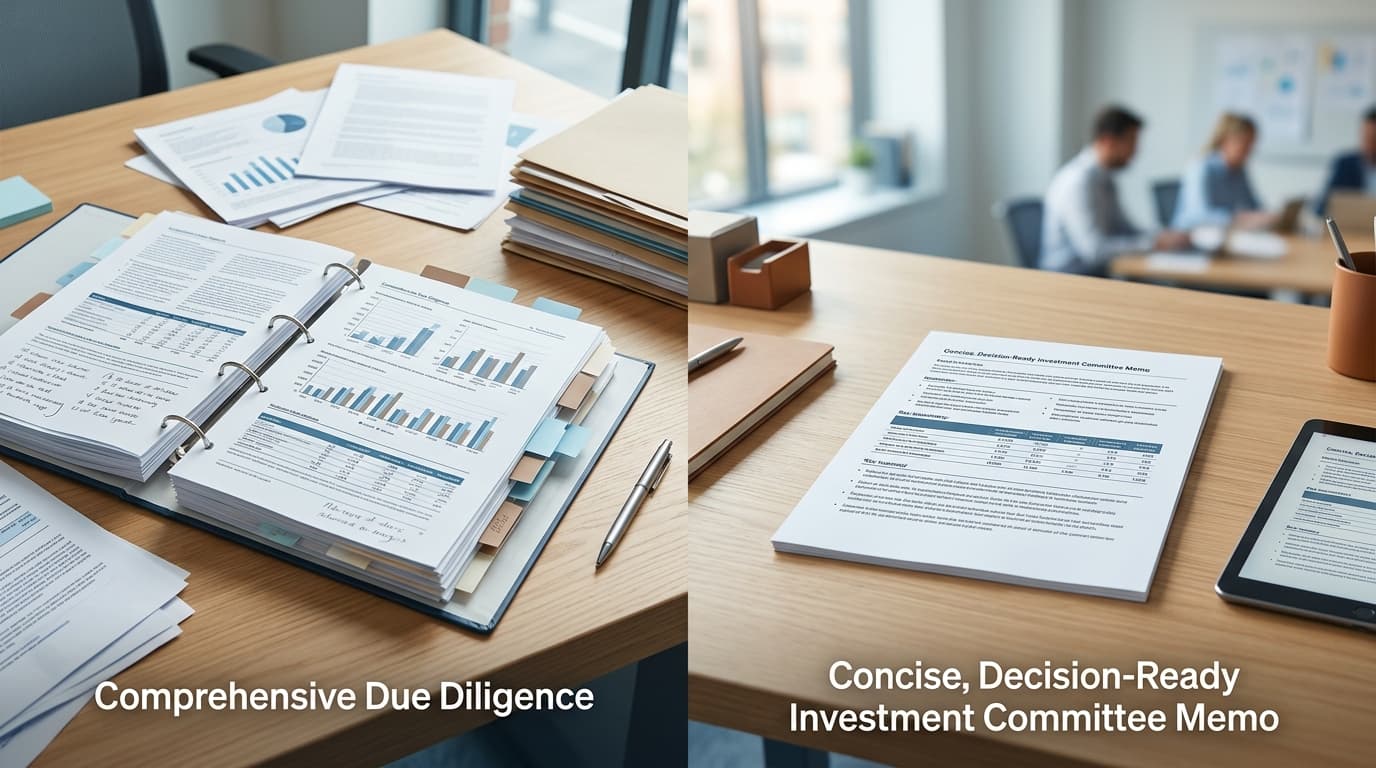
- Generate defensible committee deliverables: Use Report Builder to compile auditable, investor-ready investment committee memos with direct source-to-deck citations to justify the final roll-or-sell decision.
By institutionalizing this structured diligence approach, LP deal teams transform compressed secondaries evaluation cycles from high-risk administrative burdens into repeatable, high-conviction investment decisions.
How Plausity accelerates this workflow
Plausity is an AI-native due diligence and deal intelligence platform that helps M&A advisory firms, VC and PE funds, corporate development teams and family office investment teams structure evidence, findings and questions across a data room. It does not replace human advisers, does not guarantee deal outcomes, and does not provide legal, tax, audit, regulatory or investment advice — all AI-generated findings require confirmation and advisor review by qualified professionals.
To explore the underlying capabilities, see the Plausity AI analysis engine and the findings and risk intelligence product page. For team-level workflows, see how VC and PE funds and M&A advisory firms use Plausity across live deals.