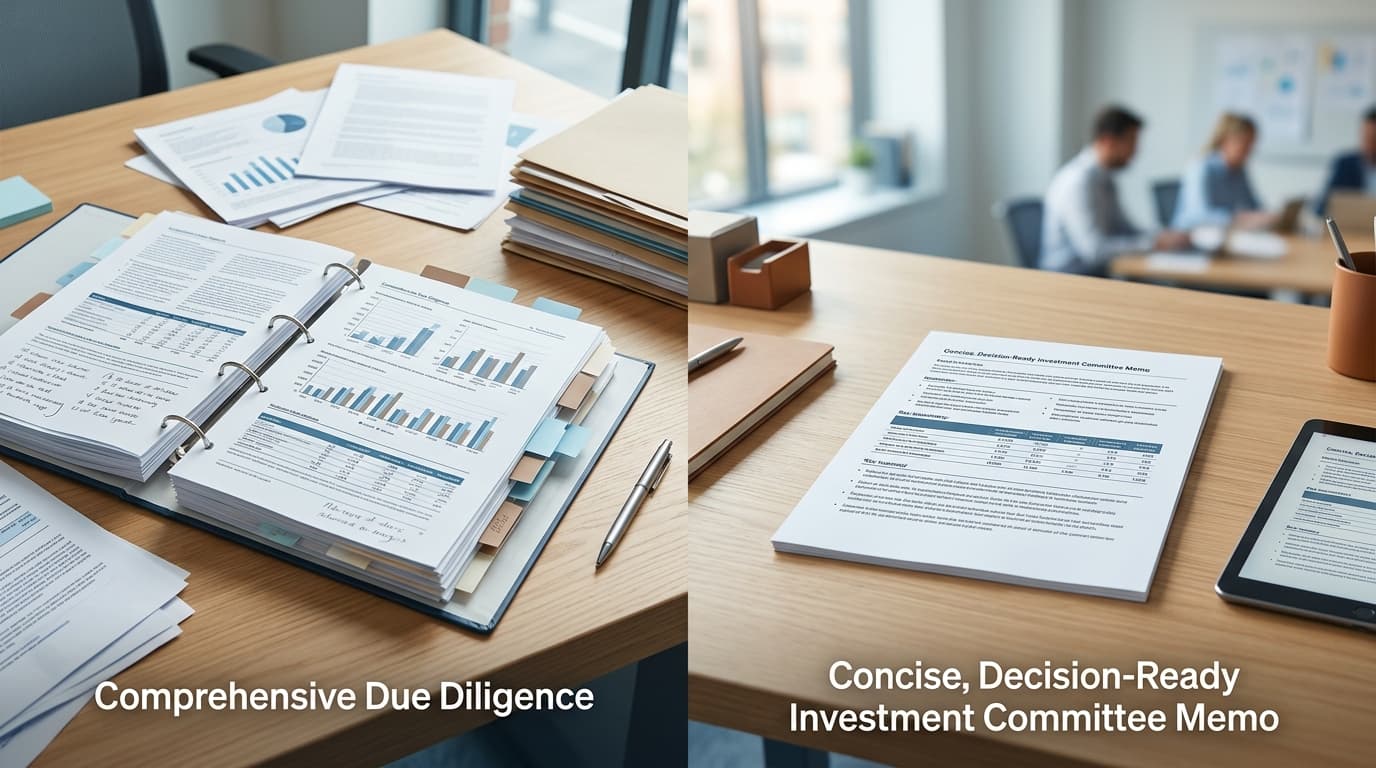
Why this topic matters now
The emergence of frontier reasoning models marks a structural shift in enterprise software from passive generative assistants to autonomous agentic execution. For private equity investors, venture capital deal teams, and corporate M&A leads, this new model cycle changes how target technology architectures, competitive moats, and operational dependencies must be underwritten. Evaluating a target company now requires determining whether its software delivers defensible, proprietary workflow integration or merely wraps underlying foundation models that could be rendered obsolete by the next foundation release.
The widening performance gap across enterprise software adoption underscores why deal teams must modernize their technical diligence frameworks. Aggregate usage data shows that frontier enterprise organizations generate 8.3x as many output tokens per active user as typical firms, a gap that has more than tripled since the start of the year. Furthermore, autonomous coding and multi-step task execution have scaled dramatically, with Codex generating 64% of combined Codex and ChatGPT output tokens among enterprise customers. When evaluating targets that claim artificial intelligence leadership, investment committees cannot rely on surface-level product demonstrations.
- Shift from assistance to execution: Target applications are moving from single-turn text completion to multi-step agentic workflows that interact directly with enterprise databases, APIs, and operational tools.
- Accelerated token consumption: Top-tier enterprise deployments consume output tokens at more than eight times the rate of median adopters, reflecting heavy delegation of complex analytical tasks.
- Moat re-evaluation: High-performing reasoning models commoditize simple prompt wrappers, requiring rigorous software moat diligence to test whether a company owns defensible workflow context or easily replicable interface code.
Investment professionals must now interrogate how target systems execute chain-of-thought logic, maintain audit trails, manage token economics, and prevent catastrophic failures. The diligence agenda has moved from verifying whether a company uses artificial intelligence to assessing how safely and profitably it orchestrates agentic systems across core business operations.
The main diligence framework for agentic AI
Evaluating target companies in the frontier model era requires a structured four-pillar diligence framework. Traditional software diligence focused on static codebase quality, proprietary database schemas, and architectural scalability. In contrast, agentic software diligence evaluates dynamic reasoning loops, test-time compute orchestration, context window management, and deterministic boundary controls.
Core pillars of the agentic diligence framework
Deal teams must systematically evaluate how target applications handle complex multi-step reasoning without compounding operational errors. An agentic application does not simply query a model; it plans execution steps, queries external tools, validates intermediate outputs, and corrects errors dynamically. Diligence must verify whether the target has engineered deterministic guardrails around these probabilistic reasoning loops or left critical business processes vulnerable to drift.
- Reasoning Architecture & Orchestration: Audit whether the target utilizes structured planning frameworks, multi-agent coordination, and fallback routing to manage latency and test-time compute costs.
- Source Grounding & Retrieval Precision: Verify that all autonomous outputs are grounded in verified enterprise records through high-accuracy retrieval pipelines rather than unconstrained model memory.
- Deterministic Execution Controls: Test the boundaries preventing autonomous agents from triggering unapproved database writes, financial transactions, or unauthorized external communications.
- Data Feedback Loops & Context Capture: Assess whether the target captures proprietary user interaction data and domain-specific corrections to continuously refine its workflow orchestration.
A key focus of this framework is determining whether the target company possesses defensible workflow embeddedness. If a target's core value proposition consists of straightforward prompt engineering over third-party APIs, subsequent foundation model updates pose an existential replication risk. Sustainable value creation rests in deep data ingestion pipelines, specialized domain logic, and robust verification layers.
What deal teams should test in frontier models
When assessing targets that incorporate frontier reasoning models, deal teams must rigorously benchmark capability claims against verified safety and accuracy limits. Frontier models trained with reinforcement learning to produce internal chains of thought have demonstrated dramatic breakthroughs in complex problem solving. For example, OpenAI o1 achieved a 74% pass@1 accuracy on qualifying exams for the USA Mathematical Olympiad (AIME 2024), compared to just 12% for GPT-4o. In advanced scientific domains, o1 was the first model to exceed the accuracy of recruited PhD-level experts on the GPQA Diamond benchmark for chemistry, physics, and biology.
However, elevated reasoning capabilities do not eliminate factual inaccuracy or operational vulnerability. Deal teams must test how target systems manage model hallucinations in high-stakes workflows. Official evaluations on the SimpleQA benchmark reveal that while o1 reduces hallucinations compared to earlier architectures, it still recorded a 0.44 hallucination rate on fact-seeking prompts, against 0.61 for GPT-4o. Without strict external validation layers, autonomous agents can articulate incorrect conclusions with high statistical confidence.
| Diligence Dimension | Benchmark Standard | Technical Verification Method |
|---|---|---|
| Reasoning Competence | AIME 2024 (74% pass@1) | Evaluate multi-step logic and mathematical validation in production logs. |
| Scientific & Domain Accuracy | GPQA Diamond (exceeds recruited PhD-level experts) | Test domain-specific problem solving against verified golden evaluation sets. |
| Factual Grounding & Hallucination | SimpleQA (0.44 hallucination rate for o1) | Audit retrieval-augmented generation and citation verification pipelines. |
| Source Traceability | Deterministic Citation | Verify that every generated figure links directly to a raw source record. |
To satisfy institutional investment standards, deal teams must evaluate IC memo traceability across all AI-generated deliverables. Every conclusion presented to an investment committee or board must maintain an unbroken chain of custody back to raw data-room documents, verified filings, or auditable codebase repositories.
Red-flag table: Identifying AI vendor dependencies and risks
A critical component of modern technology diligence is surfacing architectural vulnerabilities, governance gaps, and hidden operational liabilities. Deal teams must scrutinize vendor contracts, API rate limits, model fallback strategies, and intellectual property provenance. Furthermore, investment professionals must remain alert to misleading marketing narratives, including unverified claims of having achieved Artificial General Intelligence (AGI).
The table below outlines common red flags encountered during technical due diligence, their commercial and operational implications, and the required verification steps for deal teams.
| Risk Category | Observed Red Flag | Business & Deal Impact | Diligence Verification |
|---|---|---|---|
| Single-Vendor Dependency | Hardcoded reliance on a single proprietary model API without fallback gateways. | Severe operational vulnerability to API price increases, rate outages, or sudden model deprecation. | Inspect router infrastructure, multi-model API abstraction layers, and failover routing logic. |
| Ungrounded Execution | Autonomous agents executing database writes without source verification or audit logging. | High risk of compounding hallucinations corrupting enterprise data and triggering legal liability. | Review execution logs, deterministic validation layers, and human-in-the-loop sign-off gates. |
| Data Privacy & IP Exposure | Customer data transmitted to external model providers without explicit zero-data-retention agreements. | Material regulatory breach under GDPR and EU AI Act; forfeiture of enterprise customer contracts. | Audit vendor Data Processing Agreements (DPAs), enterprise API licensing, and SOC 2 Type II reports. |
| Unsubstantiated AGI Claims | Pitch materials claiming autonomous AGI capabilities or self-improving proprietary algorithms. | Misleading commercial narrative masking commodity wrapper software; regulatory scrutiny. | Perform technical code review to separate foundation API calls from genuine proprietary algorithms. |
Deal teams should reject any target valuation premised on unverified AGI breakthroughs. Current frontier models excel at complex reasoning, mathematics, and code synthesis under specific constraints, but they remain probabilistic engines requiring deterministic governance and human oversight.
Evidence checklist and data room request list
To conduct thorough due diligence on a target's AI architecture, deal teams must request specific technical, operational, and legal artifacts early in the diligence cycle. Generic software request lists fail to capture the nuances of model routing, inference cost structures, and data governance. Corporate M&A project leads and investment professionals require concrete proof of system resilience.
Deal teams should insert the following five-part request package into their virtual data room requirements when assessing targets deploying frontier AI models:
- AI System Architecture Diagrams: Detailed topology mapping user interfaces, orchestration middleware, model gateways, vector databases, and enterprise API integrations.
- Vendor Licensing & DPA Contracts: Master service agreements and Data Processing Agreements with all foundation model providers, confirming enterprise privacy terms and zero-retention policies.
- Model Safety & System Cards: Internal red-teaming reports, safety evaluation metrics, and third-party benchmark scorecards for all fine-tuned or custom-hosted models.
- Inference Unit Economics & Token Logs: Historical monthly API expenditure, token consumption breakdowns per active user, and cost-of-goods-sold (COGS) attribution models.
- Workflow Audit Logs & Human Review Policies: Comprehensive system logs demonstrating data lineage, user intervention points, and rollback protocols for automated actions.
When examining virtual data rooms, evaluating these artifacts allows the investment team to quantify technical debt, verify gross margin sustainability, and ensure compliance with emerging regulatory frameworks such as the EU AI Act.
How a diligence platform supports the AI diligence workflow
Evaluating high volumes of technical documentation, vendor agreements, and data room disclosures under compressed deal timelines presents a major operational bottleneck for investment professionals and advisory partners. Specialized data room analysis software provides the structured analysis required to review complex deal collateral rapidly and accurately.
Such a platform accelerates this workflow by structuring unstructured virtual data room contents into audit-ready findings, risk matrices, and thematic investment memos. It coordinates core analytical tasks across financial, commercial, technology, and legal workstreams, supporting human deal teams throughout the underwriting lifecycle.
- Data Room Ingestion: Securely scans and processes thousands of virtual data room documents, including technical whitepapers, vendor agreements, code audits, and financial models within minutes.
- Risk Radar: Continuously evaluates identified issues based on materiality, regulatory exposure, and operational severity, automatically surfacing critical red flags for senior deal leads.
- AI-Analysis Engine: Reads, cross-references, and reasons across disparate data-room files to verify source grounding, identify contract inconsistencies, and trace data lineage.
- Report Builder: Compiles verified diligence findings into standardized, investor-ready reports and memos with direct source evidence links embedded across every section.
Plausity does not replace human advisers or provide regulatory, legal, or investment advice. Instead, it organizes complex evidence, surfaces anomalies, and enforces strict source traceability, allowing deal teams to focus their human judgment on strategic valuation and risk underwriting.
How to use this in your next diligence workflow
Integrating a frontier model diligence framework into your firm's standard operating procedures requires clear sequencing from initial data ingestion to final investment committee presentation. As deal cycles compress, investment professionals must establish an auditable workflow that systematically assesses target AI capabilities without introducing operational bottlenecks.
- Initiate Deal Workspace in Collaboration Hub: Establish workstream permissions, assign technical and commercial diligence leads, and configure target-specific evaluation parameters.
- Deploy Data Room Ingestion for Rapid Triage: Ingest the complete virtual data room, ensuring all AI architecture diagrams, vendor contracts, and token usage logs are indexed and parsed.
- Execute Technical & Moat Audits with AI-Analysis Engine: Cross-examine target claims against source documentation to evaluate API dependency, reasoning architecture, and retrieval precision.
- Flag Material Liabilities via Risk Radar: Surface single-vendor dependencies, data compliance gaps, and unverified capability claims directly to deal leads for targeted management Q&A.
- Draft Final Deliverables with Report Builder: Generate structured, source-linked due diligence memos and investment committee evidence packs with full citation traceability.
By implementing this structured diligence discipline, private equity, venture capital, and corporate M&A teams can confidently underwrite targets in the frontier model era, separating genuine technical defensibility from fragile wrapper software.
How Plausity accelerates this workflow
Plausity is an AI-native due diligence and deal intelligence platform that helps M&A advisory firms, VC and PE funds, corporate development teams and family office investment teams structure evidence, findings and questions across a data room. It does not replace human advisers, does not guarantee deal outcomes, and does not provide legal, tax, audit, regulatory or investment advice — all AI-generated findings require confirmation and advisor review by qualified professionals.
To explore the underlying capabilities, see the Plausity AI analysis engine and the findings and risk intelligence product page. For team-level workflows, see how VC and PE funds and M&A advisory firms use Plausity across live deals.