Why AI scale matters for asset managers now
The private equity and alternative investment landscape is undergoing a structural bifurcation. While financial engineering and debt arbitrage drove returns over previous market cycles, today's elevated cost of capital has placed operational transformation at the center of the investment thesis. In the 2026 Private Equity and Venture Capital Outlook published by S&P Global Market Intelligence, 60% of General Partners confirmed that higher financing costs are compelling teams to focus on portfolio company operations, with operational improvements (72%) identified as the premier value creation lever.
Within this operating environment, scale has emerged as the decisive competitive moat. Mega-cap and upper-middle-market sponsors are not merely experimenting with isolated artificial intelligence point solutions; they are building institutional platforms that integrate data assets, specialized operating teams, and enterprise compute infrastructure. Smaller funds often struggle to match these capital commitments, creating a widening capability gap across deal sourcing, risk underwriting, and post-close EBITDA expansion.
The structural advantages of institutional scale
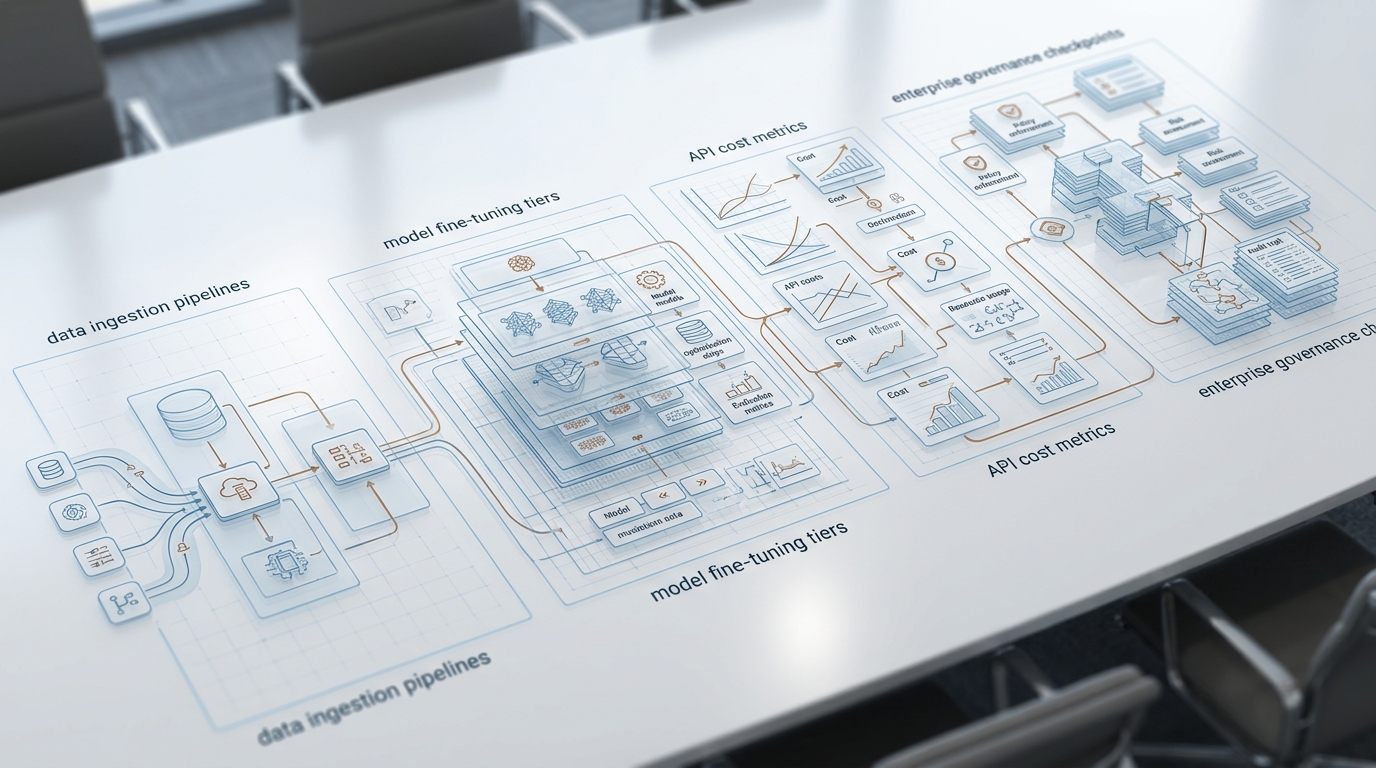
Alternative asset managers with tens of billions in assets under management leverage scale to establish proprietary feedback loops. By aggregating operational data across dozens of portfolio companies, these managers build centralized knowledge repositories that smaller peers cannot replicate. Establishing an institutional operating model allows leading sponsors to underwrite complex technology transactions with greater underwriting precision while rapidly deploying proven automation playbooks across newly acquired assets.
- Proprietary Data Ingestion: Aggregating cross-portfolio transactional and operational data to establish specialized benchmarks and identify operational bottlenecks before signing.
- Preferential Hyperscaler Partnerships: Securing volume-discounted API access, dedicated compute clusters, and co-development access from major cloud and model providers.
- Centralized Operating Partners: Maintaining dedicated in-house data science and AI transformation teams that deploy directly into portfolio companies during the first 100 days.
- Accelerated Learning Loops: Transferring successful automation frameworks, vendor evaluations, and governance protocols across portfolio assets to compress value creation cycles.
As mid-tier consolidation accelerates across private capital markets, the ability to rigorously audit, value, and scale AI assets during due diligence has shifted from an optional capability to a core fiduciary requirement.
The core AI due diligence framework for private markets
Evaluating AI capabilities within target companies requires moving beyond marketing narratives to inspect technical reality. PwC's analysis of S&P Global Market Intelligence deal data found that roughly one quarter of transactions valued at $5 billion or more carry an AI theme, spanning data center products, AI-related power demand, and the integration of AI capabilities into the acquirer's own offerings. Investment teams evaluating targets must determine whether a company possesses genuine technological differentiation or merely relies on superficial wrapper code.
A comprehensive private markets due diligence framework evaluates target assets across three interdependent pillars: maturity benchmarking, operating architecture, and risk diagnostics. For investment professionals, structuring this assessment early in the deal screening phase prevents overpaying for commoditized technology while isolating quantifiable margin improvement opportunities.
Three-pillar diligence architecture: Benchmarking, architecture, and diagnostics
Diligence teams must rigorously evaluate how deeply AI is woven into the target's core value proposition. Assessing replication risk requires checking whether the target's core algorithms can be easily duplicated by competitors using open-source models, or if the company possesses a durable proprietary data loop that widens its moat over time.
- Maturity Benchmarking: Assess whether the target's technical capabilities represent foundational research, embedded production workflows, or basic prompt wrappers over third-party APIs.
- Operating Architecture: Map data flow pipelines, compute dependencies, hosting environments, and the unit economics of model inference against projected revenue scaling.
- Risk Diagnostics: Audit training data provenance, licensing rights, open-source code compliance, model drift monitoring, and regulatory readiness under emerging global AI standards.
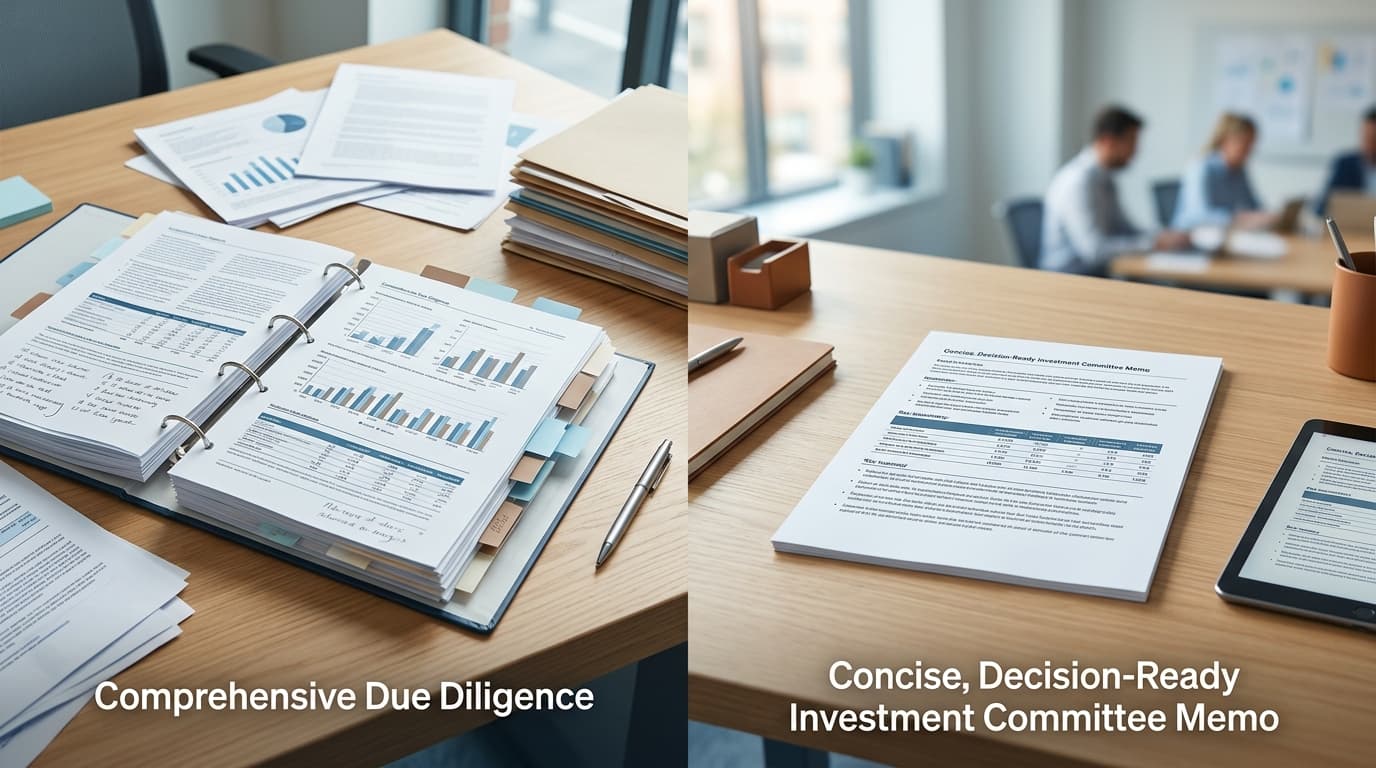
By applying this structured framework, deal professionals can decouple recurring software revenue from transient consulting services, establishing a verifiable baseline for investment committee memos.
What deal teams must test: Infrastructure and deployment
Technical diligence on AI infrastructure cannot remain an isolated workstream managed solely by third-party IT consultants. Commercial and financial deal leads must understand how infrastructure choices directly impact gross margins, customer retention, and exit multiples. In a global industry study of senior fund managers published by Clearwater Analytics, 58% of respondents indicated they expect AI to transform decision-support and portfolio recommendations, while 62% expect AI to fundamentally overhaul how data is synthesized and summarized across operations.
To validate these operational promises in an acquisition target, investment teams must test two core operational dimensions: proprietary data governance and vendor dependency.
Evaluating data moats versus generic model wrappers
The most critical determinant of AI enterprise value is the exclusivity and quality of underlying data assets. Deal teams must verify whether the target possesses clean, labeled, historical data that is legally permissible for model training and fine-tuning. If a target relies on generic public data to tune its models, its competitive advantage is vulnerable to rapid degradation as foundation models advance.
Simultaneously, deal teams must stress-test vendor concentration. Targets heavily reliant on single-provider commercial APIs face significant operational vulnerabilities, including sudden pricing adjustments, API deprecation, and service outages. Underwriting models must explicitly factor in inference costs as query volumes expand, ensuring that revenue growth does not trigger disproportionate compute expenditures that erode EBITDA margins.
Red-flag table: Spotting AI washing and dependencies
As valuation multiples for AI-enabled businesses remain robust, sellers increasingly rebrand legacy software and rule-based heuristics as proprietary artificial intelligence. Spotting AI washing during early confirmatory diligence prevents costly underwriting errors and post-close write-downs. Maintaining an automated risk register ensures that technical red flags are systematically surfaced and factored into purchase price negotiations.
| Diligence Domain | Observed Symptom (AI Washing) | Underlying Structural Risk | Deal Impact & EBITDA Adjustment |
|---|---|---|---|
| Algorithm Architecture | Target claims proprietary machine learning models, but codebase reveals basic regression rules and third-party API wrappers. | Absence of intellectual property moat; negligible barriers to entry for competitors. | Downward adjustment to technology valuation multiple and reduction in terminal growth rate. |
| Cost Structure & Margins | COGS expands linearly with user query volume due to unoptimized third-party API calls. | Negative gross margin leverage; unit economics deteriorate as user adoption accelerates. | Reduction of pro-forma EBITDA margins by 300-800 basis points to reflect ongoing compute costs. |
| Data Governance & Rights | Training datasets contain scraped customer records without explicit commercial processing consent. | Severe copyright infringement exposure and regulatory enforcement under GDPR and the EU AI Act. | Establishment of substantial post-closing indemnification escrow; mandatory data purging. |
| Key Personnel Dependency | Entire AI codebase and pipeline maintained by two contractors with no internal documentation or transfer protocols. | Immediate operational disruption and catastrophic knowledge loss upon transaction closing. | Requirement for structured earn-outs, retention packages, and specialized technical hiring budgets. |
| Model Performance & Drift | Accuracy rates tested only on static historical datasets without production drift monitoring. | High probability of model hallucination and critical failure in live enterprise client environments. | Increased customer churn projections and elevated warranty reserve provisions in financial model. |
Surfacing these anomalies before signing provides deal leads with empirical leverage to restructure transaction terms, demand specific indemnities, or adjust pro-forma EBITDA calculations.
Evidence checklist and data room request list
Confirmatory AI due diligence requires granular, verifiable documentation rather than high-level pitch decks. In the S&P Global Market Intelligence survey, 43% of private equity GPs identified data privacy concerns and 38% cited model accuracy as significant operational barriers to scaling technology solutions. As allocators demand greater transparency into how private capital firms underwrite technology risks, deal teams must compile rigorous value creation evidence packs directly from primary records.
Core documentation requirements for the virtual data room
To thoroughly inspect an acquisition target, investment analysts and M&A advisers should issue a targeted data room request list encompassing the following five core documentation categories:
- Data Provenance and Consent Logs: Complete registry of all training datasets, including source provenance, acquisition dates, user consent documentation, and licensing agreements confirming commercial rights.
- API and Compute Billing Records: Itemized monthly cloud computing invoices (AWS, Azure, GCP) and foundation model API usage logs for the trailing 24 months, detailing token consumption and inference unit costs.
- Model Evaluation and Benchmark Reports: Quantitative test results from internal and independent model evaluation harnesses, including precision, recall, hallucination rates, and edge-case stress tests across production environments.
- Software IP and Open-Source Audits: Detailed software bill of materials (SBOM) and automated code scan reports identifying all open-source libraries, training weights, and copyleft licensing restrictions (e.g., GPL, AGPL).
- Regulatory and Governance Policies: Documented AI ethics frameworks, model risk management guidelines, bias mitigation procedures, and compliance gap assessments against the EU AI Act and NIST AI Risk Management Framework.
Collecting this evidence early enables technical and financial workstreams to reconcile management claims against audited operational logs, eliminating assumptions from the investment committee memo.
How Plausity supports the AI diligence workflow
Modern due diligence demands analyzing vast volumes of unstructured information under compressed transaction timelines. Plausity provides an AI-native due diligence and deal intelligence platform designed specifically for private equity investment teams, M&A advisory partners, and corporate development leads. The platform structures and accelerates complex evaluation workflows while ensuring all findings remain fully auditable by human advisers.
The platform integrates directly into the core phases of deal evaluation through specialized capabilities that cross-reference data room materials against commercial and operational benchmarks:
- Data Room Ingestion: Securely scans and processes thousands of virtual data room documents within minutes, ingesting unstructured PDFs, technical specifications, vendor contracts, and complex financial models.
- AI-Analysis Engine: The core platform engine reads, interprets, and cross-references disparate operational data points across technical, financial, and legal files to evaluate management claims and identify subtle inconsistencies.
- Risk Radar: Continuously evaluates identified findings based on materiality, balance sheet impact, and regulatory exposure, automatically highlighting hidden dependencies, API cost inflation, and licensing liabilities.
By automating the mechanical extraction and synthesis of diligence findings, deal teams can redeploy hundreds of analytical hours into high-conviction underwriting, strategic valuation discussions, and executive reference calls.
How to use this in your next diligence workflow
Translating an institutional AI diligence framework into repeatable deal execution requires clear operational alignment across your investment committee, deal team members, and external advisors. As transaction pace accelerates, teams that establish structured diligence workflows will consistently outperform competitors relying on manual, ad-hoc reviews.
To implement this framework on your next live transaction or portfolio review, follow this four-stage execution sequence:
- Issue Structured VDR Requests Early: Integrate the AI evidence checklist into your Day-1 confirmatory diligence request list to secure API logs, training data rights, and SBOM audits before management meetings.
- Automate Ingestion and Cross-Referencing: Utilize AI diligence workflows to ingest virtual data room archives, enabling immediate extraction of operational metrics and automated reconciliation against vendor contracts.
- Coordinate Workstreams in One Shared Hub: Align technical advisors, financial analysts, and legal counsel in a single collaboration workspace to share insights, track workstream milestones, and eliminate information silos in real time.
- Draft Evidence-Backed Deliverables: Generate institutional-grade investment committee memos, red-flag risk registers, and post-close 100-day value creation plans from a structured report builder, maintaining full source-to-deck citation traceability.
By institutionalizing these diligence protocols, private market professionals protect downside capital, underwrite technological value creation with empirical rigor, and secure an enduring competitive advantage in an increasingly AI-driven market.
How Plausity accelerates this workflow
Plausity is an AI-native due diligence and deal intelligence platform that helps M&A advisory firms, VC and PE funds, corporate development teams and family office investment teams structure evidence, findings and questions across a data room. It does not replace human advisers, does not guarantee deal outcomes, and does not provide legal, tax, audit, regulatory or investment advice — all AI-generated findings require confirmation and advisor review by qualified professionals.
To explore the underlying capabilities, see the Plausity AI analysis engine and the findings and risk intelligence product page. For team-level workflows, see how VC and PE funds and M&A advisory firms use Plausity across live deals.