The Evolution of Sector Consolidation Mapping: Moving Beyond Spreadsheet Inertia
In the modern private equity landscape, the buy-and-build playbook has evolved from an occasional value creation tactic into a primary strategic driver. Add-on transactions have steadily climbed as a share of overall deal volume, accounting for approximately 75.9% of all U.S. buyout activity in recent quarters. In this highly competitive deal environment, private equity sponsors and platform-company management teams can no longer afford to be reactive. Executing a successful roll-up strategy demands programmatic, proactive roll up acquisition mapping rather than a passive reliance on investment bank introductions or incoming broker decks. For sponsors executing these intensive expansion campaigns, modern due diligence for PE starts long before an official letter of intent is drafted, beginning with how targets are systematically mapped, tracked, and screened.
The Structural Friction of Manual Fragmented Market Mapping
Traditionally, identifying bolt-on opportunities in highly fragmented industries (such as regional specialized services, veterinary care, or localized industrial distribution) has been a grueling manual process. Analysts spend weeks scraping basic business directories, searching regional registries, and inputting qualitative information into monolithic spreadsheets. This manual fragmented market mapping approach introduces significant structural friction. Because directories are quickly outdated, the resulting spreadsheet model is static, decaying the moment it is saved. High-potential targets, particularly those small-to-midsize regional operators that lack an active digital presence or active broker representation, are frequently overlooked. This spreadsheet inertia limits the deal team to a narrow, pre-screened universe of targets that are already actively in-market, driving up competition and asset multiples while missing proprietary, off-market opportunities that offer superior arbitrage.
| Operational Dimension | Manual Spreadsheet Approach | AI-Driven Mapping Platform |
|---|---|---|
| Update Frequency | Static and periodic, typically updated quarterly or bi-annually, leading to stale market data | Continuous and real-time, pulling from live web scrapers, localized news, and registry updates |
| Data Sources Reviewed | Limited to high-profile directories, broker lists, and basic search engine queries | Multi-dimensional ingestion of unstructured registries, local business news, and niche databases |
| Target Discovery Depth | Identifies only well-known middle-market players, missing smaller regional firms | Uncovers highly fragmented, off-market targets with minimal digital presence |
| Screening Rigor | Basic qualitative sorting based on self-reported website descriptions or high-level financials | Automated mapping against investment criteria, commercial fit, and regulatory compliance flags |
Transitioning to Continuous Market Landscape Mapping and Automated Screening
Overcoming spreadsheet inertia requires private equity firms to adopt dynamic market landscape mapping solutions. By leveraging AI-native data models, sponsors can automate target discovery across highly fragmented sectors. Rather than manually researching individual entities, machine learning engines continuously parse millions of unstructured data points, localized business listings, and industry registries to construct a live, comprehensive competitive map. This systematic approach transforms both platform acquisition screening (identifying the initial anchor investments with robust operational scale) and ongoing bolt on acquisition screening (filtering hundreds of smaller, hyper-local operators for geographic and strategic alignment). Instead of managing a static list, deal teams operate a real-time dashboard that ranks targets by size, synergy potential, and acquisition probability, transitioning the firm from a reactive buyer to a programmatic consolidator.
To capture this speed and depth at scale, leading investment professionals are integrating AI-powered workflows directly into their sourcing pipelines. Integrating tools like Plausity's AI-Analysis Engine allows deal teams to transition seamlessly from macro-level sector consolidation mapping to micro-level target screening. When a potential bolt-on is identified, the platform's advanced algorithms can rapidly ingest unstructured target information, cross-referencing operational footprints and financial metrics against the sponsor's core investment thesis in minutes. This shift to AI-native due diligence eliminates weeks of manual spreadsheet compilation, ensuring that sponsors maintain full risk visibility through advanced capabilities like Risk Radar before initiating outreach to targets. This analytical depth ensures that investment professionals can confidently execute programmatic M&A strategies without compromising on risk management.
Accelerating Roll Up Acquisition Mapping through LLM-Driven Data Synthesis
In highly fragmented markets, private equity sponsors executing buy-and-build strategies face a massive data bottleneck. Traditional spreadsheet-based methods for fragmented market mapping rely on manual analysts scraping local commercial registries, searching regional trade publications, and compiling static Excel lists. This manual process is not only slow, but it also misses up to 80% of niche operators who maintain a minimal digital footprint but represent ideal add-on targets. Today, forward-looking private equity teams and M&A advisory partners are leveraging an AI-native due diligence platform to replace static pipelines with dynamic, LLM-driven databases. By automating roll up acquisition mapping, deal teams can ingest and synthesize unstructured records at scale, converting regional, highly fragmented value chains into a unified, actionable pipeline in a fraction of the traditional time.
Aggregating Unstructured Databases for Comprehensive Market Landscape Mapping
Building a robust proprietary pipeline requires aggregating highly diverse data sources, from local business directories and regulatory filings to localized company websites. Unlike traditional database aggregators that only index structured fields, modern large language models can read and interpret unstructured text. By utilizing Plausity's AI-Analysis Engine, PE sponsors can automatically ingest data from dozens of local registries and translate localized service descriptions into standardized business metrics. This capability transforms raw, unstructured data into a structured market landscape mapping that categorizes potential targets by geographic density, operational focus, and service lines. The resulting database provides the clean foundation required to conduct scalable bolt on acquisition screening and identify high-value targets before competitors do.
Semantic Search: Moving Beyond Keywords for Platform Acquisition Screening
Standard keyword-based searches in CRM databases often fail because small, regional targets do not use standardized corporate terminology. For instance, a search for precision medical manufacturing might miss a specialized, family-owned company that describes its services as micro-milling for medical instruments on its website. Semantic search solves this problem by understanding the underlying context and intent of a query. Rather than filtering by exact word matches, LLM-driven platforms analyze the conceptual relationships between companies. When performing platform acquisition screening or searching for complex sub-specialties, investment teams can describe their ideal target profile in plain natural language. The AI system searches the synthesized database for companies with matching operational footprints, accelerating the identification of strong core entities around which a roll-up can be anchored.
Mitigating Database Decay in Sector Consolidation Mapping
A common pitfall of manual market mapping is database decay: the moment an analyst finishes a static spreadsheet, the data begins to age as companies are acquired, change leadership, or shut down. In fast-consolidating sectors, keeping a manual pipeline current is practically impossible. AI-driven sector consolidation mapping resolves this by continuously scraping and analyzing real-time digital signals, such as regulatory registry updates, local news announcements, and corporate website changes. Because these platforms run on automated scheduled workflows, PE deal teams maintain a living, self-updating map of their target sectors. This real-time visibility ensures that when sponsors launch a bolt on acquisition screening process, they are querying up-to-date financial, geographical, and operational data, avoiding wasted outreach to targets that are no longer available or have changed strategic focus.
Automating Bolt On Acquisition Screening and Platform Acquisition Screening at Scale
In highly fragmented industries, private equity sponsors rely heavily on a systematic buy-and-build playbook. Add-on transactions now comprise approximately 73% of all US buyout activity, indicating that growth is increasingly driven by acquisition rather than organic expansion alone. However, traditional target sourcing often stalls because manual processes rely on static legacy databases, outdated public registries, and narrow professional networks. This approach creates a massive bottleneck for deal teams trying to build an exhaustive pipeline. To overcome these limitations, modern investment firms are shifting away from manual spreadsheets toward automated market landscape mapping, utilizing advanced algorithms to identify and score potential targets in real time.
Defining the Ideal Target Profile for Fragmented Market Mapping
To execute a scalable roll-up, investment professionals must translate qualitative investment theses into programmatic search parameters. This begins with establishing a robust Ideal Target Profile (ITP). Using the Plausity AI-Analysis Engine, deal teams can ingest proprietary investment criteria, geographic constraints, and operational guidelines. The engine then crawls unstructured market data, localized news reports, trade journals, and corporate filings to build a comprehensive baseline dataset. Through fragmented market mapping, the platform uncovers hidden market players and niche service providers that are typically absent from conventional databases, ensuring that sponsors capture the entire addressable market from day one.
Accelerating Bolt On Acquisition Screening and Pipeline Velocity
Once the regional market landscape is mapped, the primary operational challenge is executing rapid, high-throughput bolt on acquisition screening. Junior analysts typically spend hundreds of hours scrubbing lists, estimating revenue proxies, and trying to infer service offerings. An AI-native due diligence platform automates these multi-step workflows. By utilizing machine learning to analyze digital footprints, headcount trends, and customer sentiment, the platform screens hundreds of companies simultaneously. This allows platform-company management teams to accelerate their roll up acquisition mapping and sector consolidation mapping efforts, securing proprietary bilateral discussions before competitors enter the process.
| Screening Metric | Manual Spreadsheet-Based Process | AI-Driven Automated Screening |
|---|---|---|
| Sourcing Method | Keyword searches in rigid legacy directories | Semantic evaluation of web footprints and news |
| Processing Speed | Weeks of analyst research to screen a single niche | Minutes to run high-volume, multi-source screening |
| Target Fit Accuracy | High false-positive rate based on generic codes | Contextual screening against exact ITP criteria |
| Data Freshness | Static lists that degrade and become obsolete | Evergreen pipelines refreshed by continuous monitoring |
Platform Acquisition Screening for Synergy and Operational Alignment
For platform acquisition screening, the requirements are significantly more complex than those for smaller add-ons. Platform acquisitions require deep operational compatibility, compliance, and scalable technology foundations. Integrating advanced systems for due diligence for PE lets deal teams evaluate organizational structure and technical maturity early in the screening phase. By applying automated reasoning to parse regulatory compliance documents and corporate disclosures, sponsors can pinpoint red flags before entering expensive exclusivity periods. This upfront screening ensures that capital is deployed only on highly viable platforms capable of anchoring subsequent bolt-on integration.
Instantly Assessing Target Risk in Highly Fragmented Segments
Executing a buy-and-build or roll-up strategy requires evaluating dozens, sometimes hundreds, of targets within a condensed timeframe. In highly fragmented sectors, the sheer volume of prospective deals creates a significant diligence bottleneck. While initial fragmented market mapping helps identify potential targets, conducting comprehensive manual due diligence on each small company is cost-prohibitive and slow. Traditionally, deal teams have been forced to rely on high-level spreadsheet summaries, which frequently overlook critical structural risks, or spend excessive fees on manual advisory reviews. This trade-off is increasingly untenable. Industry data indicates that 87% of private equity firms now leverage advanced data analytics to perform more precise due diligence and identify prospective deal targets. For PE sponsors executing accelerated roll-up programs, resolving this diligence dilemma requires shifting from manual, sample-based checking to automated risk screening across the entire pipeline.
Automating Risk Surfacing with Plausity's Risk Radar
To resolve this bottleneck, forward-thinking deal teams are deploying Plausity's Risk Radar to automate the identification of critical liabilities at the earliest stages of the transaction lifecycle. By connecting directly to virtual data rooms through Data Room Ingestion, the platform's core AI-Analysis Engine ingests, processes, and cross-references hundreds of files simultaneously. Instead of waiting weeks for manual contract reviews, Risk Radar automatically flags material risks, legal liabilities, and regulatory compliance issues in minutes. This capability transforms bolt on acquisition screening from an ad-hoc, high-risk exercise into a structured, highly reliable process. PE sponsors and corporate M&A project leads can immediately isolate high-risk targets that do not meet investment criteria before committing significant resources to deep-dive diligence.
This automated screening is particularly vital when evaluating risks that typically remain hidden in standard spreadsheet-based mapping, such as customer concentration and structural revenue churn. For small and medium-sized enterprises in consolidating markets, a significant portion of revenue is often concentrated within a few key accounts. Standard financial reviews may overlook the underlying stability of these relationships. In contrast, integrating rigorous, automated customer due diligence allows sponsors to perform cohort analysis and evaluate historical revenue quality. By automating this analysis, Risk Radar alerts deal teams to customer concentration risks and potential churn patterns early, protecting the platform company from overpaying for unstable revenue streams.
Standardizing Investment Committee Target Scorecards
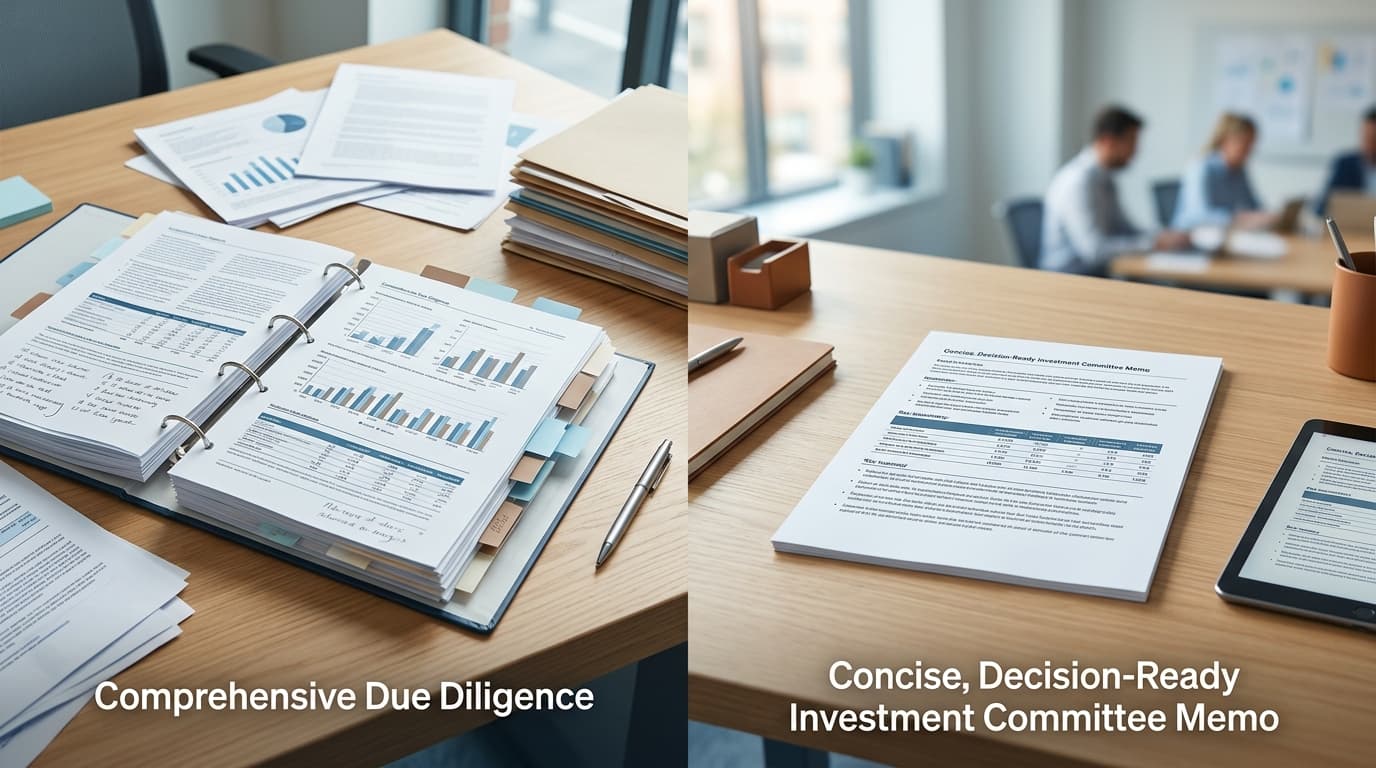
Once these risks are surfaced, deal teams must communicate them effectively to secure buy-in and maintain alignment. When executing high-volume roll-ups, standardizing investment committee reporting is critical to prevent deal fatigue and ensure objective decision-making. By utilizing Plausity's Report Builder in tandem with the AI-Analysis Engine, investment professionals can instantly convert complex, unstructured risk findings into standardized, comparable target scorecards. This automated approach ensures that every target, regardless of its size, undergoes the exact same rigorous screening process. In standardizing these outputs, PE sponsors can bridge the gap between initial roll up acquisition mapping and formal diligence, linking these findings to broader, established PE due diligence frameworks that keep the investment committee aligned on key risk thresholds.
| Risk Parameter | Spreadsheet-Based Approach | AI-Driven Approach (Plausity) |
|---|---|---|
| Analysis Speed | Weeks per target, leading to deal fatigue or skipped audits in rapid roll-ups. | Minutes per target via automated Data Room Ingestion and processing. |
| Risk Detection | Sample-based contract reviews, creating a high risk of missing hidden liabilities. | Exhaustive legal due diligence scanning 100% of files for anomalies. |
| Revenue Stability | Manual Excel calculations of top-customer revenue shares, masking customer churn. | Automated cohort and customer concentration analysis flagged by Risk Radar. |
| Committee Reporting | Ad-hoc, subjective narrative summaries drafted manually from scratch. | Standardized target scorecards auto-generated by the Report Builder. |
Ultimately, mitigating risk in high-volume acquisition strategies requires an industrial-scale approach to diligence that manual processes simply cannot support. Whether executing platform acquisition screening on potential platform anchors or conducting rapid-fire screening on dozens of bolt-on targets, integrating AI-native risk detection ensures that speed does not compromise deal quality. Transitioning from legacy spreadsheet-based tools to automated, data-backed screening models allows PE sponsors to maintain high deal velocity while safeguarding capital. By embedding structured risk intelligence into the overarching market landscape mapping and sector consolidation mapping workflows, deal teams can execute their buy-and-build strategies with absolute confidence, turning diligence from a transaction bottleneck into a repeatable competitive advantage.
Streamlining Execution: From Data Room Ingestion to Investment Committee Ready Reports
For private equity sponsors executing buy-and-build and roll-up strategies, deal velocity is a critical determinant of multiple arbitrage success. While robust roll up acquisition mapping and fragmented market mapping identify the potential landscape, the actual execution phase requires rapid, high-fidelity analysis of target documents. When a platform is established, the race is on to execute sequential bolt-on acquisitions to capture synergies and lower the weighted average acquisition multiple, as documented by Bain & Company in their analysis of successful programmatic M&A execution. However, traditional manual private equity diligence workflows present a massive operational bottleneck. Lean deal teams and platform management offices find themselves buried under disorganized virtual data rooms, manually extracting data, managing endless Excel trackers, and drafting investment committee memoranda from scratch.
Eliminating Friction with Data Room Ingestion
The initial friction point in any transaction is the document collection and intake phase. For mid-market roll-ups, bolt-on targets often lack sophisticated corporate infrastructure, resulting in disorganized data rooms filled with scanned PDFs, unsorted contracts, and inconsistent financial files. Instead of wasting valuable associate hours sorting and categorizing this influx, modern deal teams deploy Data Room Ingestion tools. Plausity connects directly to major virtual data rooms, automatically extracting, OCR-processing, and organizing unstructured data into structured, queryable knowledge. This eliminates the standard delay between data room access and active analysis, allowing teams to initiate their bolt on acquisition screening and platform acquisition screening workflows immediately upon receiving credentials.
Running Deep Analysis via the AI-Analysis Engine
Once files are ingested, the core analytical work begins. Rather than relying on sample-based manual reviews of customer contracts or supplier agreements, sponsors leverage the AI-Analysis Engine to perform exhaustive, line-by-line diligence. This engine scans thousands of pages to cross-reference representations, identify legal liabilities, detect change-of-control clauses, and uncover concentration risks that might jeopardize the integration process. By coupling this analysis with automated threat identification tools like Risk Radar, the deal team gains an instantaneous, comprehensive view of the target's operational risk profile. This level of depth ensures that no critical liabilities are missed in the rush of rapid roll-up execution, effectively protecting the sponsor from post-close surprises.
| Workflow Dimension | Traditional Manual Execution | AI-Powered Execution (Plausity) |
|---|---|---|
| VDR Processing | Manual download, sorting, and manual index mapping taking up to 3 days per target | Instant automated ingestion, OCR scanning, and auto-classification completed in minutes |
| Contract & Risk Audit | Sample-based manual contract reviews that take days and risk missing hidden liabilities | Comprehensive line-by-line analysis of 100% of contracts to instantly flag anomalies |
| Synthesis & Reporting | Manual copy-pasting of findings into template Word documents, taking 24 to 48 hours | Automatic report drafting with verified source citations, generated in real time |
Compiling Investor-Ready Outputs with Report Builder
The final bottleneck in the diligence cycle is translating complex raw findings into structured, investor-ready reports. In programmatic M&A, investment committees require rigorous documentation to approve capital allocation, yet drafting these reports manually remains incredibly time-consuming. Using Plausity's Report Builder, deal teams can automatically compile findings from the AI-Analysis Engine into professional, structured due diligence reports and investment memoranda. Every claim, risk assessment, and financial metric in the generated report contains full source traceability back to the specific line in the virtual data room. This audit-trail transparency ensures absolute compliance with institutional underwriting standards while enabling deal teams and advisory partners to operate at 10x the speed of legacy manual processes.
Plausity brings AI-native analysis to this workstream. Explore Plausity's platform for PE sponsors running buy-and-build strategies, or read more on sourcing proprietary, off-market targets before they reach a broker process.