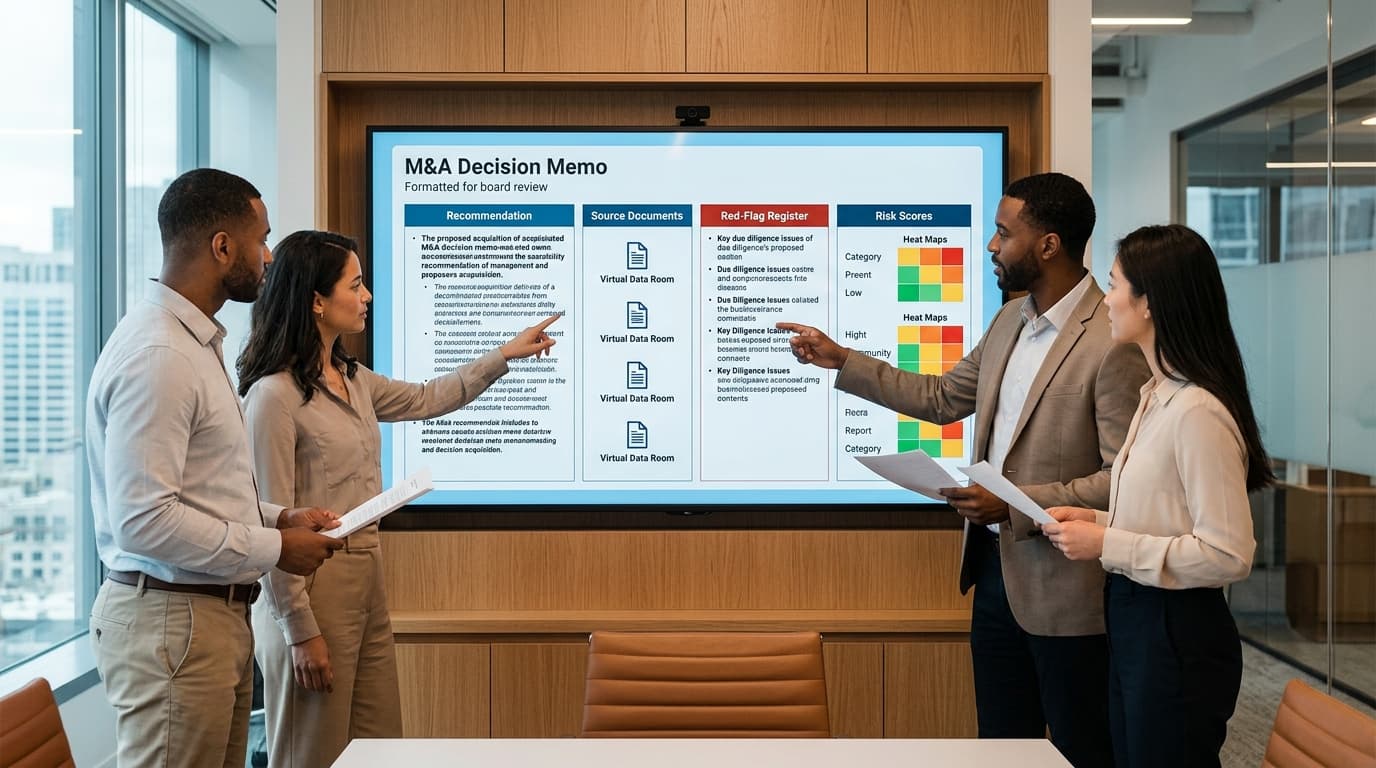
What red flag screening is and why it happens before the LOI
Red flag screening is a deliberately fast, outside-in review of everything you can see about a target before a data room exists: statutory filings, press releases, the teaser, a management deck, registry extracts, customer reviews, litigation databases. Its job is not to verify the deal. Its job is to answer one question early: is there anything serious enough to stop, reprice or restructure this transaction before we commit money, management time and exclusivity? Where confirmatory due diligence tests a signed thesis against the seller's own records, red flag screening tests whether a thesis deserves to be signed at all.
The distinction matters because the two exercises have different standards of proof. A screen works from hypotheses and incomplete evidence, and it is entitled to stay inconclusive. An audit works from primary documents and must be conclusive. Teams that blur the two either over-invest before the LOI, effectively running full diligence on a deal they do not yet control, or under-invest and arrive at exclusivity with untested assumptions. A screen is a filter, not a verdict: its output is a short list of falsifiable risk hypotheses, each tagged walk, reprice or investigate, not a signed-off set of findings.
Why late discovery is the expensive kind
The cost of deferring this work shows up directly in deal mortality data. In Axial's 2025 Dead Deal Report, covering 75 collapsed transactions, 46.6% of broken LOIs died on what diligence found, or failed to find: 25.3% on non-QoE diligence findings and a further 21.3% on quality-of-earnings EBITDA discrepancies. Deals in that dataset spent an average of 106 days under exclusivity before falling apart. That is months of fees, management attention and advisor spend ending in nothing, almost all of it spent verifying facts that a disciplined outside-in screen would at least have hypothesised earlier. Customer concentration, contracts that do not survive change of control, undocumented add-backs and tax exposure, the clusters that dominate the dead-deal data, all leave traces in public filings, registries and management materials before the data room opens.
The stakes of weak pre-deal vetting are larger than any single broken LOI. Research by Baruch Lev and Feng Gu, based on a sample of 40,000 acquisitions over 40 years, finds that 70% to 75% of deals fail when measured on post-acquisition sales and margin trends, stock performance and goodwill write-offs. Their conclusion for buyers is straightforward: diligence and research have to be more rigorous before signing, not after. Red flag screening is precisely that discipline, applied at the stage where walking away is still cheap.
The practical implication for deal teams is sequencing. The screen does not replace confirmatory diligence; it scopes it. Risk hypotheses raised before the LOI determine which workstreams get budget, which experts are briefed, which structural protections (escrows, earnouts, indemnities) the term sheet should anticipate, and how much exclusivity to request. Teams that skip the screen discover their red flags inside exclusivity, when the only remaining options are reprice or walk. Teams that run one enter the data room with questions instead of assumptions, which is a materially stronger negotiating position. Structuring that early evidence into a traceable risk register, rather than scattered notes, is what makes the sequencing hold under time pressure.
The pre-LOI framework: risk hypotheses before evidence
Structure the pre-LOI screen as a set of falsifiable risk hypotheses, one per workstream, written down before any document is read in depth. The ICAEW's best-practice guideline for commercial due diligence describes red flag CDD as an early-stage, focused exercise designed to raise critical risks in specific areas, typically where a purchaser wants to identify potential deal-breakers before committing to further diligence and significant deal costs. The discipline is to state what would have to be true for the deal thesis to break, then test only the evidence that bears on it.
Phrase hypotheses so they can be killed
A usable hypothesis names a mechanism, a materiality threshold and the evidence that would confirm or clear it. "Revenue quality is weak" is an opinion. "A material share of revenue sits under contracts that terminate on change of control" is a hypothesis a targeted contract review can kill. Weak phrasing produces a reading list; strong phrasing produces a decision.
- Commercial: the top customers shown in the teaser or case studies are concentrated, and renewal risk is visible in public references or announcement patterns.
- Financial: reported growth rests on one-off items or accrual timing detectable in preliminary figures and statutory filings.
- Legal: litigation, IP ownership gaps or change-of-control consents are traceable in public registers and press releases.
- Technology: key-person dependency or licence exposure is inferable from job postings, open-source disclosures and published architecture material.
- Regulatory: pending enforcement or licence-renewal risk appears in regulator publications covering the target's jurisdiction.
Thresholds and triage outcomes
Set materiality and deal-relevance thresholds before screening starts, so each hypothesis resolves to one of three outcomes: walk, reprice, or investigate further in confirmatory diligence. A flag that cannot move price, structure or the go/no-go decision does not belong on the list. Each surviving flag should carry the evidence that triggered it and the confirmatory workstream it feeds, so the screen converts into a scoped diligence plan rather than a loose set of concerns, which is the logic behind risk register automation for red-flag reporting.
The practitioner view behind this framework is that diligence fails at consequence, not discovery: the information that kills deals is usually findable early, in filings, announcements and management materials, and what is missing is the discipline to act on it before exclusivity compresses the timeline. Hypotheses written before the data room opens are what make that discipline enforceable.
Red flag categories: what to test in each workstream
A pre-LOI screen only holds up if it is organised by workstream rather than by instinct. The practical method is to assign each risk hypothesis to one of five categories (commercial, financial, legal and regulatory, technology, and people or organisation) and attach a specific, testable question to each. The categories are not equally weighted for every deal, but covering all five prevents the common failure where a team runs a deep financial screen and never asks whether the revenue underneath it is contractually secure. The Axial Dead Deal Report, which analysed 75 unsuccessful 2025 transactions, found that non-QoE diligence findings caused 25.3% of broken LOIs and QoE EBITDA discrepancies a further 21.3%: the failures cluster exactly where early screening should have looked.
Commercial and financial flags
Commercially, test customer and supplier concentration first, because it is the most visible in public materials: a target whose website or press releases name a handful of anchor clients, or whose growth story leans on one channel, is a concentration hypothesis you can log before any data room exists. Revenue quality follows. Ask whether stated growth has a structural driver (contracted backlog, pricing power, expansion in existing accounts) or rests on one-off wins that will not repeat, which is the core question of commercial due diligence. Financially, the pre-LOI questions are earnings quality and cash conversion: how much of reported EBITDA sits in add-backs, and whether working capital is quietly funding the business, the ground that financial due diligence later covers in depth. Add-backs without documentation are the classic late-stage surprise, and quality-of-earnings discrepancies rose from 10.6% of broken LOIs in 2023 to 21.3% in 2025, more than doubling as a share of failed deals.
Legal, regulatory and technology flags
Legal and regulatory screening before exclusivity focuses on what public filings, registries and the teaser reveal about contract structure and exposure: change-of-control clauses in material contracts, non-assignable licences, IP ownership (particularly where development was outsourced), and litigation or licensing risk in regulated sectors. The stakes are easy to underestimate. A worked example: a single contract carrying a material share of EBITDA that includes a change-of-control termination right converts a routine legal review into a valuation question, because the buyer cannot assume the revenue survives closing. On the technology side, test key-person dependency on systems and architecture, deferred maintenance visible in release notes or support forums, and whether the platform's scalability claims are backed by evidence or by narrative.
- Commercial: customer and supplier concentration, revenue quality, growth claims without structural drivers
- Financial: earnings quality, undocumented add-backs, working capital strain
- Legal and regulatory: change-of-control clauses, non-assignable contracts, IP ownership, litigation and licensing exposure
- Technology: key-person dependency, deferred maintenance, unproven scalability
- People and organisation: retention risk in the functions the thesis depends on
Each flag should be recorded with its evidence, its materiality hypothesis and a triage decision: walk, reprice or investigate further. That structure is what turns a scatter of observations into a screen, and it is what Risk Radar is designed to support, scoring findings by materiality, financial impact, legal exposure and deal relevance so the team's attention lands on the flags that can actually move price or terms. It is also what makes the handover to confirmatory diligence efficient, because every open question arrives already scoped and sourced.
The evidence you can actually gather before exclusivity
Pre-LOI screening is not a smaller version of confirmatory due diligence. It is a discipline of knowing which sources exist before a seller grants VDR access, what each can genuinely prove, and what it structurally cannot. The ICAEW commercial due diligence guideline treats this early-stage, focused review as a distinct exercise: a red flag CDD designed to surface critical risks quickly, typically on the limited information shared before full disclosure. Working the evidence base deliberately, rather than opportunistically, is what separates a screening hypothesis from a guess.
| Source | What it can prove | What it cannot prove |
|---|---|---|
| Public filings and registry extracts | Legal existence, ownership chain, statutory filings history, charge registers | Current trading performance, off-balance-sheet commitments |
| Press releases and news coverage | Announced strategy, funding rounds, major customer wins, leadership changes | Whether announced claims match operational reality |
| Regulator publications and litigation records | Sanctions, enforcement actions, ongoing disputes, licence status | Outcome, materiality or settlement exposure of live cases |
| Teaser, CIM and management presentations | Management's own framing of the equity story, KPIs and growth plan | Independent verification of any figure presented |
| Outside-in signals: job postings, customer reviews, competitor statements | Hiring direction, attrition signals, customer sentiment, competitive pressure | Root cause, scale or financial impact of the signal |
Process materials deserve particular attention. The teaser, the confidential information memorandum and management presentations are effectively the round-one disclosure set: the seller has chosen what to show before any VDR exists, which makes them both the richest and the most biased source available pre-LOI. Read them not for what they say but for what they assert without support. Every unaudited growth claim, every customer concentration figure presented without a contract list, is a testable hypothesis for confirmatory work. Structured, source-grounded extraction of these documents, as described in Plausity's approach to data room findings, keeps those assertions traceable rather than absorbed into the deal narrative.
Outside-in signals close the gap that seller-controlled material leaves. Job postings reveal where the target is investing or struggling to hire; customer reviews and competitor statements test the commercial story from the demand side. Where the thesis depends on customer behaviour, primary evidence gathered before exclusivity, in the spirit of Plausity's Primary Research layer, can surface what no document will.
The discipline that ties it together is the evidence-gap log. Every question the pre-LOI material cannot answer becomes a numbered line in the confirmatory DD request list, owned by a workstream and tied to the risk hypothesis it tests. Nothing is then discovered late simply because nobody looked first; the confirmatory phase starts with a map of what remains unknown, not a blank page.
How early flags shape confirmatory DD scope and deal structure
A red flag confirmed before exclusivity is not a reason to stop; it is an instruction. Each surviving flag converts into one of three things: a scoped confirmatory workstream, a prioritized request list for the data room, or a structural protection in the term sheet. That is the practical difference between pre-LOI screening and a generic full-scope diligence plan. Instead of commissioning every workstream at equal depth, the team spends budget where the early evidence pointed, and negotiators arrive at the table with specific asks rather than a list of concerns.
| Early flag | Confirmatory DD response | Structural remedy |
|---|---|---|
| Restated or unreliable earnings | Focused quality-of-earnings work on the affected lines | Purchase price adjustment or repricing |
| Contingent liability (litigation, tax, covenant breach) | Legal and financial workstream scoped to quantify exposure | Escrow or indemnity holdback sized to the exposure |
| Unproven forward performance | Commercial diligence on pipeline, churn and pricing power | Earnout tied to the specific metric in question |
| Residual unknowns after confirmatory work | Targeted gap-closing requests, then accept and document | W&I insurance to transfer the residual risk |
These structures are mainstream, not exotic. SRS Acquiom's 2026 M&A Deal Terms Study, which analyzes more than 2,300 private-target acquisitions valued at $569 billion that closed between 2020 and 2025, reports that 24% of deals completed in 2025 included an earnout, up from 22% in 2024, and that 88% of 2025 private-target deals involved some form of escrow or holdback. Deal machinery for repricing, holding back and transferring risk is readily available; the constraint is knowing early enough which lever to pull.
Timing is what preserves those options. A flag caught in the pre-LOI window leaves the full toolkit open: restructure the consideration, reprice, carve the problem asset out of the perimeter, seek regulatory or third-party approvals before signing, or walk. The same flag discovered in the final week of exclusivity rarely does, because sunk process costs, adviser momentum and competitive pressure have already narrowed the choices to sign or renegotiate from weakness. This is why disciplined teams log flags in a living risk register from day one rather than in a red-flag report at the end risk register automation.
For the confirmatory phase, the handoff should be explicit: every materiality-scored finding carries its source evidence, its owner and its proposed remedy, so counsel can draft protections and workstream leads can scope requests directly from it. Platforms built for this, such as Plausity's Risk Radar and its findings and risk intelligence workflow, help teams trace each flag back to its underlying document and carry it into deal terms. The output is a diligence plan that reads like a negotiation agenda, which is exactly what a flag-driven process should produce VC and PE funds.
How Plausity supports red flag screening and early risk work
The pre-LOI method described above maps directly onto the workflow Plausity is built for, and the mapping is worth spelling out precisely. The AI-Analysis Engine reads, interprets and cross-references exactly the materials an early screen depends on: statutory filings, press releases, teaser documents and whatever management presentations the seller has shared. Instead of an analyst manually reconciling a revenue claim in the teaser against a segment note in the annual report, the engine performs that cross-referencing across the full document set and attaches each finding to its source, so the risk hypothesis you registered in week one can be traced to the sentence that supports or contradicts it.
Triage is where early screening most often becomes ad hoc, with flags ranked by whoever shouts loudest in the deal meeting. The Risk Radar structures that step by evaluating each finding against materiality, financial impact, legal exposure and deal relevance, so a walk-away flag and a pricing footnote land in visibly different tiers before the go/no-go conversation starts.
Coordination and the hand-off into confirmatory work follow the same pattern. The Collaboration Hub keeps workstreams aligned and shares findings in real time across the deal team, and once a data room opens, Data Room Ingestion connects to the VDR so the evidence-gap log built during screening can be worked through systematically rather than rebuilt from scratch. The Report Builder then drafts findings into deliverables with full source traceability, which is what allows a red flag raised pre-LOI to survive into the IC memo with its evidence chain intact.
The AI-plus-human framing is not a marketing line but the position the ICAEW's financial due diligence guideline takes: AI and data analytics combined, critically, with human oversight enable a significantly greater level of insight than was previously possible. Plausity supports analysis of the material a team already has. It is not a proprietary deal-sourcing database and does not perform automated deal discovery; the hypotheses, the judgement and the walk-or-proceed call remain with the investor VC and PE teams.
How to use this in your next diligence workflow
The method only pays off if it runs on a live target, under time pressure, before exclusivity is signed. The sequence below is deliberately short enough to execute in the window between teaser receipt and LOI submission, and it is the discipline more buyers are adopting as targeted pre-LOI diligence replaces the old sign-first, diligence-later model. For VC and PE investment professionals and advisory analysts, the goal is simple: enter exclusivity with hypotheses already formed, not with a blank request list.
- Build the risk-hypothesis register at teaser or CIM stage. Draft one falsifiable hypothesis per workstream (commercial, financial, legal, technology, regulatory), each with a materiality threshold and a named owner. A hypothesis without a threshold cannot be confirmed or killed, and one without an owner will not be worked.
- Work the public-evidence checklist. Filings, registry extracts, press releases, customer reviews, hiring patterns and management materials either corroborate or contradict each hypothesis. Log every gap explicitly as a future DD request rather than letting it silently disappear.
- Triage each confirmed flag: walk, reprice or investigate. Only flags that clear the materiality threshold earn a triage decision, and the decision is recorded with its rationale so the investment committee can audit the reasoning later.
- Convert survivors into scoped confirmatory workstreams. A confirmed pricing-power hypothesis becomes a defined customer-reference module; a confirmed churn hypothesis becomes a cohort analysis request. Scope follows evidence, not habit.
- Carry the rest into structural asks. Warranties, indemnities, escrows and conditions precedent in the LOI and SPA negotiation should trace directly back to flags identified in the screen, not to generic precedent language.
Tooling matters most at steps one and two. Plausity's Risk Radar scores findings by materiality, financial impact and deal relevance, while the AI-Analysis Engine cross-references early materials against each hypothesis with source-linked traceability, and the risk register automation discipline keeps every flag owned and dated. When the data room does open, Data Room Ingestion maps the new documents against the existing register, so confirmatory diligence tests hypotheses instead of restarting from zero.
Run this way, the screen changes the character of exclusivity. Nothing surfaces in the data room that a disciplined outside-in review could have flagged weeks earlier, and every surprise that does surface is one the team can show it tested with the evidence available at the time.
How Plausity accelerates this workflow
Plausity is an AI-native due diligence and deal intelligence workspace that helps M&A advisory firms, VC and PE funds, corporate development teams and investment-banking teams structure evidence, findings and questions across a data room. Plausity supports evidence extraction, source grounding, findings management and IC preparation — it does not replace human analysts, advisers or investment professionals, does not provide legal, tax, audit, regulatory or investment advice, and does not make autonomous investment decisions. All findings require human review. Built for today's investment and deal teams. Trusted by >200 firms.
To explore the underlying capabilities, see the Plausity AI analysis engine and the findings and risk intelligence product page. For team-level workflows, see how VC and PE funds and M&A advisory firms use Plausity across live deals.