Why this matters now: The recent-IPO take-private framework
The surge in recent-IPO take-private transactions reflects a structural shift across public and private capital markets. Many companies that completed initial public offerings during peak market cycles have experienced severe post-listing valuation compression, leaving them stranded with depressed multiples, illiquid equity, and burdensome public compliance expenses. In the first quarter of 2024, over half of the 15 US middle-market companies delisting for less than one billion dollars were businesses that had gone public in the boom IPO years of 2020 and 2021. For private equity sponsors, corporate development teams, and lenders, these boomerang targets offer an attractive entry valuation paired with an extensive public disclosure record.
Public-to-private due diligence differs fundamentally from conventional private buyouts. Instead of relying solely on vendor-prepared data rooms, deal teams have access to audited historical filings, quarterly earnings transcripts, and equity research commentary before signing a non-disclosure agreement. In take-private software transactions, this public baseline provides early valuation visibility while shifting the core investigative burden toward diagnosing operational slippage, governance conflicts, and shareholder litigation exposure.
- Baseline transparency: Form 10-K, Form 10-Q, and S-1 registration statements provide audited accounting histories and risk disclosures prior to formal sponsor outreach.
- Valuation visibility: A quoted share price gives both sides an observable reference point, so negotiations tend to focus on the control premium rather than on the starting valuation itself.
- Fiduciary oversight: Conflicted deals are steered through an independent special committee empowered to select its own advisors and to say no, plus an informed, uncoerced vote of a majority of the unaffiliated minority stockholders.
- Financing flexibility: Recent buyouts frequently utilize private credit consortia and maintain existing low-cost legacy debt packages to optimize capital costs.
What buyers are really testing: Expectations vs. reality
When evaluating a newly listed target, investment committees must systematically test the company's operating reality against the ambitious projections presented in its IPO prospectus. Deal teams deconstruct quarterly execution records to identify whether post-listing underperformance stemmed from broad macroeconomic headwinds or structural flaws in unit economics.
Deconstructing the Valuation Reset and Public Overhead
A primary focus of diligence is determining whether multiple compression reflects a temporary market correction or persistent revenue deceleration. Maintaining a public listing creates substantial administrative overhead, including external legal and audit retainers, transfer agent fees, investor relations management, and heightened directors and officers (D&O) insurance premiums. While eliminating public costs represents an immediate run-rate EBITDA enhancement in the buyout model, buyers must verify that the SaaS valuation reset has not permanently damaged the business fundamentals.
Scrutinizing Churn and Net Retention Drift
Buyers must test whether management sustained pre-IPO growth rates through unrepeatable discounts, extended payment terms, or deferred churn recognition. Confirmatory analysis requires evaluating customer cohort retention schedules, expansion momentum, and gross margins to verify revenue quality across reporting periods. If net revenue retention declined steadily post-IPO, the sponsor must underwrite conservative organic growth targets.
What newly listed companies are expected to show
Target boards and management teams navigating a take-private acquisition must substantiate their recovery plan with verified transactional data. Buyout sponsors expect transparent documentation that reconciles external regulatory reporting with internal management accounts across legal, operational, and financial dimensions.
- Audited disclosure reconciliation: Line-item cross-references bridging public Form 10-K and Form 10-Q filings directly to raw general ledger transactions.
- Customer retention metrics: Granular gross and net revenue retention schedules broken down by customer cohort, product line, and contract vintage.
- Litigation and regulatory records: Detailed logs of post-IPO securities class actions, derivative complaints, regulatory inquiries, and indemnification obligations.
- Talent and executive equity audit: Comprehensive review of underwater stock option pools, vesting schedules, and structured compensation plans to ensure executive retention through post-close operations.
Target companies must also establish clear procedural integrity under applicable corporate law. In Kahn v. M&F Worldwide Corp., the Delaware Supreme Court held that the business judgment rule, rather than entire fairness, governs a controlling stockholder buyout that is conditioned on both approval by an independent special committee and an uncoerced, informed vote of a majority of the minority stockholders. Deals that skip either protection therefore carry materially higher litigation and standard-of-review risk.
Red-flag table: Public-to-private execution risks
Take-private transactions introduce legal and operational risks that can jeopardize deal completion or compress buyout returns. Investment teams should maintain a structured risk register to surface anomalies and regulatory thresholds before submitting binding offers.
| Risk Category | Specific Red Flag | Financial & Execution Impact |
|---|---|---|
| Regulatory Disclosure | Premature Schedule 13D trigger or leaked transaction interest | The SEC has kept a close focus on the timing and contents of sponsor Schedule 13D amendments in take-private deals, so private negotiation room can disappear early. |
| Governance & Fiduciary | Conflicted insider talks prior to formal Special Committee authorization | Without both an independent special committee and a majority-of-the-minority vote, a controller deal is reviewed under entire fairness rather than the business judgment rule. |
| Valuation Anchoring | Board anchored on IPO issue price rather than standalone intrinsic value | Creates unbridgeable pricing gaps and leads to protracted transaction impasse. |
| Capital Structure | Change-of-control acceleration clauses in legacy credit agreements | Lenders treat a change in who controls the business as a fundamental change in the dynamics of the investment and expect the option of exiting the deal, so favorable legacy debt terms cannot be assumed to survive. |
| Human Capital | Underwater equity options driving elevated senior engineering and sales turnover | Requires substantial management incentive pool carve-outs and post-closing retention bonuses. |
Unintended disclosure leaks represent an acute hazard in public-to-private transactions. When an acquiring group accumulates over 5% beneficial ownership or forms an agreement with existing shareholders, SEC Regulation 13D mandates prompt disclosure of plans or proposals, which can trigger an unmanaged market auction or attract activist intervention.
Data-room evidence checklist
To complete confirmatory diligence within accelerated public transaction timetables, deal teams must organize data rooms around an exhaustive evidence checklist. Rigorous verification protects the investment thesis and informs the post-acquisition value creation roadmap.
- Capitalization and lock-up registers: Full shareholder cap tables, sponsor rollover commitments, insider lock-up expiration dates, and convertible security conversion formulas.
- Special Committee documentation: Committee minutes, independent financial advisor engagement terms, and alternative bid evaluation records. In a Rule 13e-3 deal the parties must file all reports, opinions and appraisals from outside parties that are materially related to the transaction, so valuation materials should be prepared on the assumption they become public.
- Non-GAAP accounting bridges: Itemized reconciliations between GAAP net income and adjusted EBITDA metrics across all public reporting periods.
- Commercial contract terms: Top customer contracts reviewed for change-of-control termination rights, assignment restrictions, and volume rebate structures.
- Credit facility documentation: Debt agreements audited for mandatory prepayment penalties, portability provisions, and restrictive financial covenants.
- Public overhead schedules: Detailed line-item accounting of public listing fees, external legal and audit retainers, and executive D&O insurance premiums.
Practical implications for deal timing
Uncovering these findings early directly influences transaction timing. Public-to-private transactions typically require four to six months between transaction signing and shareholder closing. Uncovering ambiguous debt portability provisions or undisclosed shareholder litigation late in diligence can force proxy statement amendments, delaying regulatory clearance and increasing market volatility risk.
How to use this in your next diligence workflow
Private equity investment professionals, M&A advisory partners, and corporate development leads should embed structured take-private diligence protocols into their acquisition playbooks. Testing public registration claims against raw operational data early enables deal teams to establish disciplined valuation boundaries and navigate complex public governance dynamics.
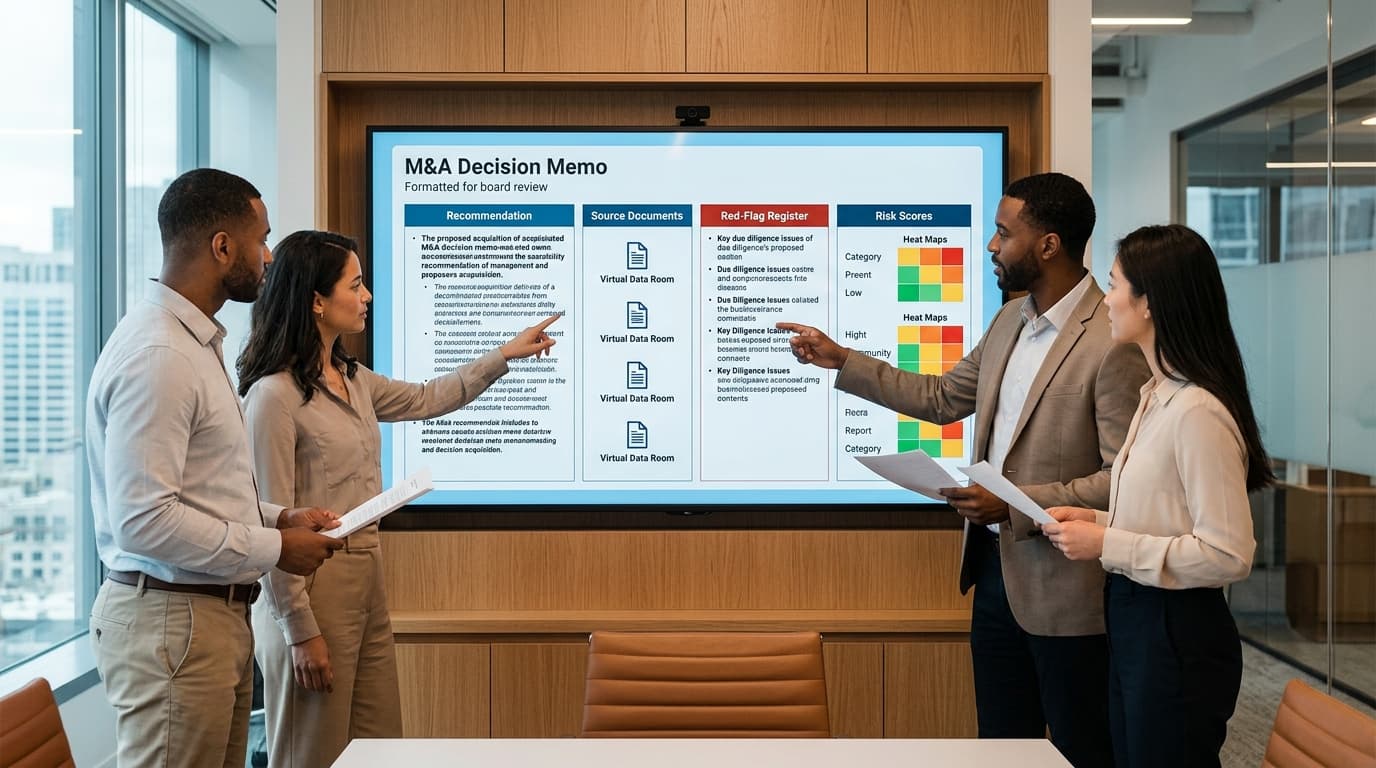
Modern deal teams leverage Report Builder to generate professional, investor-ready diligence reports with full source traceability, while using Collaboration Hub to coordinate legal, commercial, and financial workstreams in real time. Integrating automated document ingestion and structured risk intelligence turns complex public filings into decisive investment execution.
How Plausity supports the workflow
Evaluating newly public targets requires ingesting, reconciling, and auditing thousands of pages of SEC filings, Board packages, commercial contracts, and accounting schedules. Plausity provides an integrated due diligence environment designed to accelerate take-private reviews while maintaining complete source traceability.
Using Data Room Ingestion, deal teams rapidly process electronic data room archives, public EDGAR repositories, and financial spreadsheets. The core AI-Analysis Engine cross-references prospectus commitments against subsequent quarterly filings, flagging revenue recognition variances, non-GAAP reconciliations, and contract assignment risks in minutes.
To safeguard deal economics, Risk Radar evaluates flagged items against materiality, legal exposure, and valuation impact. Deal teams can isolate critical risks such as debt acceleration triggers or pending shareholder claims without relying on fragmented manual spreadsheets.