Why this matters now
Autonomous freight has shifted from speculative research and development into a commercially contracted reality. Market momentum accelerated markedly following Gatik's landmark achievements, including securing more than $600 million in contracted commercial revenue and surpassing 85,000 fully driverless customer orders across high-volume retail supply chains. For venture capital, growth equity, and corporate development deal teams, these milestones signal that physical AI deployment in logistics is no longer confined to isolated sandboxes.
The Shift to Commercial Scaling
The global autonomous truck market was valued at $42.91 billion in 2025 and is projected to expand from $46.58 billion in 2026 to $107.7 billion by 2034, registering a compound annual growth rate of 11.04%. When evaluated against the backdrop of over 12 million commercial freight vehicles operating across North America and Europe, even modest automation penetration represents massive capital redeployment. Deal teams evaluating this sector must navigate operational models that blend enterprise SaaS dynamics with complex physical operations, similar to the operational complexities observed in AI mobility carve-outs.
- Capital allocation is shifting away from unconstrained long-haul highway experiments toward bounded, high-frequency regional corridors.
- Enterprise shippers such as Walmart, Kroger, and Tyson Foods are transitioning from multi-month pilot evaluations into multi-year commercial commitments.
- Sovereign wealth funds and top-tier industrial strategics are anchoring growth rounds, demanding rigorous operational validation over synthetic benchmark demonstrations.
This commercial inflection alters the investment equation. Mobility tech investors can no longer rely purely on software growth multiples. Evaluating an autonomous carrier requires scrutinizing edge-case disengagement logs, maintenance capital intensity, and real-world asset utilization.
The Main Diligence Framework
Assessing a driverless trucking target demands a dual-lens diligence framework that bridges deep tech evaluation with heavy asset fleet management. Standard software metrics such as annual recurring revenue and gross retention fail to capture the true cash burn, compute overhead, and operational drag inherent in autonomous operations.
Tackling Driver Idle Time and Asset Economics
A primary driver of autonomous freight economics is the elimination of the 70 percent operational idle time typical of human-driven fleets, which are constrained by statutory hours-of-service limitations and mandatory rest cycles. Autonomous platforms unlock 20 to 24 hours of daily asset availability on recurring middle-mile routes. However, converting this continuous runtime into structural profitability depends on whether the company's sensor architectures and edge hardware can sustain extreme operational tempo without prohibitive replacement cycles, an essential consideration in AI software moat diligence.
- Operational Design Domain (ODD) Defensibility: Measure the geographic, meteorological, and infrastructure constraints within which the autonomous driver operates without human intervention.
- Fleet Architecture and Capex Intensity: Analyze whether the target pursues asset-heavy fleet ownership or an asset-light Autonomous-System-as-a-Service model partnering with established original equipment manufacturers.
- Total Cost of Ownership (TCO) Transformation: Evaluate fuel efficiency gains, teleoperation center labor ratios, sensor degradation schedules, and insurance premiums against traditional carrier cost baselines.
Investors must determine whether gross margins reflect genuine software leverage or are artificially inflated by deferred maintenance, unbooked remote-operator headcount, and subsidized carrier trials. Rigorous verification ensures projected EBITDA uplift rests on repeatable unit economics rather than aggressive accounting assumptions.
What Investors Should Test
Venture capital and private equity teams must execute structured validation across technical, commercial, and regulatory pillars before pricing a driverless trucking asset. Surface-level software demonstrations frequently obscure critical physical-world bottlenecks.
Key Areas for Rigorous Testing
- Edge-Case Safety and Simulation Coverage: Interrogate the target's closed-loop simulation environments and physical test-track validation logs. Confirm whether the software stack handles adverse weather, sensor occlusion, and unexpected construction zones deterministically rather than relying on unmonitored fallback behaviors.
- Middle-Mile and Tweener Lane Unit Economics: Verify lane profitability on routes ranging from 10 to 400 miles. Assess whether dock-to-dock routing is fully autonomous or requires human hostlers at distribution centers, as terminal handoffs can erode route-level margins.
- Teleoperation and Remote Assistance Ratios: Audit the exact ratio of remote human supervisors to deployed autonomous vehicles. If a single supervisor can manage only two or three trucks during nominal operations, the labor savings thesis collapses.
- Regulatory Readiness and State Permit Portability: Evaluate compliance with evolving state Department of Motor Vehicles regulations, local autonomous vehicle testing permits, and federal Department of Transportation safety self-assessments.
- Insurance Cost Projections and Loss History: Examine actuarial data, commercial fleet insurance structures, and loss run histories to verify whether insurance carriers are willing to underwrite driverless risk at parity with or discount to human-operated equivalents.
A comprehensive evaluation must also assess integration depth with enterprise supply chain systems, including modern freight broker software, to ensure the target can dynamically accept and execute automated freight dispatch orders without manual intervention.
Red-Flag Table
During technical and commercial due diligence, distinguishing between scalable market leadership and fragile operational pilots is vital. The matrix below outlines healthy operational signals alongside critical red flags that should prompt deal teams to adjust valuation models or mandate escrow protections.
| Diligence Dimension | Healthy Operational Signal | Investment Red Flag |
|---|---|---|
| Customer Contract Structure | Multi-year commercial agreements with volume commitments and indexed fuel/maintenance pass-throughs | Unpaid Memorandums of Understanding (MOUs) or open-ended pilots without commercial conversion milestones |
| Safety Validation & Disengagements | Public, auditable simulation benchmarks with decreasing critical disengagement rates across expanding operational domains | Opaque safety claims, unshared raw telematics, or high frequencies of unlogged emergency stop maneuvers |
| Teleoperation Dependency | One remote supervisor overseeing 15 to 20 nominal vehicles, intervening only during complex terminal exceptions | One-to-one or one-to-three human operator ratios acting as remote drivers rather than exception managers |
| Hardware Supply Chain & OEM Ties | Production agreements with tier-1 truck manufacturers and certified automotive-grade compute integrations | Bespoke, aftermarket sensor retrofits lacking automotive validation or dependable component supply channels |
| Liability & Insurance Allocation | Contractually defined liability structures with tier-1 commercial underwriters pricing risk against empirical safety data | Target absorbing unbounded primary liability or operating under temporary, non-renewable surplus lines insurance |
Deal teams that systematically cross-reference these indicators avoid paying software-level valuation multiples for operations that are fundamentally high-cost research labs with significant hardware drag.
Evidence Checklist and Data-Room Request List
To establish an audit-ready baseline and properly price operational risk, investment committees must mandate a comprehensive evidence pack from the target's data room. Structured information ingestion is the foundation for defensible underwriting.
Target Document Request Matrix
- Raw Safety Telematics and Disengagement Logs: Time-series sensor data, edge-case failure logs, simulation-to-real correlation reports, and complete historical safety driver intervention records.
- Customer Contracts and Service Level Agreements (SLAs): Fully executed multi-year shipper contracts, lane commitment schedules, guaranteed on-time delivery thresholds, and penalty clauses for delayed shipments.
- Hardware Maintenance and Bill of Materials (BOM): Component-level replacement schedules, sensor degradation models, compute hardware thermal failure rates, and long-term procurement agreements with tier-1 automotive suppliers.
- Actuarial Loss Runs and Insurance Policies: Primary and excess commercial liability policies, formal insurer risk engineering reports, claims histories, and documented subrogation frameworks with equipment manufacturers.
- Regulatory Filings and Compliance Audits: State and federal autonomous vehicle operating permits, National Highway Traffic Safety Administration (NHTSA) safety filings, and documented emergency response procedures.
Extracting and verifying these records ensures that risk assessments reflect empirical performance data rather than curated marketing presentations. Deal teams benefit substantially from implementing structured risk register automation early in the evaluation cycle.
How Plausity Supports the Workflow
Conducting due diligence on autonomous freight companies requires processing thousands of technical schematics, carrier agreements, and telematics reports under strict deal deadlines. Plausity provides an integrated AI-native due diligence environment designed to streamline and accelerate these complex evaluations.
Accelerated Analysis and Risk Intelligence
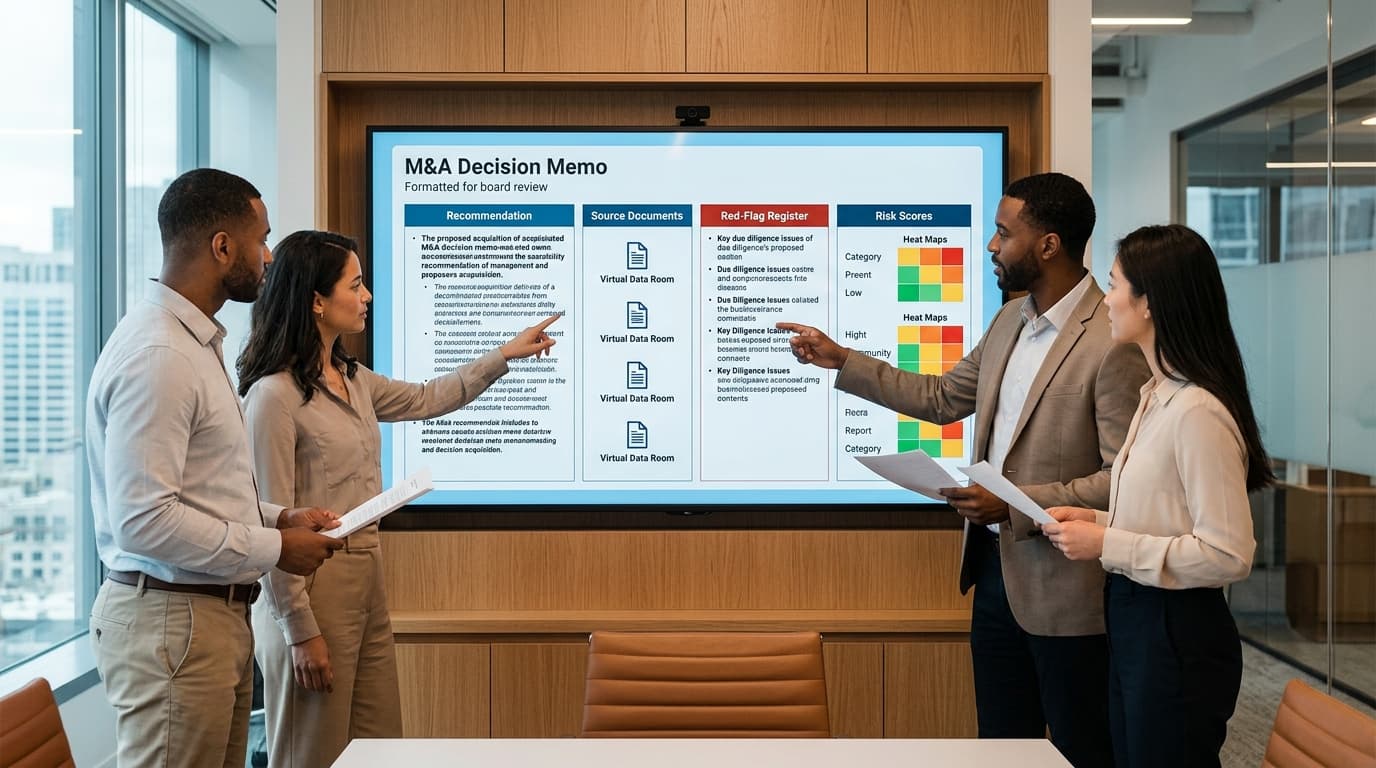
The workflow begins with Data Room Ingestion, which connects directly to virtual data rooms to parse, OCR, and organize complex technical specifications, regulatory filings, and long-form freight contracts in minutes. Once ingested, the AI-Analysis Engine performs deep cross-document analysis, cross-referencing shipper service level agreements against historical on-time delivery telematics to identify performance anomalies.
- Automated Contract Risk Detection: Pinpoints restrictive liability terms, unhedged shipper indemnities, and termination-for-convenience clauses across legacy customer files.
- Materiality-Based Risk Scoring: Utilizes Risk Radar to categorize technical debt, hardware supply chain dependencies, and regulatory non-compliance by financial and deal materiality.
- Cross-Workstream Alignment: Coordinates technical, legal, and commercial diligence tracks in real time through the Collaboration Hub, ensuring all advisers evaluate identical verified data points.
By connecting unstructured technical data with commercial contract analysis, deal teams can uncover hidden operational friction points well before the investment committee convenes.
How to Use This in Your Next Diligence Workflow
Translating an autonomous freight diligence framework into actionable deal execution requires a systematic, repeatable process. Deal teams should apply these structured stages in upcoming mobility and logistics automation transactions to ensure complete coverage.
Step-by-Step Implementation Roadmap
- Scope the Operational Boundaries: Establish the target company's exact Operational Design Domain boundaries, examining route topologies, weather envelopes, and physical dock constraints during initial screening.
- Automate Data Ingestion and Contract Extraction: Deploy Data Room Ingestion to rapidly structure incoming technical disclosures, shipper agreements, and maintenance histories.
- Run Automated Cross-Referencing: Execute deep queries with the AI-Analysis Engine to reconcile claimed unit economics against raw vehicle utilization logs and teleoperation staffing models.
- Synthesize Key Findings with Report Builder: Generate structured, investor-ready investment committee memorandums and diligence summaries using Report Builder, maintaining full source traceability back to data room records.
- Price Quantified Risks into Deal Terms: Translate surfaced liability gaps and capital expenditure requirements into valuation adjustments, special indemnity escrows, or post-close operational milestones.
Adopting this structured framework enables venture capital, growth equity, and corporate development professionals to underwrite autonomous freight transactions with speed, precision, and institutional rigor.