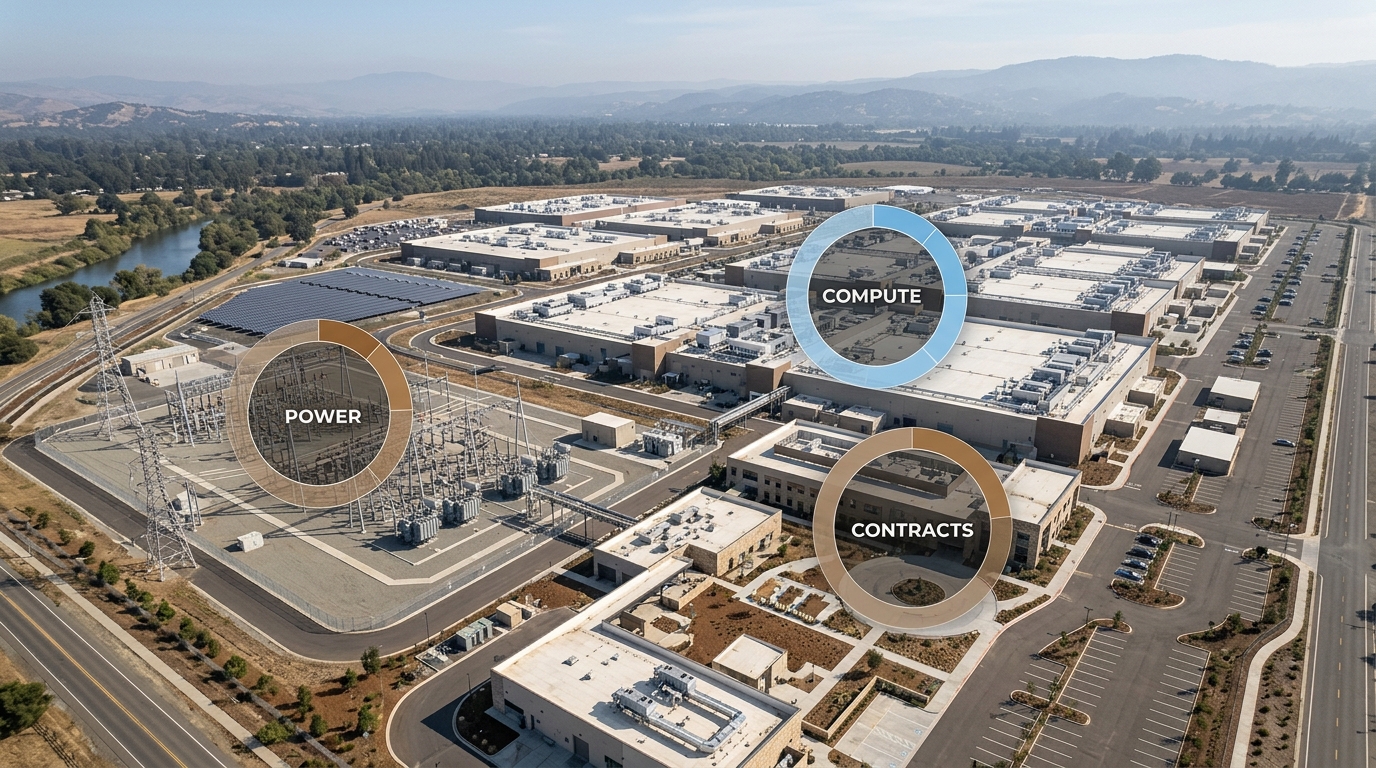
Why AI infrastructure underwriting differs from generic data-center underwriting
What should investors diligence before underwriting an AI infrastructure or AI data-center investment? Four things above all: the power that physically gates the asset, from contracted megawatts to energization timing; the compute fleet's generation mix, utilization and realistic useful life; the concentration and credit quality of the counterparties buying the capacity; and the contract terms, refresh capex and financing structure that determine whether cash flows survive a slower adoption curve. A generic data-center checklist covers site, connectivity and tenant covenants. An AI facility adds a second, faster-depreciating asset stack on top of the building, and the economics of that stack, not the shell, decide whether the investment works.
The scale of the build-out explains why the diligence bar must rise. industry research estimates that data centers equipped to handle AI processing loads alone could require $5.2 trillion in capital expenditures by 2030, part of a $6.7 trillion global compute race. Deloitte projects that US AI data-center power demand could grow more than thirtyfold, from 4 GW in 2024 to 123 GW by 2035, and notes that the largest campuses that hyperscalers are planning reach up to 2 GW, with early-stage 50,000-acre campuses that could consume 5 GW.
The capex pattern also inverts classic infrastructure economics. PwC's Global Data Centre Outlook projects $31.6 trillion of cumulative capex through 2050 and calculates that every $1 of construction spending commits roughly $12 of subsequent ICT equipment investment, with ICT equipment rising from about 70% of total data-center capex in 2026 to 93% by 2050. The durable asset is increasingly the building and the power; the revenue-generating asset is the equipment inside it, which turns over continuously.
Finally, the buyer mix has widened beyond the hyperscalers. Neoclouds, model developers, enterprises and governments now lease AI capacity, each with a different credit profile, contract discipline and demand durability. PwC describes data centers as hybrid assets with a complicated risk profile, and warns that the build-out will not lift all boats: capturing the economics requires active positioning. The sections that follow break the resulting diligence into testable dimensions.
Power availability and energization: the evidence investors must require
Contracted power is the gating diligence item for any AI facility, because a data center without energized megawatts is a shell with a delivery risk attached. The first distinction to force in the data room is between contracted MW and energized MW: a power purchase agreement or utility letter of intent is not delivered capacity. Deloitte's 2025 AI Infrastructure Survey found there is currently a seven-year wait on some requests for grid connection, and that 72% of surveyed power company and data-center executives rate power and grid capacity as very or extremely challenging, the leading obstacle to data-center development.
- Interconnection position: queue number, queue region, and the utility's own published energization timeline, tested against the contract ramp of the anchor tenants. If tenants' minimum commitments start before energization, the operator is buying delay risk it cannot control.
- Power pricing: the contracted $/MWh or demand-charge structure, escalation clauses, and pass-through of utility tariff changes. In markets where residential rates have already risen faster than the national average, political tolerance for subsidizing data-center load is thinning.
- Redundancy and resilience: N-level redundancy for power and cooling, backup generation capacity, and the grid-stress record of the region. Deloitte documents harmonic distortions, load-relief warnings and near-miss incidents in leading data-center growth regions.
- Behind-the-meter and on-site generation: gas turbines, fuel cells or geothermal that bypass the interconnection queue, with their own permitting, fuel-supply and emissions constraints priced in.
Renewable and regulatory commitments deserve their own workstream. Hyperscalers are the leading buyers of renewable power purchase agreements and have set clean-energy targets, yet Deloitte found that load growth in top data-center markets has recently been met primarily with increased gas generation, and that 95% of the interconnection queue consists of renewables and storage projects that are largely stuck. Permitting is a second clock: it still takes more than two years to complete an environmental impact statement in the US, and state-level restrictions on projects have multiplied over the past year. For an asset whose revenue contracts run a decade or more, a two-year permitting slip or a state policy reversal is a material underwriting variable, not a footnote.
Compute capacity: fleet mix, utilization and vendor concentration
The compute stack is where AI infrastructure departs furthest from real-asset orthodoxy. Start with the fleet itself: which GPU generations are deployed, in what mix, at what contracted utilization, and how exposed the operator is to a single vendor. Nvidia now releases new AI chips on an annual basis, down from a two-year cadence, and AMD has followed suit. An annual architecture cycle compresses the window in which any given fleet commands premium pricing.
That makes the useful-life assumption the most contested number in the model. CoreWeave has used six-year depreciation cycles for its infrastructure since 2023, and Google, Oracle and Microsoft have pegged server lifespans at up to six years, with Microsoft's latest annual filing disclosing a range of two to six years. Short seller Michael Burry argues the realistic useful life of AI server equipment is closer to two to three years, and that the largest hyperscalers are therefore understating depreciation. The counterargument is not trivial: CoreWeave's chief executive notes its 2020-vintage A100 chips remain fully booked, and a batch of 2022 H100s was re-let at 95% of original pricing after a contract expired. Both can be true: chips stay rentable, but at falling rates.
Customer concentration and counterparty credit quality
Who buys the capacity, and on what terms, determines whether contracted revenue is an asset or an option. Concentration in AI infrastructure is extreme by the standards of any other infrastructure class. Nscale's IPO filing disclosed more than $103 billion of contracts, roughly 85% of which is concentrated in two counterparties: $43.8 billion with Microsoft through 2033 and $44.6 billion with Anthropic. The same reporting notes CoreWeave generates 67% of its revenue from Microsoft, and Applied Digital derives 67% of its revenue from Oracle. A credit paper by hedge fund Sona Asset Management, featured in the trade press, found that many AI infrastructure providers depend heavily on a small number of customers, and that a single setback or strategic shift by a major player can affect the entire industry.
Counterparty credit quality and conditionality matter as much as headline backlog. Nscale's IPO filing states that its agreements with Microsoft and Anthropic, worth up to $43.8 billion and approximately $44.6 billion respectively, are subject to delivery and service availability requirements. Diligence should therefore separate signed, unconditional revenue from commitments that depend on the operator delivering capacity on schedule, and stress the latter against the counterparty's own funding needs. A $44.6 billion contract with a model developer that itself depends on continued capital-market access is a different credit from a $43.8 billion investment-grade hyperscaler commitment, even at the same notional.
Contract structure: take-or-pay, tenor and termination rights
Contract structure converts concentration into either protection or exposure. The terms to test:
- Take-or-pay obligations: does the buyer pay for reserved capacity whether or not it draws, or only for consumed compute?
- Minimum commitments: the floor revenue per year, and whether the floor survives a downgrade or ownership change at the customer.
- Tenor versus asset life: a six-year contract against a fleet the vendor refreshes annually leaves the tail years exposed to repricing.
- Renewal terms: renewal options priced at market, at a discount, or at all; and who holds the option value.
- Price escalation: fixed escalators, indexation, or flat pricing in a market where input costs and chip performance are both moving fast.
- Termination and walk-away rights: termination for convenience, milestone-linked cancellation rights, and change-of-control triggers, which determine how real the backlog is.
Capex requirements: initial build versus continuous refresh
Capital structure and delivery risk should be underwritten together, because both determine whether the asset that energizes is the asset that was financed. The first discipline is to separate initial construction capex from continuous refresh capex. PwC's central scenario projects $31.6 trillion of cumulative data-center capex through 2050, with annual spend rising from roughly $800 billion in 2026 to $1.8 trillion by 2050, driven by recurring upgrades of chips and other ICT equipment every few years. A model that treats the construction budget as the capital requirement understates the true commitment by the multiple that PwC estimates at roughly $12 of ICT capex per $1 of construction.
Debt and financing risk
Debt and financing risk is where the scenario converges. The tests to run: sensitivity of coverage ratios to interest cost at refinancing; the cost of a 12- and 24-month construction delay given transformer and interconnection timelines; utilization and contract-ramp assumptions against the energization date; and the refinancing wall that lands when the first GPU generation is written down. The systemic dimension is no longer hypothetical. The Financial Stability Board estimates private credit has grown to between $1.5 trillion and $2 trillion in assets and warns that its concentration in sectors including technology, and its leverage and liquidity structures, could amplify stress in adverse scenarios. Reporting on the FSB's work noted that the AI industry accounted for more than a third of private credit deal activity, meaning an AI-demand disappointment would not be contained within the equity.
Technology obsolescence and asset-life assumptions
Debt and financing risk is where the scenario converges. The tests to run: sensitivity of coverage ratios to interest cost at refinancing; the cost of a 12- and 24-month construction delay given transformer and interconnection timelines; utilization and contract-ramp assumptions against the energization date; and the refinancing wall that lands when the first GPU generation is written down. The systemic dimension is no longer hypothetical. The Financial Stability Board estimates private credit has grown to between $1.5 trillion and $2 trillion in assets and warns that its concentration in sectors including technology, and its leverage and liquidity structures, could amplify stress in adverse scenarios. Reporting on the FSB's work noted that the AI industry accounted for more than a third of private credit deal activity, meaning an AI-demand disappointment would not be contained within the equity.
AI-demand scenario testing without forecasting demand
No investor can credibly forecast AI demand, and the published forecasts diverge too widely to arbitrage: PwC's own scenario range for cumulative capex runs from roughly $22 trillion to nearly $50 trillion through 2050, a spread wide enough to swallow most underwriting assumptions. The disciplined alternative is to anchor scenarios to observable, contract-level inputs rather than demand curves, and to ask what has to be true for each case to clear its return threshold.
- Base case: contracted ramp as signed, renewal of a majority of expiring contracts at market pricing, power cost per the utility tariff, utilization per the operator's own historical fleet data. The test: does the deal clear hurdle on contracted cash flows alone, before any speculative upside?
- Upside case: faster ramp, premium renewals, higher utilization from inference growth. The test: how much of the upside is already priced into the entry multiple, and does the upside case require capex the capital plan has not yet funded?
- Downside case: slower adoption, renewal rates at or below market, flat or falling compute pricing as newer architectures arrive, and a refinancing at wider spreads. The test: breakeven utilization, and whether later-year refresh capex remains fundable if adoption slows.
The final question is which assets each downside strands. Power infrastructure, interconnection rights and permitted capacity are scarce regardless of which vendor's chips win, and PwC identifies power as the decisive factor directing where AI investment flows. Compute equipment is the opposite: it is the layer most exposed to obsolescence and repricing. industry research's analysis of the build-out explicitly flags the risk of overbuilding, noting that future demand is uncertain and that investors face the twin dangers of missing growth and building capacity that goes unserved. A downside scenario that strands compute but preserves contracted power and a creditworthy tenant is a very different loss from one that strands both. Diligence should say which one the deal structurally resembles.
Evidence checklist and running the diligence process
The framework compresses into a single table that a deal team can run across every AI infrastructure target, with each dimension tied to a document request, a red flag and a downside implication.
Obsolescence is economic before it is physical. A five-year-old GPU can be fully functional and still lose its pricing power when a newer architecture delivers better performance per dollar and per megawatt; Nvidia's own chief executive joked that when Blackwell ships in volume, "you couldn't give Hoppers away". The diligence test is therefore a mismatch test: does the depreciation schedule and debt tenor assume a longer productive life than the vendor's release cadence supports? PwC's modelling assumes servers, GPUs and networking equipment are replaced every few years, which is why ICT equipment dominates long-run capex. An asset-life assumption at the optimistic end of that range, financed with ten-year debt, embeds a refinancing event precisely when the collateral is weakest.
Supply-chain dependency: GPUs, transformers, cooling and labor
| Dimension | What to test | Evidence | Red flag | Downside implication |
|---|---|---|---|---|
| Power | Contracted vs energized MW; queue position; energization timing vs contract ramp; power pricing and escalation; redundancy; renewable and permitting commitments | Interconnection agreements, utility letters, PPA terms, permitting records | Contract ramp starts before energization; seven-year queue positions; state restrictions pending | Revenue commitments met with undelivered power; curtailment or delay penalties |
| Compute | GPU generation mix; utilization; vendor concentration; useful-life assumption vs refresh cadence | Fleet schedules, depreciation disclosures, vendor roadmap, utilization reports | Six-year asset life against an annual chip cycle; single-vendor fleet | Accelerated write-downs; collateral value below debt at refinancing |
| Contracts and concentration | Share of backlog per counterparty; credit quality; contingent vs unconditional revenue; take-or-pay, tenor, renewal, escalation, termination rights | Signed MSAs, backlog disclosures, counterparty financials, milestone schedules | Majority of backlog with one or two counterparties; milestone-linked cancellation rights | Backlog evaporates on one counterparty setback; covenant breach at the operator |
| Capex | Initial construction capex vs continuous refresh capex; funding of later-year refresh | Capex model, PwC-style ICT ratio, capital plan through 2030s | Refresh capex unfunded beyond year three | Asset becomes uncompetitive mid-debt-term; forced equity injections |
| Financing | Interest-cost sensitivity; construction delay cost; utilization and ramp assumptions; refinancing wall | Debt term sheets, sensitivity models, hedging policy | Coverage dependent on upside-case utilization; refinancing lands at first GPU write-down | FSB-flagged stress amplification across private credit portfolios |
| Supply chain | Transformer, GPU, cooling and labor lead times; procurement strategy | Purchase orders, factory-slot agreements, labor plans | Four-year transformer lead times unbudgeted; no secured production slots | Extended construction interest; energization slips past contract start dates |
Running this checklist across thousands of data-room documents, contracts and models is itself the bottleneck in most deal processes. This is where a structured diligence platform earns its place in the workflow. Plausity's platform supports the full workstream set this framework implies: Commercial DD, Financial DD, Tech DD, ESG DD, and Regulatory & Compliance DD, together with Evidence Gap Detection that surfaces which of the requests above the data room cannot yet answer. Under the hood, Data Room Ingestion connects to VDRs and processes contracts, spreadsheets and financial models within minutes; the AI-Analysis Engine reads, cross-references and reasons over those documents; Risk Radar evaluates findings by materiality, financial impact and deal relevance; Report Builder drafts investor-ready deliverables with full source traceability; and the Collaboration Hub keeps the deal team and advisors aligned in real time. Plausity offers a demo of this workflow on request.
How Plausity accelerates this workflow
Plausity is an AI-native due diligence and deal intelligence workspace that helps M&A advisory firms, VC and PE funds, corporate development teams and investment-banking teams structure evidence, findings and questions across a data room. Plausity supports evidence extraction, source grounding, findings management and IC preparation — it does not replace human analysts, advisers or investment professionals, does not provide legal, tax, audit, regulatory or investment advice, and does not make autonomous investment decisions. All findings require human review. Built for today's investment and deal teams. Trusted by >200 firms.
To explore the underlying capabilities, see the Plausity AI analysis engine, findings and risk intelligence and evidence gap detection product pages, plus the IC memo and AI Q&A Assistant product pages. For team-level workflows, see how VC and PE funds and M&A advisory firms use Plausity across live deals, and how AI Impact due diligence, value creation, Tech DD and Commercial DD workstreams support the analysis.