What an AI Analyst Actually Does in Due Diligence
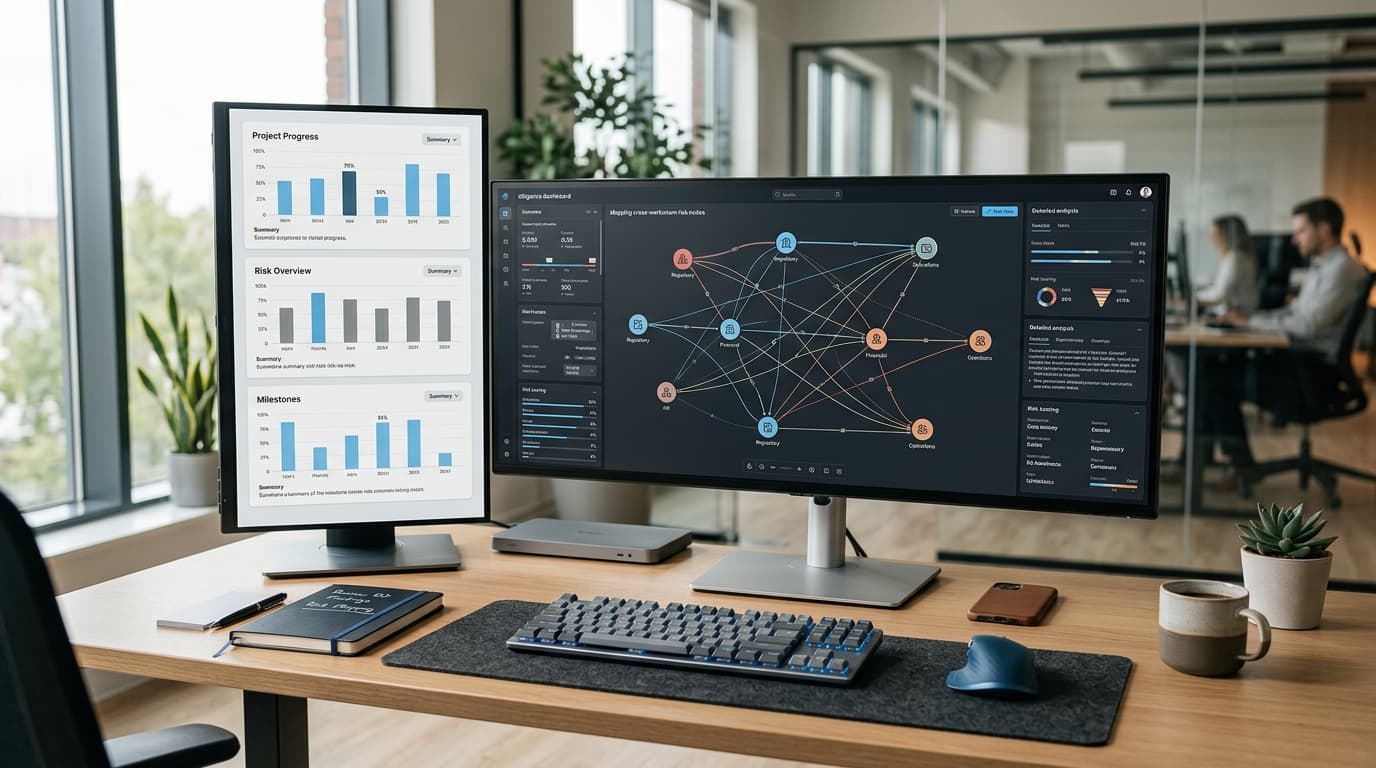
An AI analyst in due diligence is a specialized computational system designed to ingest, parse, cross-reference, and organize unstructured deal information across virtual data rooms. Rather than operating as an autonomous decision-maker or replacing investment professionals, an AI analyst functions as an institutional-grade research and synthesis engine. It extracts verifiable evidence, evaluates contractual obligations, identifies cross-document discrepancies, and organizes raw disclosures into audit-ready findings for deal teams.
In high-velocity transaction environments, the primary bottleneck is rarely financial modeling; it is the time required to read, verify, and reconcile thousands of fragmented documents under tight exclusivity deadlines. A survey by Deloitte revealed that 86% of corporate and private equity leaders have integrated generative AI into their M&A workflows to handle deal data and accelerate evaluation cycles. By handling mechanical extraction and multi-file reconciliation, an AI analyst allows investment committees and M&A advisory firms to focus on thesis validation, commercial judgment, and risk pricing.
| Core Diligence Task | Traditional Manual Approach | AI Analyst Execution |
|---|---|---|
| Document Intake & Indexing | Manual folder browsing and naming triage across thousands of files | Automated parsing, OCR extraction, and multi-format document classification |
| Evidence Extraction | Ad hoc copying and pasting quotes into disconnected spreadsheets | Direct extraction with exact citation tokens tied to source document coordinates |
| Cross-File Reconciliation | Manual cross-checks between pitch decks, contracts, and financial models | Automated detection of factual, structural, and numerical contradictions across workstreams |
| Risk Registering | Manual risk logging based on selective sampling and analyst memory | Continuous risk indexing with severity categorization and audit-ready traceability |
Crucially, an AI analyst operates under deterministic constraints rather than unconstrained generation. Every finding, data point, and flagged risk is anchored directly to source files in the data room, ensuring that investment associates, partners, and external legal counsel can audit every claim in seconds without relying on black-box summaries.
Why This Matters for Deal Teams Under Pressure
Transaction teams operate under acute structural pressure defined by compressed exclusivity windows, expanding compliance requirements, and increasingly voluminous disclosure packages. Sellers routinely upload thousands of unstructured files, including scanned legacy contracts, unstandardized financial reports, customer schedules, and regulatory filings. Human deal teams face an onerous translation tax: spending dozens of hours converting unstructured seller disclosures into structured formats before substantive analysis can even begin.
Because of finite time and staffing constraints, traditional diligence workflows are often forced to rely on sampling. Analysts review only a fraction of customer agreements, supplier contracts, or operational logs, creating significant blind spots around hidden liabilities, change-of-control provisions, customer concentration risks, and non-standard indemnities. In PwC's Private Equity Trend Report 2026, based on a survey of 250 partners and managing directors at European private equity firms, 83 per cent said they intend to deploy data analytics and generative AI in due diligence in 2026, against 65 per cent in 2025.
- Mitigates the translation tax: Eliminates manual re-keying, table reformatting, and repetitive cross-referencing across messy vendor data.
- Eliminates selective sampling: Expands document review coverage to every available data room file instead of relying on narrow statistical samples.
- Reduces deal execution fatigue: Prevents junior analyst burnout caused by repetitive manual indexing, enabling teams to allocate intellectual capital to strategic evaluation.
- Accelerates question generation: Generates targeted, highly contextual buyer inquiry lists for management meetings days earlier in the diligence cycle.
By expanding analytical coverage across the entirety of a data room, deal teams protect their investment thesis from late-breaking surprises that could derail transaction negotiations or erode post-acquisition value.
The Framework: Human Judgment vs. AI Processing
Deploying an AI analyst successfully requires an explicit division of labor between deterministic machine processing and probabilistic human judgment. AI models excel at high-volume data ingestion, pattern recognition, systematic cross-referencing, and structural anomaly detection. Conversely, human dealmakers possess the domain expertise, contextual intuition, and commercial negotiation capabilities required to interpret what those findings mean for asset valuation.
An effective framework assigns mechanical, high-entropy tasks to the AI while reserving strategic synthesis for investment professionals. The AI analyst ingests multi-format inputs, maps charts of accounts, extracts standard and non-standard covenants, and flags missing files. The investment committee uses these structured outputs to formulate the investment thesis, evaluate management credibility, assess competitive positioning, and execute transaction terms.
| Diligence Dimension | AI Processing Responsibility | Human Professional Ownership |
|---|---|---|
| Financial Verification | Reconciling trial balances, general ledgers, and revenue sub-ledgers | Assessing quality of earnings adjustments and sustainable margin trajectories |
| Legal & Governance | Extracting assignment clauses, termination rights, and litigation records | Evaluating legal exposure, negotiating reps and warranties, and structuring indemnities |
| Commercial Diligence | Aggregating customer cohort data, churn schedules, and contract values | Validating customer relationships, pricing power, and market defensibility |
| Thesis Formation | Identifying operational variances and missing data room disclosures | Synthesizing macro trends, strategic fit, and ultimate capital allocation decisions |
By establishing clear boundaries, deal teams avoid the pitfalls of over-automation while capturing the speed and rigor of digital processing across all transaction workstreams.
Practical Workflow: The AI-Assisted Diligence Process
Implementing an AI analyst transforms the traditional, linear due diligence timeline into a continuous, parallelized workflow. Instead of waiting days for initial document sorting and indexing, deal teams can initiate structured analysis immediately upon receiving data room credentials through modern AI diligence workflows.
- Automated Ingestion and Indexing: The platform connects to the virtual data room, scans all uploaded files, runs optical character recognition on scanned PDFs, and classifies documents by workstream (corporate legal, commercial, financial, HR, IP, and regulatory).
- Entity and Clause Extraction: Specialized extraction algorithms identify key entities, dates, governing law, revenue figures, debt instruments, indemnification caps, and termination provisions across every file.
- Cross-Workstream Reconciliation: The system compares data points across separate files, verifying whether numbers cited in the confidential information memorandum match audited financial statements and customer schedules.
- Risk Logging and Prioritization: Discrepancies, non-standard terms, missing documentation, and potential regulatory liabilities are automatically tagged with severity scores and compiled into a dynamic risk register.
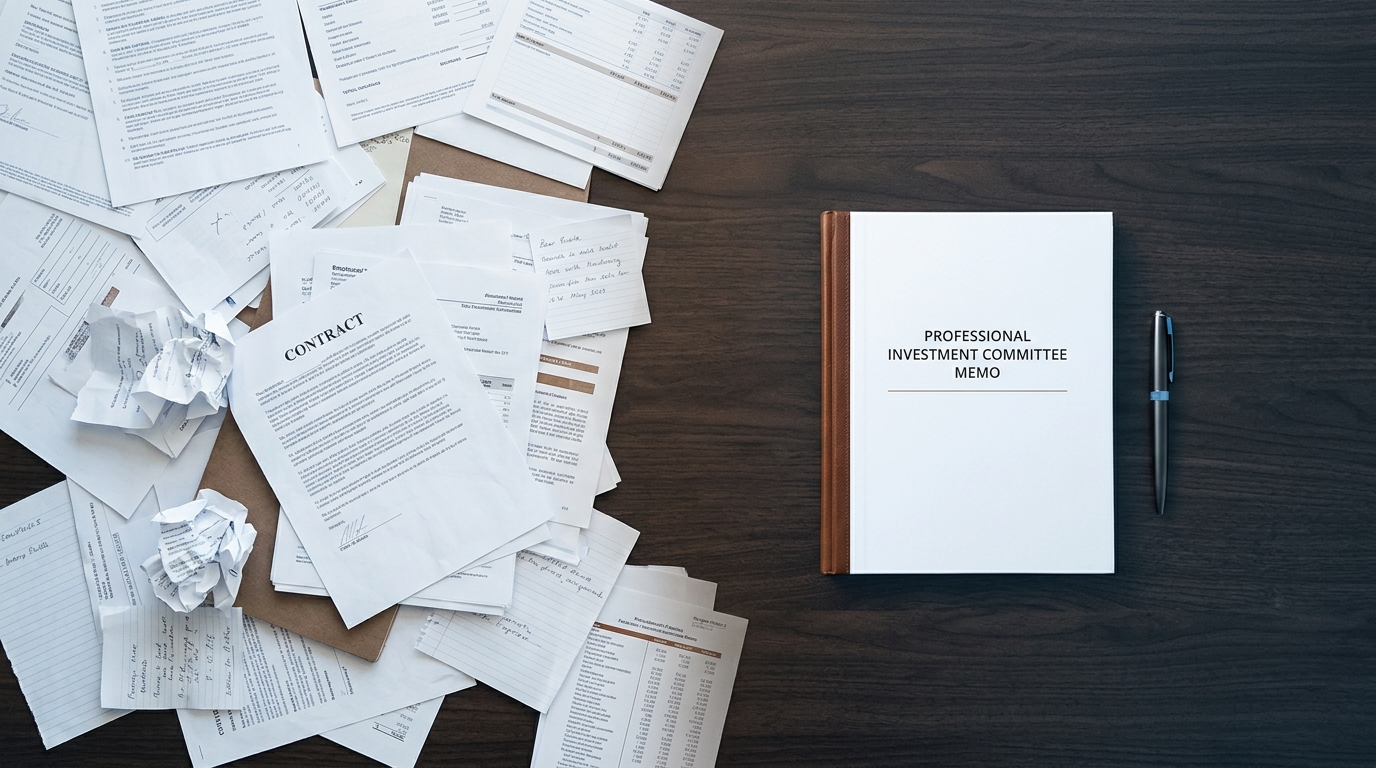
- Deliverable Synthesis and IC Preparation: Extracted findings, source-grounded evidence packs, and structured summary blocks are assembled to accelerate the drafting of the investment committee memo.
This structured sequence ensures that information is never siloed within individual workstreams. When legal analysts identify an intellectual property dispute, that finding is immediately visible to financial analysts assessing contingent liability reserves, creating seamless cross-functional alignment for private equity professionals.
Red-Flag Identification and Evidence Extraction
The most critical function of an AI analyst is uncovering hidden risks, omissions, and contradictions buried deep inside unstructured files. In complex transactions, material risks rarely present themselves in prominent overview documents; they are typically concealed within contract exhibits, side letters, unlinked footnotes, or contradictory disclosure schedules.
Unlike traditional keyword searches that fail when terminology varies, semantic analysis identifies conceptual anomalies. For instance, an AI analyst can recognize restrictive covenants or change-of-control triggers regardless of whether they are labeled as assignment clauses, ownership restrictions, or transfer limitations. Furthermore, the engine tracks negative space: by comparing provided documents against standard diligence checklists, it immediately identifies critical missing schedules or incomplete audit periods.
| Risk Category | Potential Hidden Red Flag | AI Detection Mechanism |
|---|---|---|
| Customer Concentration | Side letter granting top customer immediate termination for convenience | Semantic clause extraction across customer contract exhibits and amendments |
| Revenue Recognition | Discrepancy between pitch deck ARR and executed customer schedule billings | Automated cross-document reconciliation between marketing decks and contract ledgers |
| Regulatory & Compliance | Pending litigation matter referenced only in an unindexed board minute footnote | Full-text contextual search and cross-referencing across governance archives |
| Change of Control | Ownership change penalty embedded in a supplier master services agreement | Automated covenant classification and materiality tagging across vendor contracts |
By coupling automated detection with deterministic source coordinates, the system converts raw disclosures into an organized risk intelligence register where every observation is directly verifiable against the underlying document.
How Plausity Supports the Workflow
Plausity is an AI-native due diligence platform designed specifically for investment professionals, corporate development teams, and M&A advisers. The platform unifies the core analytical workflows required during rigorous deal evaluations into a collaborative, audit-ready operating system.
The platform streamlines due diligence through five integrated modules tailored to deal workflows:
- Data Room Ingestion: connects directly to data room environments, ingesting and classifying thousands of PDFs, spreadsheets, contracts, and financial records in minutes without manual data entry.
- AI-Analysis Engine: The core AI-Analysis Engine reasons across thousands of documents simultaneously, extracting structured evidence, reconciling cross-file data points, and surfacing contractual commitments.
- Risk Radar: Risk Radar evaluates every identified finding based on materiality, financial exposure, and legal risk, prioritizing critical anomalies for deal leads.
- Report Builder: Report Builder automatically structures and drafts comprehensive, source-traceable due diligence deliverables and investment committee memos.
- Collaboration Hub: Collaboration Hub coordinates deal team workstreams in real time, assigning review items, tracking diligence progress, and maintaining institutional knowledge.
Through this integrated architecture, deal teams can maintain analytical depth across every file while operating at the pace demanded by competitive transaction processes.
How to use this in your next diligence workflow
Transitioning to an AI-assisted due diligence workflow does not require an all-or-nothing operational overhaul. Teams can drive immediate value by implementing a structured, phased adoption plan on upcoming transaction opportunities.
- Define Core Thesis Drivers: Prior to accessing the data room, establish the critical value drivers, risk thresholds, and specific questions that the investment committee must validate.
- Configure Deterministic Rules: Set baseline extraction parameters, workstream taxonomies, and materiality thresholds to ensure the AI analyst indexes files according to your firm's specific evaluation criteria.
- Pilot on High-Volume Workstreams: Begin by deploying the AI analyst on document-dense workstreams such as commercial contract review, employment agreement triage, or financial schedule reconciliation.
- Iterate with Expert Validation: Have senior associates and sector specialists review the AI-generated findings, using inline source citations to verify evidence before incorporating it into committee deliverables.
- Institutionalize Findings: Retain the structured risk registers and evidence packs generated during diligence to accelerate post-close integration planning and value creation tracking.
By embedding structured AI capabilities into repeatable diligence practices, deal teams achieve complete document coverage, surface material risks earlier, and execute transactions with greater institutional confidence.
How Plausity accelerates this workflow
Plausity is an AI-native due diligence and deal intelligence platform that helps M&A advisory firms, VC and PE funds, corporate development teams and investment-banking teams structure evidence, findings and questions across a data room. Plausity supports evidence extraction, source grounding, findings management and IC preparation — it does not replace human analysts, advisers or investment professionals, does not provide legal, tax, audit, regulatory or investment advice, and does not make autonomous investment decisions. All findings require human review.
To explore the underlying capabilities, see the Plausity AI analysis engine and the findings and risk intelligence product page. For team-level workflows, see how VC and PE funds and M&A advisory firms use Plausity across live deals.