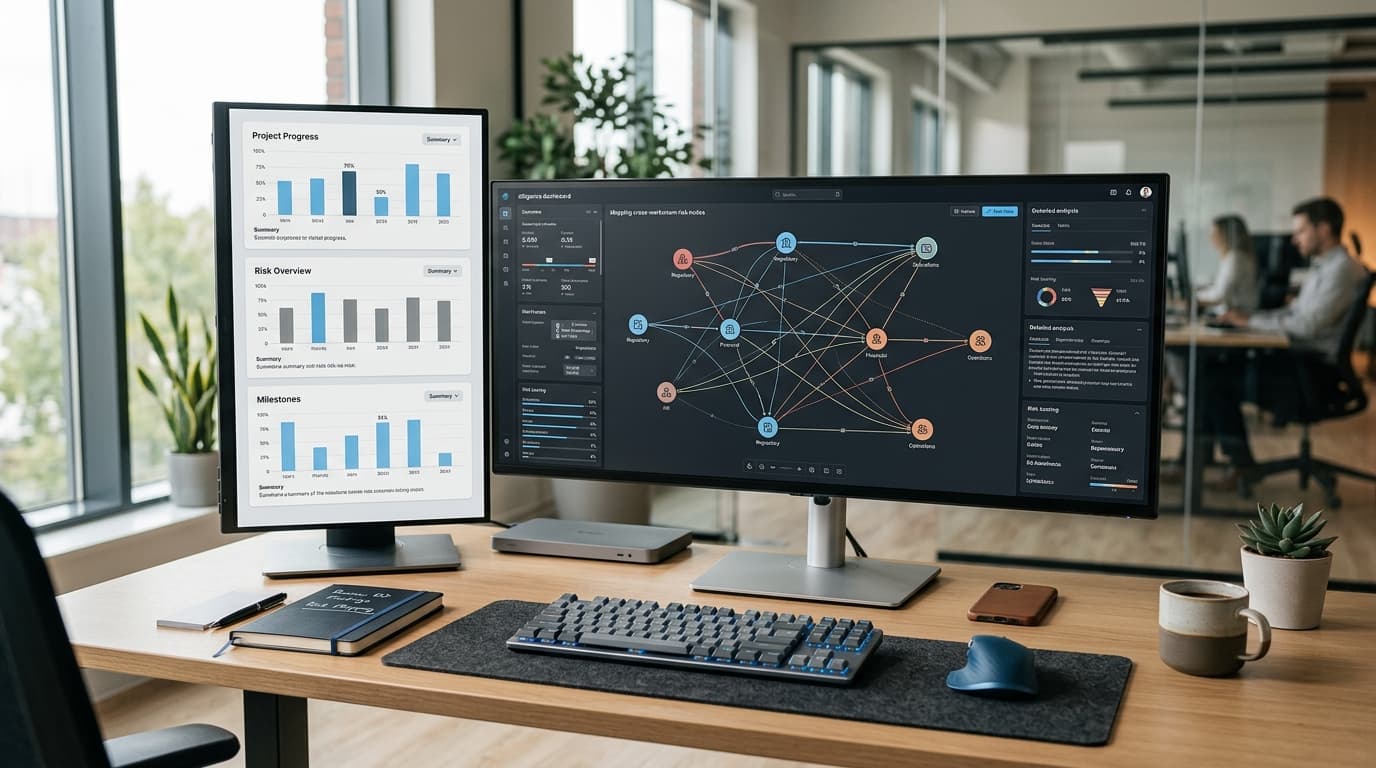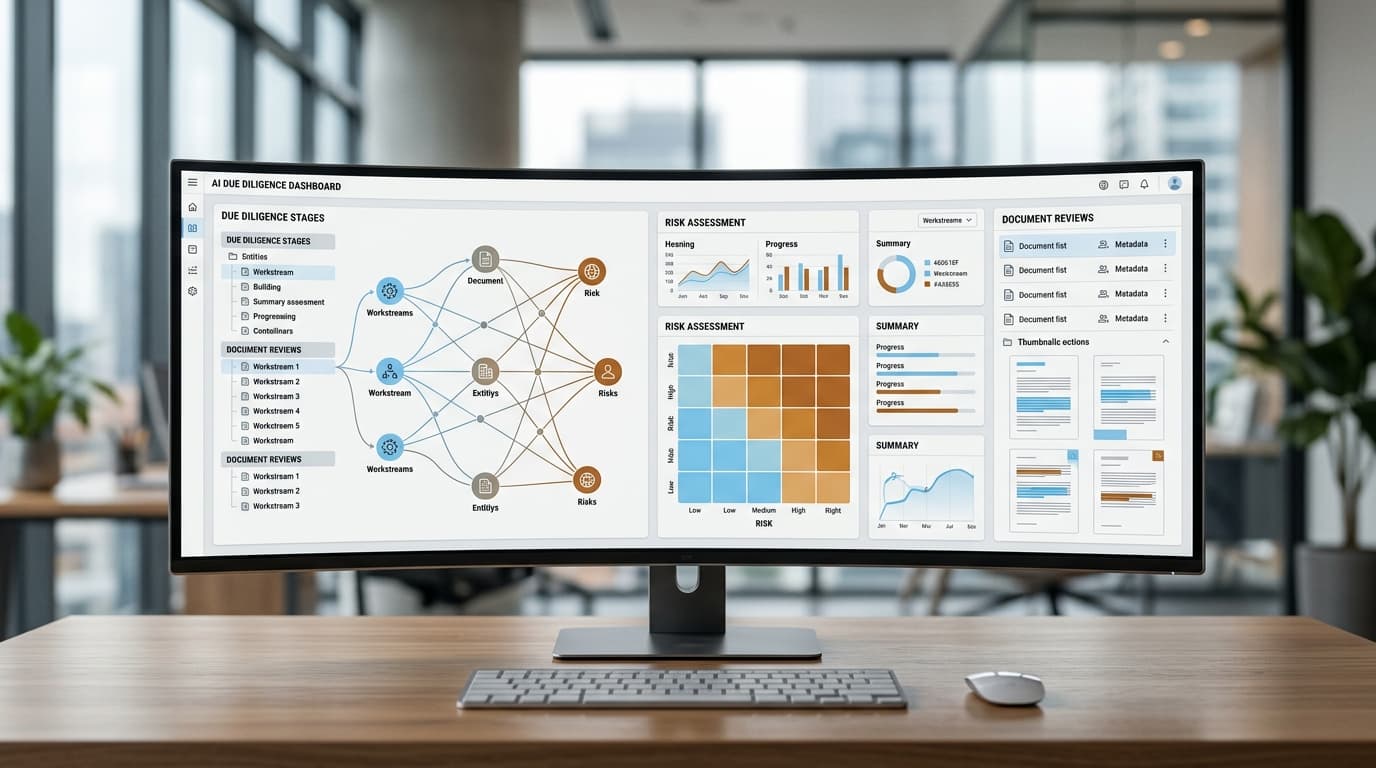
The Cost of Siloed Due Diligence Workstreams
Siloed due diligence occurs when legal, financial, commercial, and operational teams analyze a target company in isolated workstreams, creating fragmented findings across disconnected spreadsheets, email threads, and local notes. This structural fragmentation prevents cross-functional risk discovery, multiplies redundant data room inquiries, and leaves critical investment committee assumptions unverified against source evidence. When deal professionals operate without a shared diligence workspace, crucial context falls between the cracks of disjointed advisor reports. Transactions executed under siloed workflows frequently suffer from mispriced liabilities, prolonged closing timelines, and severe post-merger integration friction that destroys enterprise value.
In traditional transaction environments, financial analysts scrutinize historical earnings quality while corporate attorneys independently evaluate commercial contracts in a separate virtual data room. This division of labor creates structural blind spots. For instance, an operational advisor might discover customer churn anomalies in technical logs, while the financial modeling team projects aggressive recurring revenue growth based on outdated management presentations. Historical transaction studies indicate that between 70% and 90% of mergers and acquisitions fail to achieve their stated strategic objectives, with deficient and disjointed diligence cited as a primary driver of post-close underperformance.
Furthermore, comprehensive integration success remains rare across corporate transactions. Only 14% of respondents in PwC's 2023 M&A Integration Survey reported significant success across all three measures, strategic, operational, and financial. When deal teams evaluate target data in functional isolation, they generate uncoordinated findings that obscure systemic operational risks. Siloed execution directly inflates external advisory costs, strains target management with duplicate questions, and weakens the acquiring firm's negotiating leverage during definitive agreement drafting.
- Information asymmetry across advisory streams where legal discoveries fail to update valuation models
- Redundant diligence inquiries submitted to target management that slow transaction momentum
- Uncoordinated risk logging that leaves material integration liabilities unassigned prior to signing
- Erosion of institutional context when findings remain trapped in personal notes and unshared spreadsheets
Framework for Cross-Functional Deal Collaboration
To overcome functional isolation, modern deal teams are transitioning from sequential, fragmented review cycles to an integrated, parallel collaboration framework. In this operating model, every workstream interacts with a unified intelligence workspace that synchronizes findings across legal, commercial, and financial domains. Rather than waiting for final advisor deliverable decks at the end of exclusivity, investment leads access live workstream updates grounded directly in primary source documentation.
Core Components of an Integrated Diligence Workspace
An institutional collaboration framework relies on three interconnected pillars that govern how information moves from the virtual data room into investment memos. The first pillar is centralized data room ingestion, which establishes a single structured repository for all target files, customer contracts, regulatory disclosures, and financial exhibits. Centralizing ingestion eliminates version discrepancies and ensures every advisor evaluates identical documentation.
The second pillar involves configurable, workstream-specific analytical rules. While legal and financial specialists require distinct analytical lenses, their findings must feed into a shared context layer. Deloitte's 2026 Generative AI in M&A Pulse Study notes that integration remains a constraint, with a system's ability to integrate with approved deal data sources cited as the most important capability of an M&A technology solution.
The third pillar is a dynamic assumption log that connects commercial theses directly to underlying source contracts and financial statements. When commercial diligence confirms pricing concessions with top customers, the framework automatically flags related exposure in the working revenue model. This real-time synchronization ensures that strategic hypotheses are continually stress-tested against emerging legal and operational evidence.
- Unified ingestion that indexes virtual data room files into a single, queryable knowledge base
- Configurable workstream workspaces that enforce consistent materiality thresholds across legal, tax, and commercial reviews
- Dynamic assumption registers that cross-reference financial model drivers with underlying customer agreements and supplier terms
- Real-time risk registers that assign cross-workstream ownership to newly surfaced liabilities before investment committee submission
A Practical AI-Powered Diligence Workflow
Deploying artificial intelligence across the diligence lifecycle enables deal teams to execute exhaustive, document-by-document reviews rather than relying on manual sampling. In high-volume transactions involving thousands of data room artifacts, manual reviews frequently miss hidden liabilities buried in non-standard contract schedules or technical appendices. An AI-supported diligence workflow systematically ingests, parses, and cross-references data room files to establish full visibility across all workstreams.
Structuring Diligence Gates from Screening to Signing
An effective AI diligence workflow operates across structured decision gates that preserve rigorous human oversight. During initial screening, automated ingestion parses introductory decks, teaser materials, and confidential information memorandums to verify baseline investment criteria. As the transaction enters confirmatory diligence, specialized machine analysis processes complex commercial contracts, vendor agreements, and governance records, extracting verified excerpts and populating risk intelligence dashboards.
At each defined review gate, investment professionals validate extracted insights, tag emerging anomalies, and confirm findings before advancing the deal. Deloitte's 2026 Generative AI in M&A Pulse Study reports that trust still hinges on control, with human review remaining the top requirement for high-stakes GenAI use. Rather than replacing professional judgment, artificial intelligence structures the evidence base, highlights anomalies, and accelerates cross-workstream alignment so deal leaders can make informed investment decisions.
- Stage 1: Automated VDR ingestion and classification of multi-format documents including scanned PDFs, contracts, and financial spreadsheets
- Stage 2: Semantic entity extraction and clause analysis across vendor, customer, and employment agreements to identify non-standard covenants
- Stage 3: Automated cross-workstream reconciliation that compares financial metrics in spreadsheets against underlying executed contracts
- Stage 4: Gate review and partner sign-off on structured finding cards linked to exact page numbers and paragraphs
- Stage 5: Synthesis of verified findings into audit-ready investment committee briefing packages with direct citation traceability
Common Collaboration Failure Modes and Red Flags
Transaction breakdowns rarely stem from a complete lack of analysis; instead, they originate from communication silos where critical facts discovered by one specialist are never communicated to the broader deal team. When diligence workstreams operate independently, the resulting disconnect creates severe operational and financial vulnerabilities. Understanding common collaboration failure modes allows deal leads to install preventive safeguards early in the transaction lifecycle.
| Collaboration Failure Mode | Root Cause in Siloed Reviews | Cross-Workstream Deal Impact | Mitigation Strategy |
|---|---|---|---|
| Duplicate Target Inquiries | Independent advisor Q&A trackers operating in unshared spreadsheets | Frustrates target executive team, delays turnaround times, and signals buyer disorganization | Deploy a unified Q&A queue that automatically checks previous data room requests and answers |
| Contract vs. Model Discrepancies | Financial analysts model churn assumptions without legal review of termination clauses | Overstates projected recurring cash flows by failing to account for customer contract opt-outs | Require financial model line items to link directly to underlying verified contract terms |
| Unassigned Post-Close Liabilities | Operational risks logged in technical reports without transition ownership | Causes post-merger integration delays, unexpected capital expenditures, and synergy shortfalls | Establish a unified risk register that maps every identified diligence finding to an integration owner |
| Fragmented Institutional Memory | Junior analysts store meeting notes and document commentary on local drives | Loss of critical context during analyst turnover and compromised post-deal auditability | Mandate centralized finding cards with persistent audit trails and team-wide visibility |
Among the most damaging failure modes is the unaddressed divergence between financial valuation models and legal contract realities. If a commercial team assumes multi-year revenue stability while the legal team overlooks 30-day termination-for-convenience clauses in top customer agreements, the acquirer risks substantial value destruction immediately post-closing. Structured collaboration workflows prevent these discrepancies by forcing explicit reconciliation across workstream boundaries before valuation models are locked.
Evidence and Document Consistency Checklist
Maintaining rigorous document consistency across workstreams requires an explicit evidentiary framework. Every material claim presented in the final investment committee memorandum must trace directly back to verified data room artifacts. When cross-functional teams enforce strict version control and citation hygiene, they eliminate contradictory assertions and build high-confidence investment cases that withstand partner-level scrutiny.
Essential Verification Artifacts
To ensure absolute alignment across legal, financial, and operational reviews, deal teams must systematically cross-verify specific high-risk document categories against working assumptions. Weak data verification is a well-documented constraint: 44% of leaders cite a lack of quality third-party data as the greatest barrier to carrying out M&A due diligence effectively. Cross-functional alignment prevents contradictory assessments of target assets.
- Material Customer & Supplier Contracts: Verify change-of-control triggers, assignment restrictions, non-compete clauses, and termination-for-convenience provisions against commercial retention models
- Quality of Earnings (QoE) Schedules: Reconcile non-recurring add-backs, pro-forma adjustments, and working capital peg definitions against general ledger excerpts and audited financial statements
- Intellectual Property & IT Architecture Audits: Cross-reference software code audits, open-source licensing disclosures, and proprietary IP assignment agreements with commercial product roadmaps
- Regulatory & Environmental Compliance Filings: Align operating licenses, litigation disclosures, and ESG compliance reports with reserve calculations on the balance sheet
- Employee Census & Key-Person Agreements: Check retention agreements, non-solicitation covenants, and deferred compensation liabilities against post-close operational expense projections
Maintaining an unbroken chain of custody between findings and source documents is vital for deal governance. When an investment associate cites a change-of-control threshold or an EBITDA adjustment in an investment memo, the text should link directly to the specific page and clause in the data room. This evidentiary traceability eliminates ambiguous revisions during late-night memo drafting and ensures all transaction participants rely on identical source facts.
Practical Implications for M&A and Private Equity Teams
Adopting unified AI collaboration workflows fundamentally reshapes resource allocation across private equity, venture capital, and corporate development teams. In mid-market private equity, an investment team must routinely evaluate 80 to 100 opportunities to close a single platform acquisition. Given lean deal staffing, evaluating high deal volumes with traditional manual processes either exhausts internal capacity or forces teams to make selective, superficial diligence compromises.
Centralized AI workspaces allow investment professionals to automate mechanical document parsing and focus their high-value cognitive effort on strategic risk evaluation, deal structuring, and management vetting. This operational leverage enables small transaction teams to manage complex pipeline pipelines without expanding headcount. For M&A advisory firms and corporate development teams handling multiple concurrent transactions, standardized collaboration frameworks prevent analyst burnout and institutionalize diligence best practices across the organization.
- Higher pipeline throughput: Rapidly triage initial data room drops to disqualify unviable targets without burning advisor fee budgets
- Shift to forward-looking value creation: Transition from backward-looking compliance checking to structuring proactive 100-day integration plans
- Enhanced institutional knowledge capture: Preserve every question, finding, and document annotation in a searchable repository for future add-on acquisitions
- Reduced transaction friction: Eliminate disjointed communication handoffs between internal deal leads, external legal counsel, and accounting specialists
By consolidating findings into a living intelligence repository, PE and VC funds also build durable institutional memory across fund vintages. Insights gathered during an initial platform acquisition remain instantly searchable and accessible when the team executes tuck-in acquisitions years later, compounding the fund's sector advantage.
How to use this in your next diligence workflow
Implementing an integrated collaboration workflow on your next transaction begins with establishing a unified source of diligence context from day one of virtual data room access. Plausity provides an AI-native workspace purpose-built for M&A deal teams, corporate development groups, and private equity professionals seeking to eliminate cross-workstream blind spots.
The workflow starts with Data Room Ingestion, which connects directly to your transaction data room to ingest, categorize, and index thousands of documents, financial spreadsheets, and presentation files within minutes. Once documents are ingested, the AI-Analysis Engine reads, interprets, and cross-references data points across disparate workstreams, automatically extracting key clauses, balance sheet items, and operational metrics.
To ensure seamless cross-functional alignment, deal teams utilize the Collaboration Hub to coordinate specialist activities, assign review responsibilities, and monitor finding validation in real time. Simultaneously, Risk Radar evaluates emerging discoveries based on materiality, legal exposure, and financial impact, surfacing systemic risks and anomalies before they compromise transaction timing.
- Connect your virtual data room via Data Room Ingestion to automatically structure files and establish an indexed project workspace
- Deploy the AI-Analysis Engine to analyze commercial contracts, quality of earnings files, and operational disclosures across all active workstreams
- Manage cross-functional tasks and track finding verifications inside the Collaboration Hub to eliminate redundant inquiries
- Monitor cross-workstream liabilities in Risk Radar to quantify financial exposure and draft appropriate purchase agreement covenants
- Generate source-grounded investment committee memos using Report Builder, embedding direct citations back to original data room pages
When preparing the final investment committee memorandum, Report Builder automatically organizes structured findings into polished, audit-ready deliverables where every metric and assertion links directly to primary data room sources. By unifying data room ingestion, intelligent risk analysis, and collaborative review, deal teams eliminate workstream silos, preserve institutional context, and execute transactions with complete analytical confidence.
How Plausity accelerates this workflow
Plausity is an AI-native due diligence and deal intelligence platform that helps M&A advisory firms, VC and PE funds, corporate development teams and investment-banking teams structure evidence, findings and questions across a data room. Plausity supports evidence extraction, source grounding, findings management and IC preparation — it does not replace human analysts, advisers or investment professionals, does not provide legal, tax, audit, regulatory or investment advice, and does not make autonomous investment decisions. All findings require human review.
To explore the underlying capabilities, see the Plausity AI analysis engine and the findings and risk intelligence product page. For team-level workflows, see how VC and PE funds and M&A advisory firms use Plausity across live deals.