The 2026 Private Equity Landscape: Speed vs. Rigor
According to Bain's 2026 Global M&A Report, private equity dry powder remains at historically elevated levels, intensifying competition for high-quality assets. This environment has shortened the window for exclusivity, forcing deal teams to reach high-conviction decisions faster than ever before. However, the cost of a missed risk has also escalated. Regulatory scrutiny under the EU AI Act and evolving ESG mandates like CSRD have added layers of complexity that traditional checklists cannot adequately address.
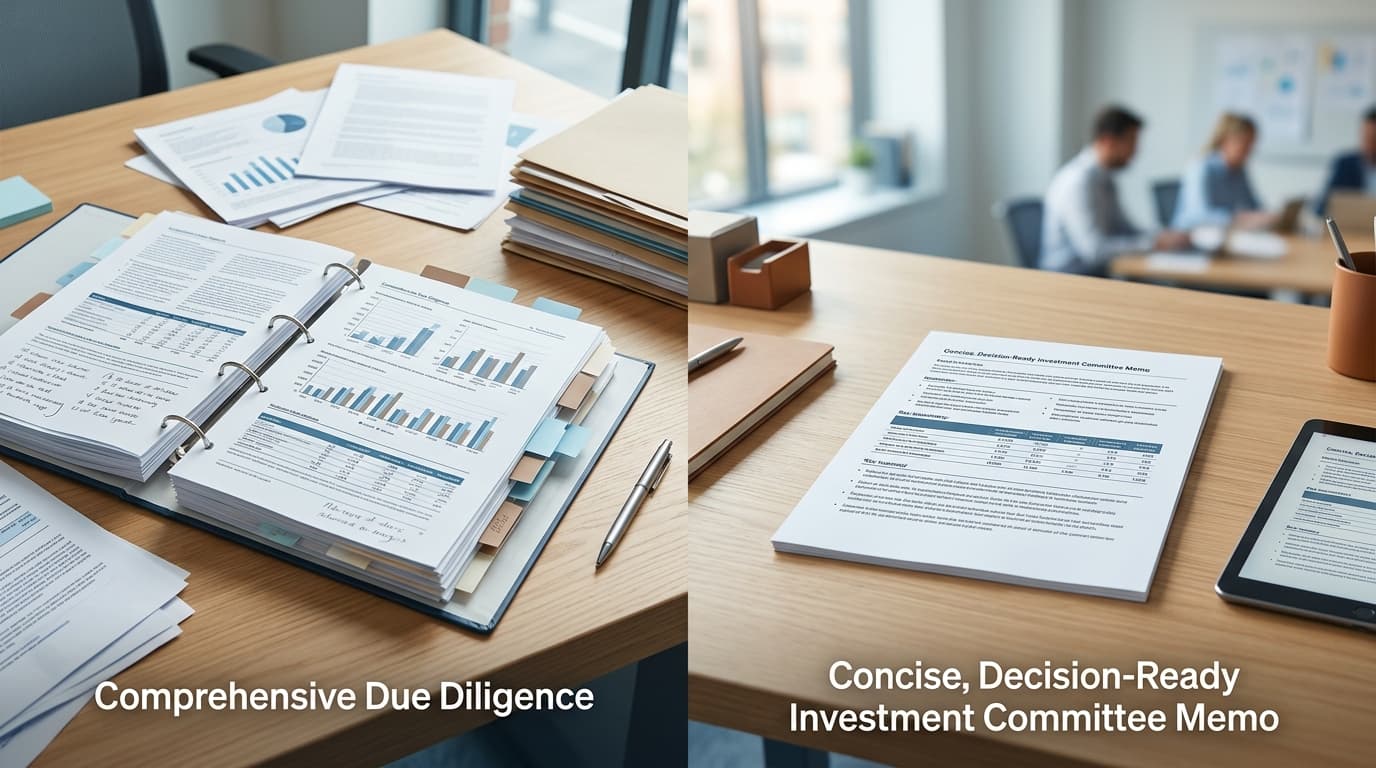
The primary challenge for investment directors is no longer just finding information; it is synthesizing it. A typical mid-market transaction now involves between 500 and 2,000 documents. When these are reviewed sequentially by separate legal, financial, and commercial teams, critical inconsistencies often fall through the cracks. Modern due diligence requires a shift toward cross-document reasoning, where data from management accounts is automatically triangulated against audited financials and customer contracts in real time.
- Timeline Compression: Traditional mid-market DD takes 4 to 8 weeks. Modern platforms aim to reduce this to days.
- Analytical Depth: Moving beyond sampling to 100% document coverage.
- Integrated Risk: Mapping how a legal clause (e.g., change of control) impacts financial projections.
The 9-Workstream Framework for Comprehensive Diligence
Effective due diligence in 2026 must operate across nine distinct workstreams simultaneously to provide a holistic view of the target. Siloed analysis is the primary cause of post-acquisition surprises. By running these streams in parallel, deal teams can identify how risks in one area compound in another.
| Workstream | Core Focus Area | Critical Risk Indicators |
|---|---|---|
| Commercial DD | Market position & revenue quality | Customer churn, concentration, renewal terms |
| Financial DD | Quality of Earnings (QoE) | EBITDA adjustments, working capital volatility |
| Legal DD | Contractual & litigation exposure | Change-of-control clauses, IP encumbrances |
| Tax DD | Multi-jurisdictional compliance | Transfer pricing, unresolved audits |
| Org & Compliance | Governance & HR culture | Regulatory mapping (GDPR, SOX), key man risk |
| Tech DD | Architecture & scalability | Technical debt, engineering maturity |
| Cybersecurity DD | Vulnerability & security ops | SOC 2 compliance, breach history |
| ESG DD | Sustainability & governance | Greenwashing detection, CSRD alignment |
| Website Compliance | Digital presence & privacy | Cookie consent, WCAG 2.1 AA accessibility |
Plausity enables this multi-workstream approach by applying 30+ industry-specific risk frameworks. For example, a healthcare transaction triggers different compliance and cybersecurity checks than a SaaS deal. This tailored approach ensures that the AI Analysis Engine looks for the specific red flags relevant to the target's vertical.
Source Traceability: The New Standard for Auditability
One of the most significant risks in traditional due diligence is the 'black box' report. Findings are often presented as conclusions without immediate access to the underlying evidence. In a high-stakes PE environment, this lack of traceability creates friction during investment committee reviews and LP reporting. Modern due diligence methodology demands that every finding is linked directly to its source.
Plausity addresses this by ensuring every identified risk or data point is hyperlinked to the specific document, page, and paragraph within the virtual data room. This level of granularity provides three distinct advantages:
- Verification Speed: Senior partners can validate an analyst's finding in seconds rather than searching through folders.
- Confidence Scoring: AI-driven analysis provides a confidence score for each finding, distinguishing between explicit facts and inferred risks.
- Audit Readiness: A complete digital trail is maintained for regulatory compliance and future exit readiness.
This 'human-in-the-loop' principle is vital. The AI automates the extraction and cross-referencing of data, but the human expert remains in control of the final conclusions. This augmentation allows a senior advisor to review a comprehensive risk matrix in hours, focusing their expertise on the most material issues rather than document retrieval.
From Risk Identification to Value Creation
Due diligence is often viewed as a defensive exercise, but in 2026, the most successful PE firms use it as the foundation for their value creation plan. The transition from the 'DD phase' to the '100-day plan' should be seamless. Findings uncovered during the audit—such as under-optimized contract terms or technical debt—should automatically populate the post-acquisition roadmap.
Plausity converts DD findings into scored, prioritized roadmaps. If the Tech DD identifies a lack of scalability in the current architecture, this is not just a red flag; it is a prioritized work item for the incoming CTO with an estimated financial impact. This proactive approach allows deal teams to present a clear vision to the board immediately upon closing.
- Prioritized Roadmaps: Risks are converted into actionable tasks with assigned owners.
- Financial Impact Estimates: Quantifying the cost of remediation or the upside of optimization.
- Management Alignment: Using DD findings to set KPIs for the target's leadership team.
Case Study: Timeline Compression in Mid-Market M&A
The practical impact of AI-augmented due diligence is best illustrated through real-world outcomes. A Big Four Advisory partner recently utilized Plausity to execute a commercial due diligence mandate for a mid-market industrial target. Traditionally, this process—involving the review of hundreds of customer contracts, market reports, and competitive analyses—would have required a three-week timeline with a dedicated team of analysts.
By leveraging Plausity's end-to-end workflow, the team was able to ingest the data room, classify all relevant documents, and generate a comprehensive red-flag summary in five days. The AI Analysis Engine identified a hidden customer concentration risk that had been obscured by fragmented billing entities across different jurisdictions. This finding, which might have been missed in a manual sample-based review, allowed the PE fund to renegotiate the deal terms before exclusivity expired.
This 75% reduction in timeline does not come from cutting corners. Instead, it comes from eliminating the manual 'heavy lifting' of document processing, allowing the senior advisors to spend 90% of their time on high-value analysis and negotiation strategy.
Security and Compliance in the AI Era
For private equity firms, data security is non-negotiable. The use of AI in due diligence must be governed by rigorous enterprise-grade standards. A common concern among deal professionals is whether their sensitive transaction data will be used to train public AI models. At Plausity, the answer is a definitive no.
The platform is built on a foundation of 'Privacy by Design,' ensuring that client data remains isolated and secure. Plausity maintains the following certifications and standards:
- SOC 2 Type II & ISO 27001: Rigorous third-party audits of security controls.
- ISO 42001: The international standard for AI governance and ethics.
- GDPR & EU AI Act Compliance: Ensuring all data processing meets the highest regulatory bars in Europe.
- Encryption: AES-256 at rest and TLS 1.3 in transit.
By providing a secure, compliant environment, Plausity allows deal teams to leverage the speed of AI without compromising the confidentiality of the transaction.