The Strategic Scope of Commercial Due Diligence
Commercial due diligence is not merely market research: it is a forensic evaluation of a company's commercial viability. The primary objective is to validate the assumptions underlying the valuation multiple. This involves a granular look at the target's market share, the defensibility of its competitive moat, and the stability of its revenue streams.
According to the Bain & Company 2026 Global M&A Report, deal professionals are increasingly focusing on 'revenue resilience' as the primary metric for mid-market transactions. This shift requires the CDD process to move beyond high-level market growth figures and into the specifics of customer concentration and contract renewal terms. A thorough CDD process identifies whether a target is growing because of superior product-market fit or simply riding a temporary market wave.
Plausity helps this depth by applying 30+ industry-specific risk frameworks. Whether the target is in SaaS, healthcare, or industrial manufacturing, the platform automatically aligns the document review with the specific benchmarks and regulatory requirements of that vertical. This ensures that the commercial analysis is grounded in industry reality rather than generic business logic.
Traditional vs. AI-Augmented CDD Workflow
The traditional CDD workflow is often sequential and siloed. Analysts spend the first week of a mandate simply organizing the data room and identifying missing disclosures. In contrast, an AI-augmented approach allows for parallel processing. As soon as documents are ingested from the VDR, the analysis engine begins classifying data and surfacing red flags.
| Phase | Traditional Manual Process | Plausity-Augmented Process |
|---|---|---|
| Data Ingestion | Manual sorting and folder mapping (2-3 days) | Automated VDR sync and document classification (Hours) |
| Analysis | Human review of contracts and reports (1-2 weeks) | Cross-document reasoning and anomaly detection (Hours) |
| Risk Scoring | Subjective assessment by junior analysts | Automated scoring by impact and deal relevance |
| Traceability | Manual citations and page references | 100% link to document, page, and paragraph |
| Reporting | Manual drafting in Word/PPT (3-5 days) | AI-assisted, investor-ready report generation for expert review (Minutes) |
This comparison highlights the efficiency gains reported by Big Four advisory partners, who have successfully compressed commercial DD timelines from three weeks to five days. The focus shifts from data collection to high-level strategic judgment, where human experts review AI-generated findings to form final conclusions.
Phase-by-Phase Breakdown of the CDD Process
A professional CDD process is divided into five distinct stages, each designed to peel back a layer of the target's commercial operations. Skipping any of these steps increases the risk of post-acquisition value erosion.
- Scoping and Hypothesis Generation: The deal team defines the critical questions. Is the market truly growing at 10%? Is the top customer likely to churn? These hypotheses guide the entire analytical effort.
- VDR Ingestion and Document Review: The team gathers internal data, including management accounts, sales pipelines, customer contracts, and marketing plans. Plausity's AI Analysis Engine reads and cross-references these files to detect inconsistencies between management claims and actual contract terms.
- Market and Competitive Assessment: This involves analyzing external data to map the competitive landscape. The goal is to determine the target's 'Right to Win' and identify any disruptive technologies or new entrants that could threaten the business model.
- Customer and Revenue Validation: Analysts perform a deep dive into the quality of earnings from a commercial perspective. This includes calculating Net Revenue Retention (NRR), analyzing customer concentration, and reviewing the 'stickiness' of the product.
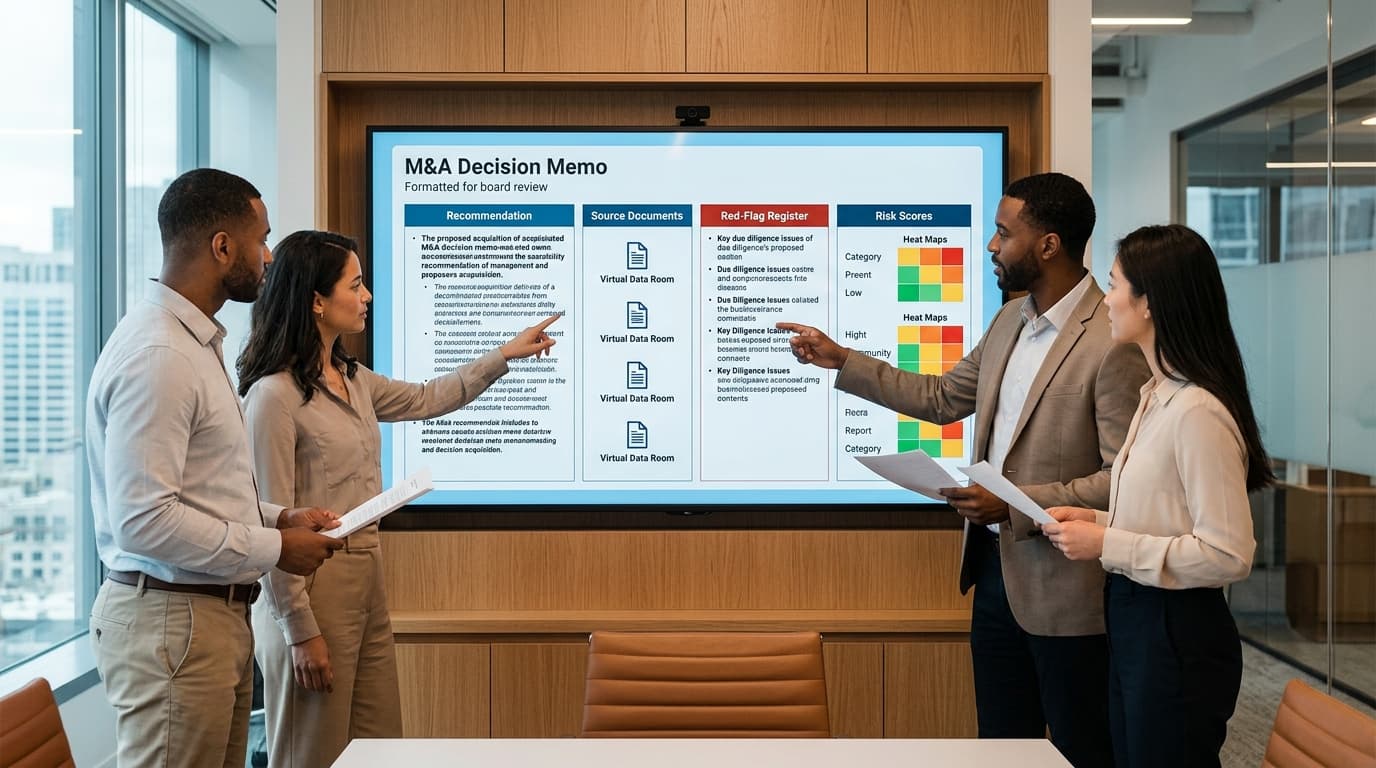
- Synthesis and Reporting: The final phase converts raw data into an executive briefing. This report must highlight red flags, quantify risks, and provide a clear recommendation to the investment committee.
Critical Risk Identification in Commercial DD
Identifying commercial risks requires looking beyond the surface-level growth numbers. A target company might show 20% year-over-year growth, but if that growth is driven by a single customer or unsustainable pricing, the deal value is compromised.
- Customer Concentration: Does the top 3 customers represent more than 30% of total revenue? Plausity automatically flags high concentration levels across the contract portfolio.
- Churn and Retention: Are customers leaving at an accelerating rate? The analysis engine triangulates CRM data with contract termination notices to find the truth.
- Pricing Power: Has the company successfully passed on inflationary costs to its customers? Reviewing historical price increases versus volume growth is essential.
- Pipeline Integrity: Is the sales pipeline realistic? AI-driven analysis can compare historical conversion rates with current pipeline stages to detect 'fluff' in the projections.
- Regulatory Headwinds: Are there upcoming changes in ESG or trade laws that could impact the commercial model? Plausity maps findings against current regulations like CSRD or the EU AI Act.
Generating Investor-Ready Deliverables
The output of a CDD process is as important as the analysis itself. Investment committees and LPs require clear, concise, and auditable reports. Traditional reporting often suffers from 'version control hell' and inconsistent formatting across different workstreams. Plausity solves this by providing a unified workspace where findings from all 9 workstreams, including Commercial, Financial, and Legal, are synthesized into a single source of truth.
The platform generates dynamic, investor-ready reports in Word, PowerPoint, and PDF formats. These are not generic summaries: they are structured briefings that include red-flag alerts, executive summaries, and even 100-day post-acquisition value creation plans. Because every finding is linked to the source document, page, and paragraph, the deal lead can validate any claim in seconds during a board meeting or Q&A session.
This level of transparency builds trust with stakeholders. When an advisor can point to the exact clause in a contract that justifies a risk score, the credibility of the entire due diligence process is elevated. This is the 'human-in-the-loop' principle in action: the AI handles the heavy lifting of data extraction and cross-referencing, while the senior advisor provides the strategic context and final sign-off.
Security and Compliance in the Digital Age
In 2026, the security of deal data is non-negotiable. Commercial due diligence involves handling highly sensitive information, including trade secrets, customer lists, and strategic plans. Using generic AI tools or uncertified platforms poses a significant risk to deal confidentiality and regulatory compliance.
Plausity adheres to the highest global security standards, including SOC 2 Type II, ISO 27001, and ISO 42001 for AI governance. All data is encrypted using AES-256 at rest and TLS 1.3 in transit. Crucially, client data is never used to train AI models, ensuring that the proprietary insights of one deal never leak into another. This commitment to security allows PE funds and advisory firms to use the power of AI without compromising their fiduciary duties or GDPR obligations.