The strategic logic behind modern brokerage consolidation
The residential real estate brokerage sector is navigating structural shifts marked by cyclical transaction volume declines, elevated mortgage rates, and post-litigation commission compression. In response to these headwinds, brokerage platforms are accelerating consolidation to aggregate production scale, diversify revenue streams, and amortize centralized technology costs over wider agent networks. The definitive business combination between The Real Brokerage Inc. and RE/MAX Holdings Inc. in an $880 million transaction provides an underwriting blueprint for merging cloud-based brokerage technology with established global franchise distribution networks.
The combined holding company, Real REMAX Group, unites Real's digital platform with RE/MAX's global footprint of nearly 8,500 franchise offices and more than 145,000 agents to create an organization supporting over 180,000 real estate professionals across more than 120 countries and territories. On a pro forma basis, the combined platform represented approximately $2.3 billion in 2025 revenue and roughly $155 million in adjusted EBITDA before synergies, spanning company-owned brokerage operations, franchising, fintech, and ancillary settlement services.
Unlocking operational leverage and unit economics
For private equity sponsors, investment committees, and corporate development leads evaluating brokerage platform combinations, scale provides vital operational defense. Separate from the roughly $880 million enterprise value ascribed to RE/MAX Holdings, the transaction targets approximately $30 million of annual run-rate cost savings, with the majority expected in 2027, primarily from shared services, corporate and public company costs, and technology efficiencies. In an environment where organic agent recruitment costs continue to rise, acquiring proven network volume allows platform operators to improve adjusted EBITDA margins while expanding the distribution surface for profitable mortgage and title offerings.
| Financial and Operational Metric | Real Brokerage Standalone | RE/MAX Holdings Standalone | Combined Real REMAX Group |
|---|---|---|---|
| Agent Headcount | more than 33,000 agents | more than 145,000 agents | more than 180,000 agents |
| 2025 Pro Forma Revenue | N/A | N/A | approximately $2.3 billion |
| 2025 Adjusted EBITDA (pro forma, pre-synergies) | N/A | N/A | approximately $155 million |
| Target Annual Run-Rate Cost Savings | N/A | N/A | approximately $30 million, mostly realized in 2027 |
| Implied Transaction Valuation Multiple | N/A | 7x 2025 EBITDA (fully synergized) | 7x 2025 EBITDA (fully synergized) |
Assessing agent retention and split economics
In residential brokerage mergers and acquisitions, agent headcount and production volume constitute the fundamental revenue-generating assets. Unlike software businesses with multi-year enterprise contracts, real estate agents operate as independent contractors capable of transferring their licenses to competing brokerages with minimal friction. Diligence frameworks must therefore segment agent rosters into granular cohorts based on production tiers, tenure, team structures, and geographic concentration to evaluate true revenue durability.
Valuation multiples in brokerage transactions reflect historical retention stability. Target brokerages with weak annual agent retention typically face substantial multiple compression because continuous recruitment spending is required merely to offset churn. Conversely, platforms demonstrating sustained retention across their top producing quartiles justify platform-level enterprise valuations, as their underlying cash flows are less susceptible to post-close attrition.
Production concentration and commission compression post-NAR
Diligence models must analyze top-10 and top-20 producing agent concentration. When a disproportionate percentage of gross commission income (GCI) is concentrated among a handful of elite mega-teams, the departure of a single team leader can materially impair regional profitability. Underwriters must review individual independent contractor agreements, bespoke split arrangements, equity incentive vesting schedules, and production-threshold cap mechanics to identify potential churn triggers upon change of control.
Furthermore, diligence must stress-test revenue models against the structural changes introduced by the August 17, 2024 National Association of Realtors (NAR) settlement rules. Under these nationwide requirements, offers of buyer broker compensation are no longer permitted on Multiple Listing Services (MLSs), and agents working with buyers must execute written representation agreements with objectively defined compensation terms prior to touring properties. M&A deal teams must audit transaction files to ensure agents are consistently executing compliant buyer agreements and evaluate how buyer-side commission compression affects brokerage net splits.
- Cohort-based retention analysis: Track historical churn across 1-year, 3-year, and 5-year agent cohorts, isolating whether turnover occurs among high producers or unproductive license-holders.
- Commission cap and net split auditing: Model the precise margin contribution of agents who have reached annual production caps versus those paying standard brokerage splits.
- Key team concentration risk: Calculate the revenue sensitivity if the largest producing teams depart, factoring in local team employment agreements and restrictive covenants.
- Buyer representation contract compliance: Sample closed transaction files post-August 2024 to verify adherence to the mandatory written buyer agreement rules, including objectively ascertainable compensation disclosures.
Evaluating franchise agreements and channel conflict
Acquiring a franchisor asset such as RE/MAX involves fundamentally different diligence considerations than underwriting a directly owned brokerage. In a pure brokerage model, revenue fluctuates with gross transaction volume and commission splits. In a franchisor model, revenue durability is anchored in contractual royalty streams, monthly continuing franchise fees, fixed per-agent desk fees, and regional master franchise agreements.
Franchisee renewal cadence and dispute history
Diligence teams must audit the target's Franchise Disclosure Documents (FDDs) and individual franchise contracts across all operating territories. Key areas of focus include expiration schedules, mandatory capital expenditure requirements, transfer approval rights, and renewal notification timelines. When major multi-office franchisees face contract expirations within 12 to 24 months of deal close, buyers must assess the probability of renewal and the defensibility of fee structures in a competitive market.
Channel conflict represents another critical underwriting dimension when integrating a cloud-based brokerage with an independent franchise network. If the acquiring entity continues to recruit agents directly into its owned digital platform within markets where franchise owners operate protected territories, broker-owners may allege bad-faith competition or breach of franchise covenants. Transaction agreements must explicitly define territory boundaries, cross-network recruiting protocols, and brand positioning to protect franchisee goodwill.
- Contract expiration cliff audits: Map regional franchise renewal schedules to quantify cash flow exposure over a 36-month post-closing horizon.
- Territory exclusivity and encroachment review: Analyze franchise agreements for exclusive territory clauses, radius restrictions, and digital brokerage carve-outs.
- Franchise fee collection health: Examine historical accounts receivable aging, fee abatements, and default rates among broker-owners to identify underlying network stress.
- Dispute and litigation logs: Review past arbitration filings and formal complaints regarding brand standards, marketing fund expenditures, and system changes.
Tech-stack duplication and integration realities
Consolidating redundant software platforms is frequently modeled as a major synergy lever in real estate M&A. However, tech-stack integration in brokerage environments carries significant operational risk. Real estate agents and independent broker-owners develop deeply embedded operational habits around their chosen customer relationship management (CRM), digital signature, transaction management, and commission accounting tools. Forcing an abrupt migration to an unfamiliar platform can trigger immediate agent dissatisfaction and accelerated turnover.
Optional adoption vs. mandatory platform migration
In the Real-REMAX combination, management addressed this operational dynamic by framing Real's proprietary reZEN platform as an optional offering rather than a mandate, with REMAX franchisees keeping their existing business model, economics, and brand identity instead of facing an immediate system-wide cutover. This opt-in strategy enables franchisees to lower their third-party software costs voluntarily while avoiding the operational friction associated with forced technical transitions.
Diligence teams must conduct a thorough software inventory to evaluate integration timelines, data migration feasibility, API compatibility, and vendor contract termination liabilities. When modeling run-rate synergies, deal teams must distinguish between immediate enterprise software savings and longer-term development costs required to support disparate franchise workflows.
| Technology Layer | Legacy Franchise Environment | Integrated Modern Platform | Integration Diligence Focus |
|---|---|---|---|
| Transaction Management | Disparate third-party vendors and manual forms | Centralized digital platform (e.g., proprietary reZEN) | Audit data portability, contract cancellation penalties, and state form compliance |
| Commission Accounting | Decentralized local back-office accounting software | Automated split calculations and electronic disbursements | Verify automated cap tracking, multi-tier split logic, and ledger integration |
| Agent CRM & Marketing | Independent third-party subscriptions selected by teams | Integrated CRM ecosystem with automated marketing suites | Assess API connectivity, contact database ownership, and user adoption rates |
| Financial Services & Wallet | Manual checks and disconnected banking channels | Integrated digital wallet and fast commission access | Review banking partner compliance, state escrow regulations, and funds flow security |
Navigating state licensing and MLS access transfers
Unlike standard corporate transactions where assets and operational permits transfer automatically upon closing, residential brokerage mergers operate under stringent state-by-state regulatory frameworks. Real estate brokerage licenses are issued by state licensing commissions and real estate boards, typically tied directly to an individual designated broker of record in each jurisdiction. A failure to execute proper regulatory filings can halt brokerage operations and invalidate pending transactions.
Designated broker continuity and closing mechanics
Regulatory approval timelines across all 50 states and Canadian provinces commonly require 30 to 90 days from initial submission. Diligence teams must verify that the designated broker of record in each jurisdiction possesses active, unblemished licenses and that proper succession plans or interim broker agreements are established prior to closing. Changing a broker of record requires coordinating regulatory notifications, bonding updates, and corporate entity amendment filings.
Equally vital is ensuring uninterrupted access to local Multiple Listing Services (MLSs) and Realtor association boards. MLS participant agreements govern an agent's ability to pull property data, syndicate listings, and submit client offers. Because hundreds of independent MLS entities exist across North America, deal teams must audit participant agreements to identify whether a corporate change of control triggers new participant applications, mandatory inspection audits, or transfer fees.
- Designated broker licensing audit: Confirm active licenses, disciplinary records, and continuing education compliance for every qualifying broker of record across all operating states.
- State regulatory notice filings: Establish a 90-day pre-close regulatory roadmap detailing state-specific notice requirements, corporate license amendments, and approval milestones.
- MLS participant agreement reviews: Map all regional MLS affiliations to determine whether equity or asset transactions require board re-applications or payment of transfer assessments.
- Errors & omissions (E&O) tail coverage: Verify adequate prior-acts coverage and transition arrangements for professional liability insurance across historical transaction volumes.
RESPA compliance and ancillary services risk
Ancillary settlement services, including mortgage origination, title insurance, escrow closing, and property insurance, represent the highest-margin segment of the modern brokerage value proposition. Brokerages that achieve high consumer attach rates across integrated title and mortgage joint ventures consistently trade at premium EBITDA valuation multiples. However, monetizing these services exposes platform operators to significant federal and state regulatory scrutiny under the Real Estate Settlement Procedures Act (RESPA).
Affiliated business arrangements and safe harbor standards
Section 8 of RESPA (12 U.S.C. § 2607) strictly prohibits paying or receiving kickbacks, unearned fees, or things of value in exchange for referring settlement service business. To operate affiliated businesses lawfully, brokerages must structure their entities under the Affiliated Business Arrangement (AfBA) safe harbor outlined in 12 CFR § 1024.15.
Diligence teams must audit affiliated entities to confirm compliance with the three statutory safe harbor requirements: providing timely, written AfBA disclosure forms specifying the financial relationship and estimated charges; strictly avoiding mandatory use or tie-in practices that condition brokerage representation on using affiliated services; and ensuring that financial distributions represent bona fide returns on equity ownership rather than disguised referral fees tied to transaction volume. Furthermore, Marketing Services Agreements (MSAs) between brokerages and third-party lenders or title companies must be rigorously reviewed to ensure payments reflect verified fair market value for actual advertising services rendered.
- Written AfBA disclosure sampling: Audit transaction records to verify that written disclosure statements were delivered to consumers on a separate piece of paper no later than the time of each referral.
- No-required-use verification: Confirm that consumer contracts, marketing materials, and internal agent guidance contain no mandatory service packaging or tied pricing.
- Ownership capital and distribution proportionality: Verify that joint venture capital contributions and profit distributions represent bona fide returns on ownership interest and are not adjusted on the basis of previous relative referrals.
- Marketing services agreement (MSA) fair-market valuations: Review independent valuation studies supporting fees paid by settlement service partners for desk rentals, web advertising, or co-marketing campaigns.
Leveraging AI for brokerage M&A diligence
Executing due diligence across large-scale brokerage transactions requires reviewing and cross-referencing tens of thousands of complex legal, operational, and regulatory documents. Between individual agent independent contractor agreements, tiered commission addenda, regional franchise agreements, state broker filings, and affiliated business joint venture operating agreements, manual document sampling creates blind spots that jeopardize post-close integration.
M&A advisory firms, private equity sponsors, and corporate development leads increasingly deploy M&A due diligence workflows to ingest, extract, and analyze target data rooms with speed and precision. Modern transaction teams use specialized platforms to connect virtual data rooms directly to automated analysis workflows, enabling comprehensive contract auditing across thousands of files simultaneously.
Transforming virtual data rooms into structured risk intelligence
Platforms such as Plausity equip deal teams with purpose-built engines designed specifically for complex transaction analysis. By utilizing Data Room Ingestion, deal teams rapidly scan and parse thousands of PDF contracts, corporate filings, and financial models. The AI-Analysis Engine reads across documents to detect non-standard indemnity obligations, evaluate franchise renewal risks, and identify commission split anomalies across regional operating units.
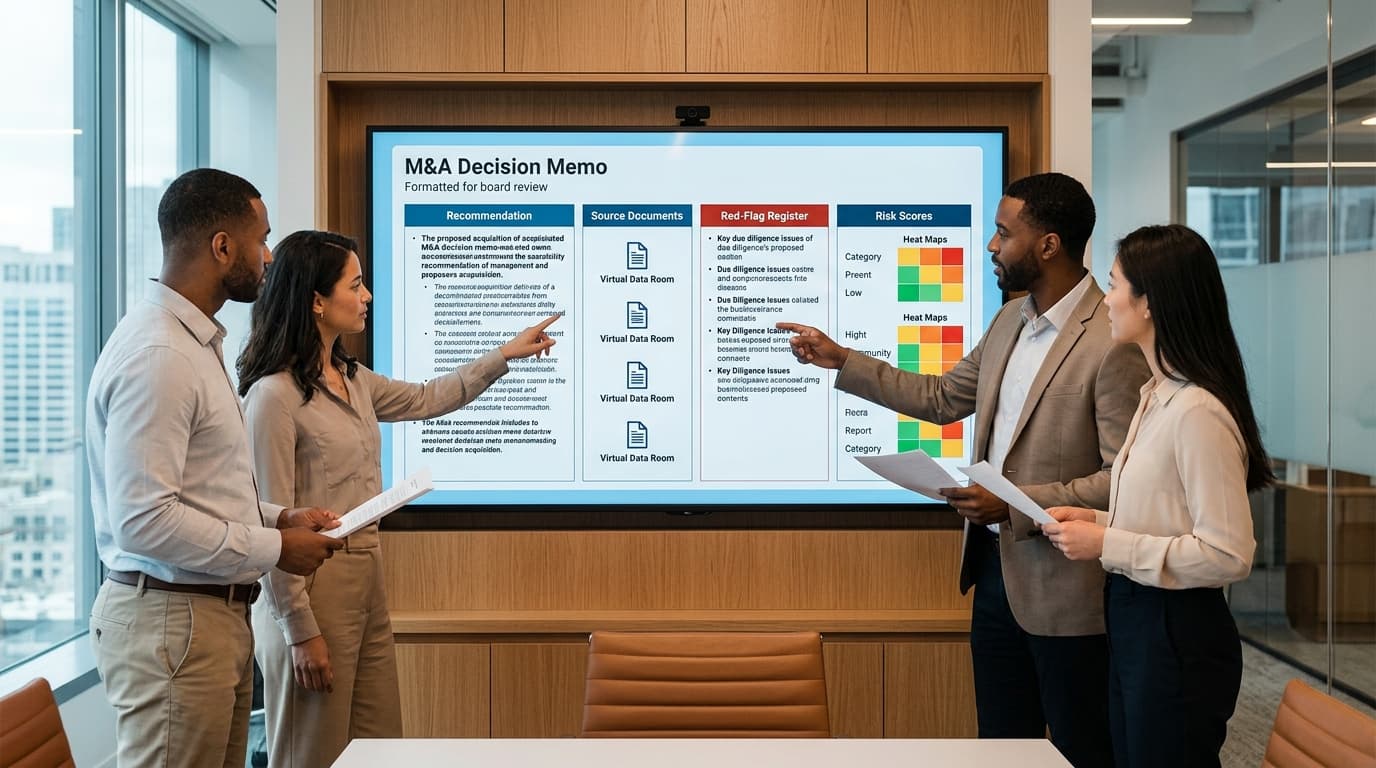
To prioritize critical deal issues, teams leverage Findings & Risk Intelligence alongside Risk Radar to score findings by financial materiality and legal exposure. Collaboration Hub facilitates real-time coordination among legal, financial, and commercial workstreams, while Report Builder automatically generates audit-ready memos and committee evidence packs with direct source-to-deck traceability. By transforming unstructured data rooms into verifiable risk registers, investment professionals can underwrite brokerage platform combinations with confidence and execute transactions on compressed timelines.
How Plausity accelerates this workflow
Plausity is an AI-native due diligence platform that helps M&A advisory firms, VC and PE funds, and corporate development teams structure evidence, findings and questions across a data room. It does not replace human advisers, does not guarantee deal outcomes, and does not provide legal, tax, audit or regulatory advice — all AI-generated findings, especially regulatory ones, require confirmation and advisor review by qualified professionals.
To explore the underlying capabilities, see the Plausity AI analysis engine and the findings and risk intelligence product page. For team-level workflows, see how VC and PE funds and M&A advisory firms use Plausity across live deals.