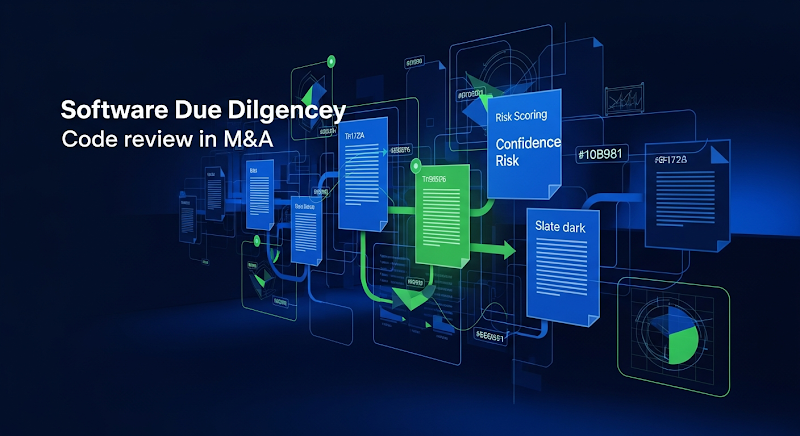
Software Due Diligence: A Strategic Framework for Code Review and Technical Risk Assessment in M&A
·10 min read
Image: Plausity
Key Takeaways
Technical due diligence must be integrated with other workstreams to identify the true financial and legal impact of software risks.
AI-native workspaces compress DD timelines from weeks to days by automating document analysis while maintaining full source traceability.
Quantifying technical debt is essential for accurate valuation and creating a realistic post-acquisition 100-day plan.
The Strategic Importance of Technical Due Diligence in 2026
In the current M&A environment, software is rarely a standalone asset. It is the engine of the business. According to the 2026 Bain Global M&A Report, over 70 percent of mid-market deals now involve a significant technology component, making technical due diligence (Tech DD) indispensable. The objective is no longer just to confirm that the software works, but to determine if the architecture can support the buyer's growth thesis. A target with high technical debt or fragmented codebases can require millions in post-acquisition remediation, directly impacting the internal rate of return (IRR).
Modern Tech DD must go beyond surface-level interviews with the CTO. It requires a deep dive into the code's structural integrity, security posture, and intellectual property (IP) provenance. Deal teams are increasingly moving away from manual sampling toward comprehensive analysis. By leveraging an AI-native workspace, advisors can ingest thousands of technical documents and code audit reports simultaneously. This approach ensures that no critical vulnerability is missed due to time constraints or human fatigue.
Integration with Other Workstreams
One of the primary differentiators in 2026 is the integration of Tech DD with other workstreams. A security vulnerability identified in the code review is not just a technical issue; it is a legal liability and a potential financial risk. Plausity runs 9 DD workstreams simultaneously, including Cybersecurity and Tech DD, to map these risks across the entire deal landscape. This cross-workstream reasoning allows for a more holistic view of the target's risk profile, ensuring that technical findings are reflected in the final valuation and purchase agreement.
Core Pillars of Software Code Review
A rigorous software due diligence process focuses on four critical pillars: quality, security, scalability, and IP compliance. Each pillar requires a specific set of benchmarks and risk frameworks tailored to the industry vertical. For instance, a fintech target requires a different security rigor than a martech platform. Plausity utilizes over 30 industry-specific frameworks to ensure the analysis is relevant to the target's market position.
Code quality assessment involves analyzing the maintainability and complexity of the software. High cyclomatic complexity or a lack of automated testing indicates significant technical debt. Security reviews focus on identifying known vulnerabilities (CVEs), hardcoded credentials, and insecure data handling practices. In 2026, with the EU AI Act and GDPR in full effect, compliance with regulatory standards is a non-negotiable component of the code review process.
Scalability and IP compliance are equally vital. The review must determine if the current architecture can handle a 10x increase in user load without a complete rewrite. Simultaneously, the analysis must verify that the target has the right to use all third-party and open-source libraries. Unresolved open-source license conflicts can lead to costly litigation or the forced disclosure of proprietary code. Plausity's AI Analysis Engine triangulates data across documentation and audit reports to detect these disclosure gaps, providing source traceability for every finding.
Quantifying Technical Debt and Financial Impact
Technical debt is the implied cost of additional rework caused by choosing an easy solution now instead of using a better approach that would take longer. In an M&A context, this debt is a hidden liability. Quantifying it requires a systematic approach to identifying architectural flaws and outdated dependencies. The table below outlines how different levels of technical debt impact the post-acquisition roadmap.
| Risk Level | Technical Indicator | Financial Impact | Remediation Effort |
| :--- | :--- | :--- | :--- |
| **Critical** | Monolithic architecture with no API strategy; deprecated languages. | High: May require a full platform rewrite. | 12-24 months |
| **High** | Significant security vulnerabilities; lack of documentation; high churn in engineering. | Medium-High: Significant investment in security and hiring. | 6-12 months |
| **Medium** | Moderate technical debt; some manual deployment processes. | Medium: Incremental investment in DevOps and refactoring. | 3-6 months |
| **Low** | Modern microservices; high test coverage; automated CI/CD pipelines. | Low: Standard maintenance and feature development. | Ongoing |
By scoring findings by financial impact and deal relevance, Plausity helps M&A project leads prioritize their focus. Instead of a 200-page report of minor bugs, the platform generates a red flag summary that highlights the issues most likely to affect the deal's success. This allows the deal team to negotiate price adjustments or holdbacks based on verified technical risks. A Big Four Advisory partner noted that using Plausity cut their commercial and tech DD timeline from three weeks to five days on a mid-market transaction, demonstrating the efficiency of this data-driven approach.
The Role of AI in Augmenting Technical Experts
It is a common misconception that AI replaces the need for senior technical advisors. In reality, AI-powered tools like Plausity augment the expert's capabilities by handling the heavy lifting of data ingestion and initial analysis. The AI scans the data room, classifies technical documents, and identifies anomalies across thousands of files. This allows the human expert to focus on interpreting the findings and making strategic recommendations.
Source traceability is the cornerstone of this collaboration. Every risk identified by Plausity is linked directly to the source document, page, and paragraph. This level of transparency allows the technical lead to verify the AI's findings instantly, maintaining a high degree of confidence in the final report. The platform's confidence scoring further assists by distinguishing between confirmed facts and areas that require further management inquiry.
This human-in-the-loop approach ensures that the final DD report is not just a collection of data, but an investor-ready deliverable. Plausity's Report Builder can generate executive briefings and management presentations in Word, PowerPoint, or PDF formats, customized with the firm's branding. This eliminates the manual overhead of formatting reports, allowing senior advisors to spend more time on value-add activities like post-merger integration planning.
Security, Compliance, and Data Integrity
When dealing with sensitive source code and proprietary technical documentation, security is paramount. M&A professionals require a platform that meets the highest standards of data protection. Plausity is built on an enterprise-grade security architecture, featuring SOC 2 Type II, ISO 27001, and ISO 42001 certifications. All data is encrypted using AES-256 at rest and TLS 1.3 in transit, ensuring that the target's intellectual property remains confidential.
A critical distinction of the Plausity platform is that client data is never used to train AI models. This ensures that sensitive deal information remains siloed and protected from leakage. Furthermore, the platform is fully compliant with GDPR and the EU AI Act, providing the regulatory certainty required for cross-border transactions. This commitment to security allows PE funds and advisory firms to conduct deep technical reviews without compromising the integrity of the target's most valuable assets.
Checklist: Critical Red Flags in Software Due Diligence
To ensure a comprehensive review, deal teams should look for the following red flags during the code review process. These issues often indicate deeper systemic problems within the target's engineering organization.
* **Lack of Version Control:** Inconsistent use of Git or other version control systems suggests a lack of discipline in the development process.
* **Hardcoded Secrets:** Finding API keys or database credentials within the source code is a major security risk and indicates poor security hygiene.
* **High Dependency on Key Personnel:** If the entire codebase is understood by only one or two developers, the 'bus factor' risk is unacceptably high.
* **Outdated Third-Party Libraries:** Using libraries with known vulnerabilities that have not been patched for years suggests a lack of maintenance.
* **Missing Documentation:** A lack of architectural diagrams or API documentation makes it difficult for new engineers to onboard and increases the cost of future development.
* **Inadequate Testing:** Low code coverage or a lack of automated regression tests means that every new feature risks breaking existing functionality.
Plausity's Findings & Risk Intelligence module automatically flags these issues, scoring them by materiality and linking them to the relevant evidence in the data room. This structured approach ensures that the deal team can address these risks early in the negotiation process, rather than discovering them after the deal has closed.