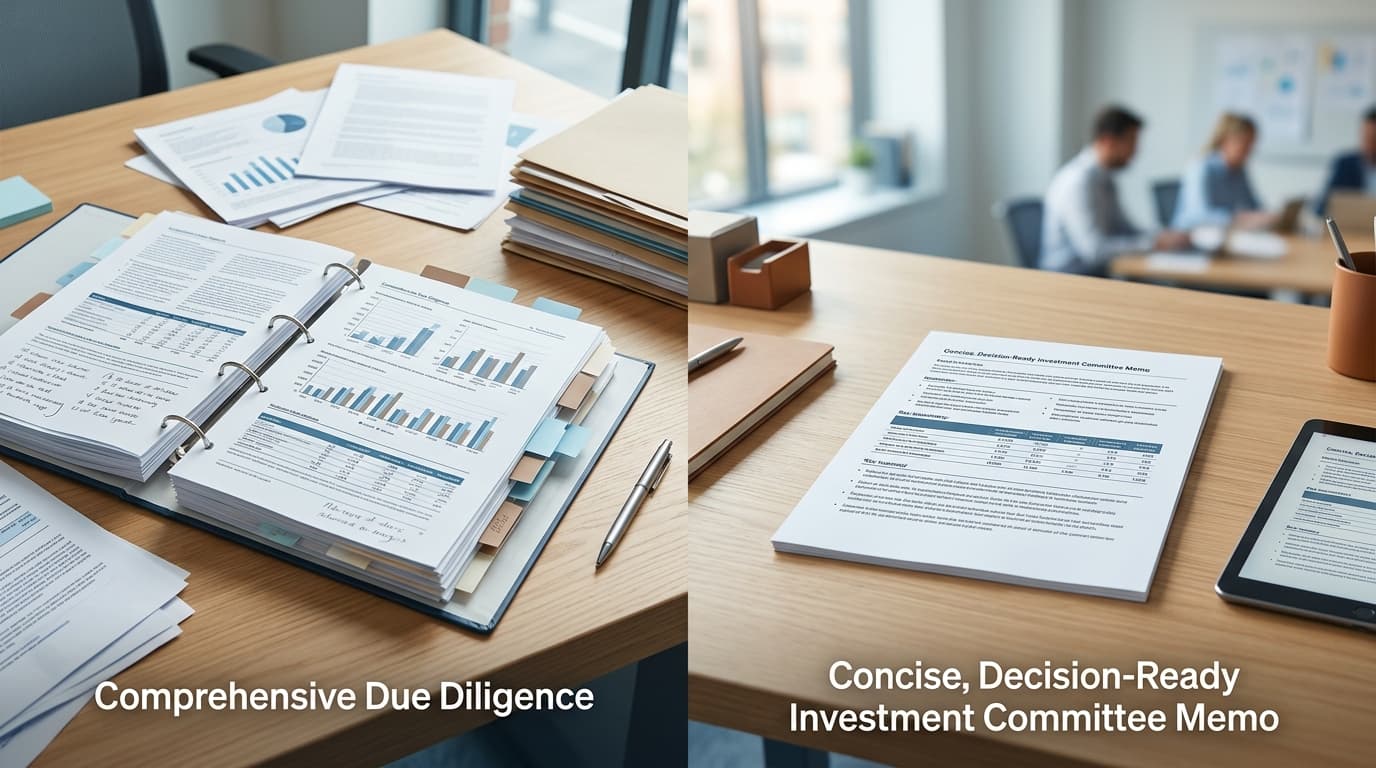
The Evolution of AI-Native Due Diligence Workspaces
Due diligence has historically been a sequential, fragmented process. Analysts often spend the first 72 hours of a deal simply organizing the virtual data room (VDR) and identifying missing disclosures. AI-native workspaces redefine this by integrating directly with VDRs to automate ingestion and classification from the outset.
Unlike generic AI tools or simple document Q&A bots, a dedicated DD platform applies domain-specific frameworks. According to Bain's 2026 M&A Report, firms adopting AI-integrated workflows have seen a 40% increase in deal throughput without expanding headcount. This efficiency stems from the platform's ability to read, cross-reference, and reason across thousands of documents simultaneously.
- Automated Classification: Documents are instantly categorized by workstream (e.g., Legal, Financial, Tax).
- Completeness Tracking: The system identifies gaps in the data room against industry-standard checklists.
- Structured Data Extraction: Key terms, financial figures, and obligations are pulled into a centralized dashboard.
Simultaneous Analysis Across 9 DD Workstreams
One of the primary bottlenecks in traditional DD is the siloed nature of workstreams. Financial findings often remain disconnected from legal risks until the final report compilation. AI-powered platforms break these silos by running multiple analyses concurrently and mapping risks across the entire transaction landscape.
| Workstream | Core Focus Areas | AI-Powered Outcome |
|---|---|---|
| Commercial DD | Market position, customer churn, revenue quality | Timeline cut from 3 weeks to 5 days |
| Financial DD | QoE, EBITDA normalization, net debt | Anomaly detection across management accounts |
| Legal DD | Change-of-control, litigation, IP rights | 100% contract portfolio coverage |
| Tech & Cyber | Technical debt, vulnerability assessment | Architecture scalability scoring |
| ESG | CSRD/SFDR compliance, greenwashing detection | Regulatory mapping and risk scoring |
Plausity covers nine distinct workstreams, including Tax, Organisation & Compliance, and Website Compliance. This breadth ensures that the deal lead has a holistic view of the target's risk profile in real time, rather than waiting for individual workstream leads to submit fragmented summaries.
Solving the Black Box: Source Traceability and Confidence Scoring
A common critique of early AI applications in M&A was the lack of transparency. Deal professionals cannot rely on 'hallucinated' summaries or unverified claims. Modern AI due diligence solves this through 100% source traceability. Every finding generated by the platform is linked directly to the specific document, page, and paragraph from which it originated.
This level of granularity allows senior advisors to validate findings in seconds. Furthermore, confidence scoring distinguishes between confirmed facts found in multiple documents and inferences that require human follow-up. For example, if a change-of-control clause is identified in a master service agreement, the platform provides a direct link to the clause, the page number, and a score indicating the system's certainty in its interpretation.
This human-in-the-loop approach ensures that while the AI handles the heavy lifting of data processing, the human expert remains in full control of the final conclusions and recommendations. It transforms the role of the analyst from a data gatherer to a data validator.
Timeline Compression: From Three Weeks to Five Days
Speed is a competitive advantage in M&A. In a competitive bidding process, the ability to reach a 'go/no-go' decision faster than other parties can be the difference between winning and losing a deal. A Big Four Advisory partner recently reported that using Plausity's AI analysis engine allowed them to compress a commercial DD timeline from three weeks to just five days on a mid-market transaction.
This compression is achieved by automating the repetitive analytical work that typically consumes 80% of an analyst's time. Instead of manually reading 500 lease agreements or 1,000 employment contracts, the AI surfaces the material risks (e.g., unusual termination rights or non-compete violations) across the entire set in minutes. This allows the deal team to focus their energy on the 20% of findings that truly impact valuation and deal structure.
The result is not just a faster process, but a more rigorous one. Because the AI can review every single document in the data room, rather than just a representative sample, the risk of missing a 'needle in the haystack' is significantly reduced.
Enterprise Security and Regulatory Compliance
Handling sensitive M&A data requires a security posture that exceeds standard SaaS requirements. AI due diligence platforms must adhere to strict data sovereignty and privacy standards to be viable for institutional use. Plausity operates under a zero-trust architecture, ensuring that client data is never used to train underlying AI models.
Compliance with the EU AI Act, GDPR, and international security standards is non-negotiable. Deal teams should look for platforms that hold the following certifications:
- SOC 2 Type II: Verified operational security and data privacy controls.
- ISO 27001: International standard for information security management systems.
- ISO 42001: The specific standard for AI governance and risk management.
- Encryption: AES-256 at rest and TLS 1.3 in transit.
By maintaining these standards, AI-native workspaces provide a secure environment for cross-border transactions where multi-jurisdictional data privacy laws must be navigated simultaneously.
Value Creation: Beyond the Closing Date
Due diligence should not end with a list of risks; it should serve as the foundation for the post-acquisition roadmap. Advanced AI platforms convert DD findings into prioritized value creation plans. By scoring risks and opportunities by financial impact, the system can automatically generate a '100-day plan' for the incoming management team.
For instance, if the DD identifies a high customer concentration risk or a specific technical debt issue, these are automatically carried over into a post-deal workspace. This ensures that the institutional knowledge gained during the diligence phase is not lost during the transition from the deal team to the operations team. This continuity is vital for Private Equity funds looking to drive rapid EBITDA growth following an acquisition.