The Evolution of Due Diligence Methodology
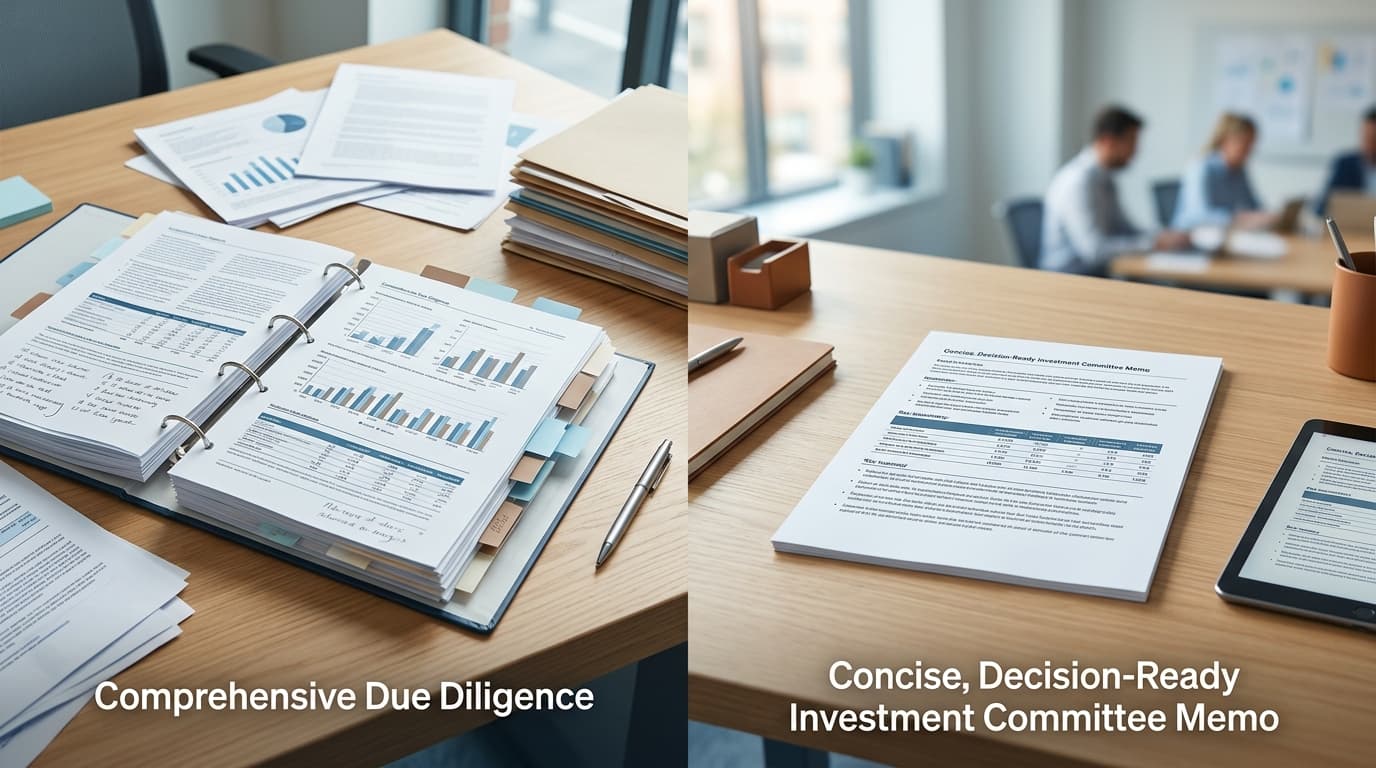
Traditional due diligence is slowed by siloed workstreams and manual data entry. Analysts spend significant hours sifting through VDRs, often missing the cross-document inconsistencies that signal deeper risks. Automated due diligence replaces this fragmented approach with a unified AI-native workspace.
According to Bain's 2024 M&A Report, deal speed has become a primary differentiator for successful private equity (PE) and venture capital (VC) funds. Automation allows teams to move from ingestion to insight without the typical operational lag. This transition does not replace the advisor but rather provides them with the analytical depth of a senior professional in a fraction of the time.
By automating the end-to-end workflow, from document classification to report generation, firms can scale their deal throughput without a proportional increase in headcount. This scalability is essential for managing concurrent mandates and cross-border transactions.
Comparing Traditional vs. Automated Due Diligence
AI-native automation delivers deeper analysis and faster turnaround than manual review. The following table outlines the core operational shifts.
| Feature | Traditional Due Diligence | Automated Due Diligence (Plausity) |
|---|---|---|
| Timeline | 4 to 8 weeks for mid-market deals | Days (e.g., 3 weeks compressed to 5 days) |
| Workstream Execution | Sequential or siloed | 9 workstreams simultaneously |
| Source Traceability | Manual citations, often incomplete | Direct links to document, page, and paragraph |
| Risk Identification | Human-dependent, prone to fatigue | AI-driven scoring with human validation |
| Deliverables | Manual Word/PPT formatting | Automated, investor-ready reports |
This comparison highlights that automation is not just about speed. It is about the consistency of the analytical framework applied across every document in the data room.
Simultaneous Analysis Across 9 Workstreams
Automated platforms run multiple workstreams concurrently to identify cross-workstream risks. Plausity covers nine distinct areas of diligence simultaneously, ensuring that findings in one area are cross-referenced with others.
- Commercial DD: Market position, revenue quality, and customer churn analysis.
- Financial DD: Quality of earnings, EBITDA (Earnings Before Interest, Taxes, Depreciation, and Amortization) normalization, and net debt reconciliation.
- Legal DD: Contract portfolio review and change-of-control clause detection.
- Tax DD: Multi-jurisdictional exposure and transfer pricing audits.
- Organisation & Compliance: Governance mapping and regulatory adherence.
- Tech & Cybersecurity: Architecture debt and vulnerability assessments.
- ESG: Regulatory mapping under CSRD and SFDR.
- Website Compliance: Privacy policy and tracking consent verification.
This cross-workstream reasoning allows the AI to detect inconsistencies, such as discrepancies between management accounts and audited financials, which might be missed in siloed reviews.
Source Traceability and Institutional Defensibility
For investment committees and limited partners (LPs), the defensibility of a due diligence report is paramount. Automated due diligence ensures that every finding is backed by a verifiable audit trail. Every risk identified is linked directly to the specific document, page, and paragraph from which it was derived.
Confidence scoring further enhances this transparency. The AI distinguishes between confirmed facts found in the data room and inferences that require further management inquiry. This allows deal leads to focus their attention on high-uncertainty areas rather than manual verification.
A Big Four Advisory partner noted that using Plausity cut their commercial DD timeline from three weeks to five days on a mid-market transaction. This efficiency was achieved without sacrificing the depth of the final report, as every conclusion remained fully traceable to the source materials.
Enterprise Security and Compliance Standards
Handling sensitive M&A data requires the highest levels of security. Automated platforms must adhere to rigorous standards to ensure data integrity and confidentiality. Plausity is built with an enterprise-first security architecture.
- Certifications: SOC 2 Type II, ISO 27001, and ISO 42001 (AI governance).
- Regulatory Compliance: Fully compliant with GDPR and the EU AI Act.
- Data Privacy: Client data is never used to train AI models.
- Encryption: AES-256 at rest and TLS 1.3 in transit.
These standards ensure that the automation process meets the requirements of global financial institutions and legal firms. Security is not an add-on but a core component of the analytical engine.
From Findings to Value Creation Roadmaps
Due diligence value extends beyond the deal closing. Automated platforms convert DD findings into prioritized post-acquisition roadmaps. These 100-day plans are scored by financial impact and ease of implementation.
By mapping risks directly to value creation opportunities, deal teams can provide their portfolio operations colleagues with a head start. This integration ensures that the insights gained during the high-pressure DD phase are not lost during the transition to ownership.
Deliverables are generated in investor-ready formats, including Word, PowerPoint, and PDF. These reports are dynamically structured based on actual findings, allowing senior advisors to spend their time on strategic recommendations rather than document formatting.