What a private equity research tool is (and is not)
A private equity research tool is an instrument that supports the entire investment workflow, from the first screen of a target to the materials the investment committee reads before approving capital. It is defined less by any single task it performs than by what it preserves: structured evidence that stays attached to the deal as it moves through the deal flow process, which Carta describes as sourcing, screening and evaluation, due diligence, investment committee, deal document negotiation and closing. That sequence is the yardstick. A tool that helps at one stage but forces the team to rebuild its work at the next is not a workflow tool, however impressive its output looks in isolation.
The distinction matters because most research tooling in PE is single-task by design. A market sizing utility, a standalone expert-call transcript service and a chatbot pointed at a data room each produce output, but none of them carries context forward. A workflow-level tool does three things a utility cannot: it ingests the deal's actual document base, it structures findings so every claim traces to a source, and it keeps that evidence base connected as the deal advances from screening memo to confirmatory diligence to IC paper. That is the practical difference between purpose-built diligence software and generic chatbots, and it is why the modern deal team AI stack is assembled around the workflow rather than around individual deliverables.
The core chain the tool must serve
- Research: screening targets, building market understanding, forming the initial thesis.
- Diligence: reviewing the data room, running commercial, financial, legal and operational workstreams, testing the thesis against evidence.
- Findings: source-grounded red flags, risk registers and management questions that a committee can interrogate.
- Decision support: IC materials that assemble the evidence into a defensible recommendation, with the decision itself left to the humans.
What such a tool must never do is equally clear. It should not make autonomous investment decisions, replace investment professionals or substitute for advisors and expert calls. As Third Bridge puts it, AI in PE does not replace analysts, make investment decisions or remove the need for expert calls; it restructures how information is processed inside the diligence workflow, and investment judgment remains human. A vendor that claims otherwise is describing a product that no institutional investor should buy, which is also why high-conviction investment decisions rest on evidence rather than on automation.
Why isolated research output breaks the deal workflow
Deal teams do not lose context in one dramatic failure. They lose it in small handoffs: the screening note that lives in one analyst's spreadsheet, the expert-call themes captured in a chat thread, the CIM summary that never makes it into the diligence question list. Each handoff strips away the reasoning behind the finding, so the next stage starts from the conclusion without the evidence. By the time the IC memo is drafted, the team is often reconstructing analysis from memory rather than assembling documented work.
The economics make this expensive. Industry funnel data supports roughly 100 opportunities reviewed or evaluated for every one or two transactions completed. At that funnel width, research produced in disconnected tools is not just inefficient, it is waste at scale: the firm pays for analysis on dozens of declined deals and then cannot retrieve any of it when a similar company reappears eighteen months later. That is why institutional intelligence built from past deals matters as much to fund investment teams as any single screen, and why past-deal knowledge should be searchable and reusable rather than archived.
Timelines leave no room for rework
Compression compounds the problem. In a competitive auction the sequence is fixed and tight: teasers and NDAs, then the CIM, then indications of interest, then expanded data room access for selected bidders, before the winning bidder moves into confirmatory diligence and signing. Street of Walls puts the confirmatory diligence phase between the first round bid and the final binding bid at approximately 3 to 6 weeks. A workflow that requires re-creating evidence at every stage cannot fit inside those windows without cutting scope, and cut scope is exactly what diligence exists to prevent. Context-aware analysis matters most precisely where the calendar is fixed.
- Findings without sources: a red flag noted in a call summary that nobody can trace back to the document or conversation that triggered it.
- Questions without evidence: management question lists drafted fresh for each meeting instead of built from documented gaps in the data room review.
- IC memos rebuilt from scratch: committee papers reassembled from email threads and individual recollections because no shared evidence base exists.
- Lost institutional memory: the reasoning behind declined deals, which is the firm's largest dataset, sitting unretrievable in inboxes and departed analysts' heads.
The full workflow: from target screening to investment committee
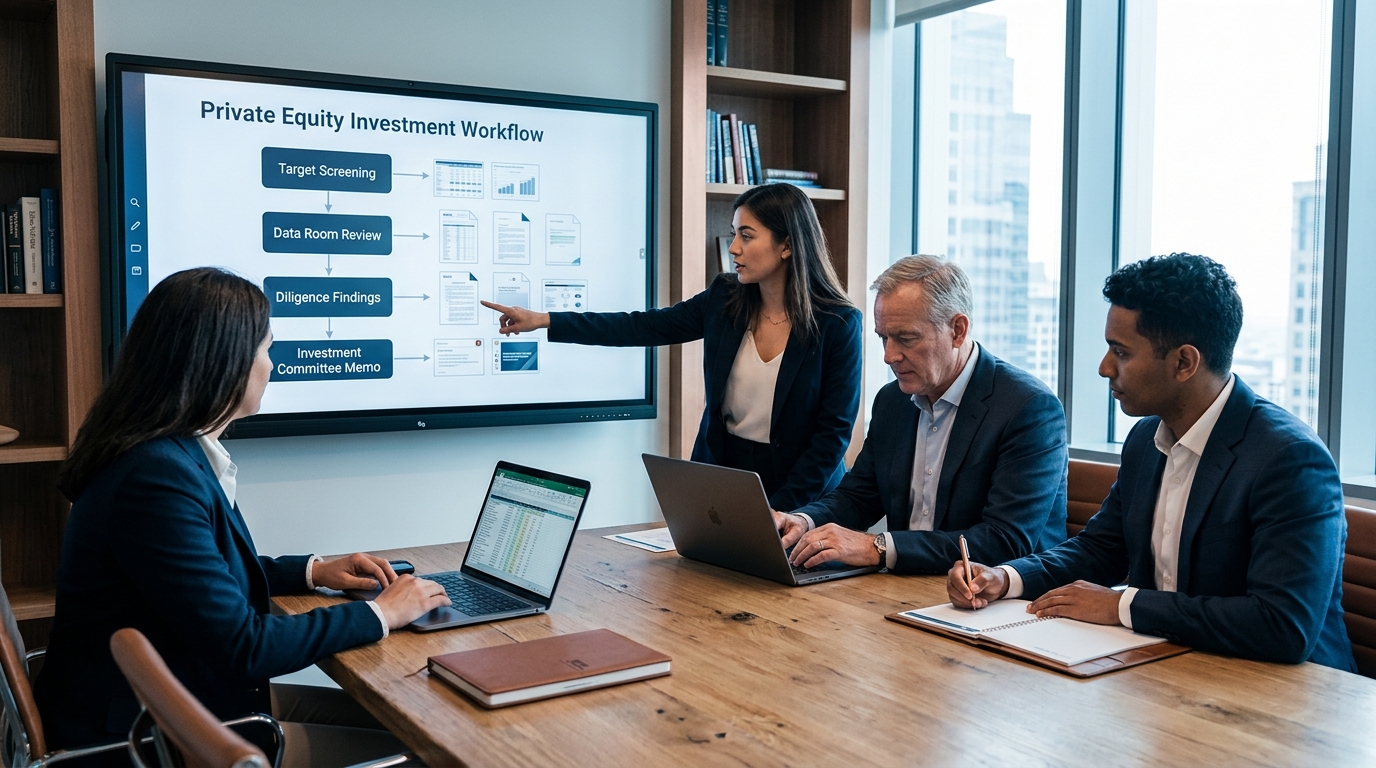
A research tool earns its place by supporting eleven connected stages, where each stage consumes the outputs of the one before it. Screening produces a shortlist and a hypothesis. Market understanding turns that hypothesis into a tested view of the sector. Company research and diligence preparation convert the thesis into a question list and a data room plan. The data room review feeds the commercial, financial, operational, legal and technology workstreams. Those workstreams produce findings and red flags, findings generate management questions, and the answers feed the investment committee paper. What the committee approves, and what the firm learns from the deals it declines, becomes reusable institutional knowledge for the next screen.
Where the timeline tightens
Two points in this chain are structurally time-boxed. Confirmatory diligence, the phase between the first-round bid and the final binding bid, averages approximately 3 to 6 weeks, during which the deal team works the target exclusively, manages consultants across workstreams and negotiates financing in parallel. Carta frames the same structure as two phases: exploratory diligence on the CIM and public signals, then confirmatory diligence after the letter of intent, when the question shifts from whether the target is a good investment to what the risks are and how to price them.
The decision document that assembles this work is the Preliminary Investment Memorandum, typically 30 to 40 pages, covering the executive summary and thesis, company and market overview, financial analysis, risks and key diligence areas, valuation, exit thinking and the proposed project plan. Every section of a PIM is downstream of research done earlier in the chain. When that research is source-grounded and retrievable, the PIM is an assembly job, which is why version control over diligence findings matters at the committee stage. When it is not, the PIM becomes a rebuild, under deadline, from fragments.
| Workflow stage | Consumes from the previous stage | Produces for the next stage |
|---|---|---|
| Target screening | Fund strategy and sector mandates | Shortlist and preliminary hypothesis |
| Market understanding | Shortlist, prior deal knowledge | Tested market view and benchmark context |
| Initial investment thesis | Market view | Thesis assumptions to verify |
| Company research and diligence preparation | Thesis assumptions | Question lists and diligence plan |
| Data room review | Diligence plan, VDR access | Document base with extracted evidence |
| DD workstreams (commercial, financial, operational, legal, tech) | Extracted evidence | Workstream findings and open items |
| Findings and red flags | Workstream findings | Ranked risks with sources |
| Management questions | Gaps and red flags | Evidence-backed question list |
| IC preparation | All of the above | PIM and IC materials |
| Reusable institutional knowledge | Committee outcome and declined-deal reasoning | Faster, better-grounded next screen |
What a professional research tool should do: a capability framework
Evaluate any PE research tool against what the workflow demands, not against demo output. Three capability layers separate institutional-grade tooling from a clever interface, and the test at each layer is whether evidence survives the handoff to the next stage.
- Ingestion and document analysis. The tool should connect to virtual data rooms and process the full document base: PDFs, spreadsheets, contracts and financial models, plus management materials and public sources. Analysis across thousands of documents, cross-referenced rather than summarised one at a time, is the baseline; a tool that only reads what you manually upload caps the workflow at its narrowest point.
- Source-grounded findings and structured risk registers. Every finding should trace to the document, page or conversation it came from, and risks should be ranked by materiality, financial impact and deal relevance rather than listed flat. This is the layer generic AI fails: outputs must be linked to identifiable sources so analysts can verify the claim and defend the conclusion, which is where most generic tools fall short.
- Workstream coordination and IC-ready outputs. Diligence is a team sport across commercial, financial, legal and operational threads, so the tool needs shared workspaces, task assignment and expert-in-the-loop review. Its outputs should be citation-linked evidence packs that withstand committee scrutiny, and the platform should retain past-deal knowledge so the next screening starts from institutional memory instead of a blank page.
Applied together, the framework answers one question: when a finding moves from the data room review to the risk register to the IC memo, does anything get lost? Purpose-built platforms answer it by connecting an AI analysis engine to findings and risk intelligence, so cross-referenced document analysis feeds materiality-ranked findings rather than a standalone summary. A tool that scores well on layer one but cannot evidence layer two will produce fast, unverifiable conclusions, which is worse than slow, verifiable ones.
Red flags and limitations: where a research tool stops
Honest limits come first. A research tool does not make investment decisions, replace analysts or remove the need for expert calls and external advisors. It restructures how information is processed: compressing mechanical review, surfacing contradictions and freeing analyst time for hypothesis refinement and strategic questioning. The decision on whether to deploy capital remains human, and any tool that implies otherwise is misdescribing itself.
The second limitation is grounding. Generic, ungrounded AI introduces hallucinated conclusions that cannot be traced to a reliable source, no audit trail for committee or regulatory scrutiny, and unclear data provenance. In an environment where investment decisions must be defensible, those risks are structural, not cosmetic. Expert calls, customer references and advisor judgment remain sources the tool cannot replace; primary evidence gathered outside the data room still has to be validated by people.
Vendor red flags to screen for
A structured evaluation helps here: asking vendors pointed questions about traceability, workflow coverage and evidence handling before signing, the same discipline recommended for choosing between advisory, software and hybrid diligence providers. The tool that passes is the one that strengthens defensibility, not the one that promises the most.
How Plausity supports this workflow
Mapped against the stages above, an AI-native due diligence and deal intelligence platform built for VC and PE fund investment professionals covers the chain from ingestion to IC preparation. The mapping below is factual, not a promise of outcomes: human investment judgment remains central at every stage.
| Workflow stage | Platform capability |
|---|---|
| Diligence preparation and data room review | Data Room Ingestion connects to virtual data rooms and processes PDFs, spreadsheets, contracts and financial models within minutes, building the document base the workstreams run on. |
| DD workstreams and findings | The AI-Analysis Engine reads, interprets and cross-references the document base to generate structured findings across commercial, financial, legal, tax and tech workstreams. |
| Findings and red flags | Risk Radar evaluates findings by materiality, financial impact, legal exposure and deal relevance, surfacing key risks and anomalies in a ranked register. |
| IC preparation | Report Builder drafts and structures investor-ready due diligence deliverables with full source traceability, so committee materials cite the evidence behind every claim. |
| Team coordination and institutional knowledge | Collaboration Hub coordinates the deal team across workstreams with task assignment, expert-in-the-loop review and audit trails, keeping evidence shared rather than siloed. |
Two aspects deserve emphasis for teams thinking about the full lifecycle. First, the workflow is configurable: ready-to-deploy custom workflows extend the same evidence chain to IC materials generation, target screening and comps analysis, so screening and diligence run on one foundation. Second, coordination is a first-class capability rather than an afterthought, because findings that live in one analyst's inbox do not survive the handoff to the committee; the Collaboration & Workflow workspace exists precisely to keep workstreams, comments and review trails attached to the deal. Teams that want to see the full sequence in one place can review how the platform runs from upload to investor-ready report.
How to use this in your next diligence workflow
The framework converts into three practical moves on your next deal, none of which requires changing how your committee decides.
- Audit your current workflow for handoff losses. Before the next deal kicks off, trace one recent deal end to end and mark every point where evidence was re-created instead of carried through: the screening thesis retyped into the diligence plan, the data room findings that never reached the question list, the IC memo rebuilt from email threads. Each re-creation point is where context died, and each one is a candidate for a connected workflow.
- Run one live deal through a connected chain. Take a single active deal from data room ingestion through findings, risk register, management questions and IC materials, with one rule: every finding must cite its source document before it moves to the next stage. The test is not speed on day one; it is whether the IC paper assembles from existing, traceable work rather than a late-night rebuild, and whether every claim in the room can be defended when a committee member asks where it came from.
- Capture what the deal produced. After the decision, archive the evidence base, the reasoning behind declined theses and the questions that proved decisive, so past-deal knowledge becomes searchable and reusable at the next screening. Keep the investment decision itself where it belongs: with the committee, on the basis of defensible evidence.
The through-line is the one this article started with: research, diligence, findings and decision support are one chain, and the value of a private equity research tool is measured by how much evidence survives the journey from first screen to investment committee. Firms that close that chain get faster processes and, more importantly, decisions that hold up under scrutiny, while the judgment on the deal stays exactly where it has always been.
How Plausity accelerates this workflow
Plausity is an AI-native due diligence and deal intelligence platform that helps M&A advisory firms, VC and PE funds, corporate development teams and investment-banking teams structure evidence, findings and questions across a data room. Plausity supports evidence extraction, source grounding, findings management and IC preparation — it does not replace human analysts, advisers or investment professionals, does not provide legal, tax, audit, regulatory or investment advice, and does not make autonomous investment decisions. All findings require human review.
To explore the underlying capabilities, see the Plausity AI analysis engine and the findings and risk intelligence product page. For team-level workflows, see how VC and PE funds and M&A advisory firms use Plausity across live deals.