Why AI belongs in the diligence scope
AI can materially affect a target company’s competitive position, operating model, cost base and future growth. It can change what customers are willing to pay for, how quickly a competitor can replicate an offering, and how much a business must invest simply to stay relevant.
Traditional due diligence explains how a company has performed and why its customers buy. It does not always reveal whether the economic basis of that performance could change during the investment period.
This playbook provides a practical framework for private equity, venture capital, M&A advisory and corporate development teams assessing the impact of AI during due diligence — without treating AI as automatically a threat or automatically an opportunity. High exposure does not guarantee disruption, and an AI roadmap is not evidence of commercial impact.
What the playbook covers
- AI disruption and competitive exposure — where demand, pricing and differentiation are most likely to shift, and which barriers to entry still hold.
- Business-model and product defensibility — whether customer relationships, workflow integration, proprietary data rights, domain expertise and regulation continue to protect the business.
- Operational and financial value-creation opportunities — separating credible margin, capacity and growth upside from unproven ambition.
- Key risks, management questions and evidence requirements — what to ask management, and what evidence should stand behind the answer.
It also sets out how to size the work: every deal deserves an initial AI-impact screen, but not every deal needs a full AI workstream.
Inside the guide
Twelve pages, structured for use inside a live deal process.
- 01 Why now? — Why historical diligence alone may not capture AI-related change
- 02 What is AI Impact Due Diligence? — A forward-looking assessment of the investment case
- 03 Determining materiality — When AI deserves deeper attention in a deal process
- 04 Business-model disruption — How AI can affect demand, pricing and competitive advantage
- 05 AI-driven value creation — Separating credible opportunity from unproven ambition
- 06 Execution readiness — Whether the target can deliver within the investment period
- 07 Common weaknesses in AI narratives — Where deal teams should remain sceptical
- 08 The investment conclusion — What a robust assessment should establish
- 09 Connecting the workstreams — Why AI Impact Due Diligence is inherently cross-functional
Plausity’s AI Impact Due Diligence stream
Plausity runs AI Impact Due Diligence as a defined workstream alongside commercial, financial, technology and legal diligence, rather than as a separate technology opinion delivered after the fact.
The work is delivered on the Plausity platform: the data room is ingested, exposure and defensibility questions are worked through against the target’s own documents, and every finding stays linked to the source it came from — so an investment committee can see what supports each conclusion and where evidence is missing.
The output is designed to feed the underwriting case and the value-creation plan: which assumptions in the thesis depend on AI, what additional investment they imply, and which questions management still has to answer. It complements — rather than replaces — specialist commercial, technical and legal advice.
Frequently Asked Questions
Free guide · PDF
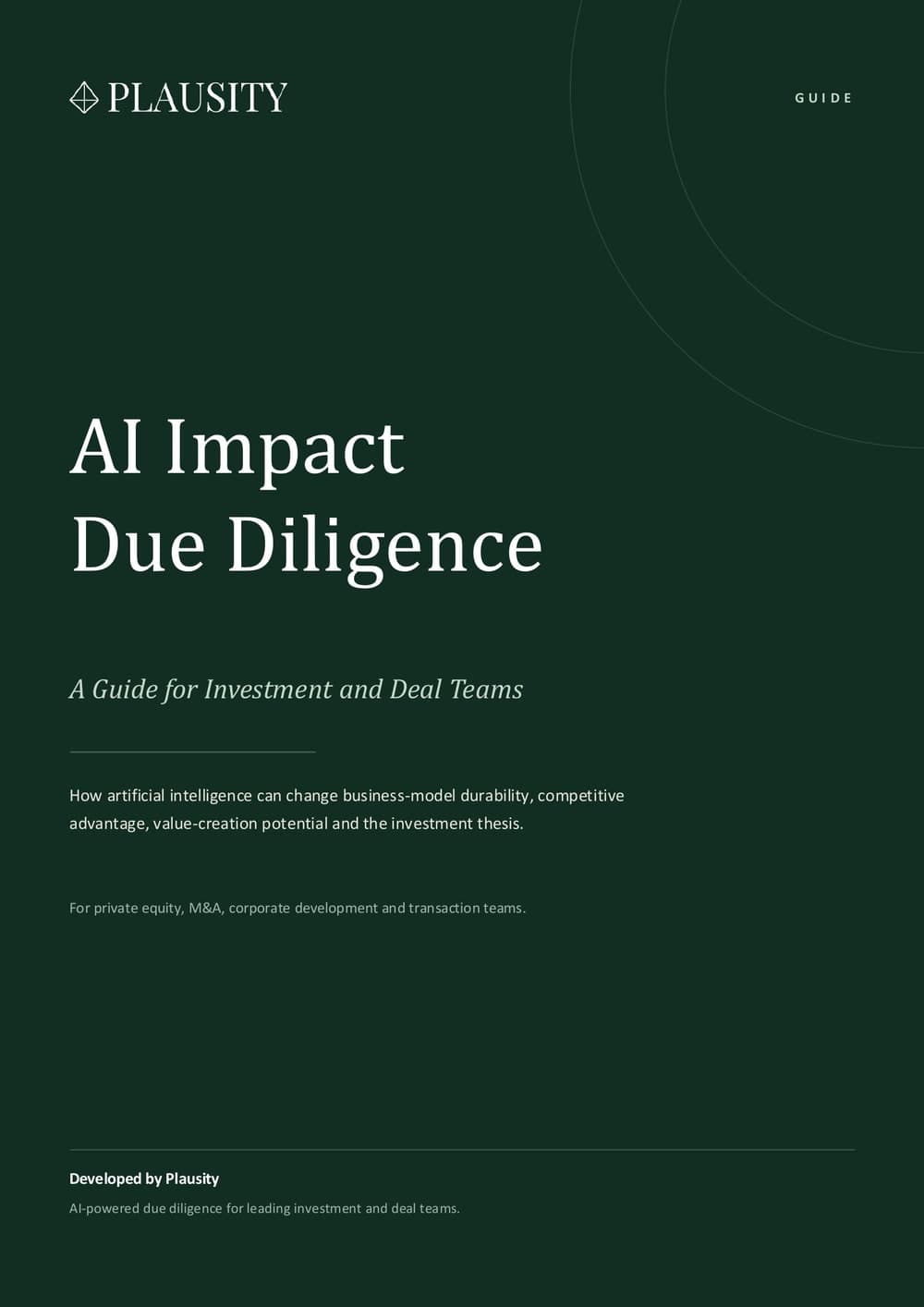
AI Impact Due Diligence
A Guide for Investment and Deal Teams — how AI can change business-model durability, competitive advantage, value-creation potential and the investment thesis.
Stay ahead
Get the next guide before everyone else
Practical due diligence frameworks, deal-team research and product updates from Plausity. No spam — unsubscribe any time.