Indice
L'Evoluzione della Metodologia di Due Diligence
The transition from manual checklists to AI-native workspaces represents a fundamental shift in how transaziones are executed. In 2026, 86% of organizations have integrated generative AI into their M&A workflows, according to Deloitte research. However, the value lies not in the AI itself, but in its application within a structured due diligence framework.
Traditional methods often result in fragmented insights. Financial teams analyze conti gestionali while legal teams review contracts, often without a mechanism to reconcile the two. An AI-native approach allows for cross-documento reasoning, where the system triangulates data across the entire data room to detect inconsistencies that human reviewers might miss in isolation.
- Revisione Manuale: Sequential, siloed, and prone to sampling bias.
- AI-Native Review: Simultaneous, integrated, and comprehensive across all documentos.
This evolution allows team di transaziones to focus on high-level strategy and negotiation rather than the operativo burden of documento processing. The goal is to augment human expertise, ensuring that senior advisor control the conclusions while the AI handles the analytical heavy lifting.
Il Framework Simultaneo dei 9 Workstream
Modern due diligence must cover the full spectrum of risk and opportunity. Plausity facilitates this by running 9 workstreams simultaneously, ensuring no critical area is overlooked. This integrated approach is essential for identifying how risks in one area, such as cybersecurity, impact valuation in another, such as financial projections.
| Workstream | Core Focus Areas | Critical Risk Indicators |
|---|---|---|
| Commercial DD | Mercato position, customer churn, qualità dei ricavi | High concentrazione dei clienti (>30%), declining mercato share |
| Financial DD | Quality of Earnings (QoE), EBITDA normalization | Unexplained adjustments, capitale circolante volatility |
| Legal DD | Change-of-control clauses, contenzioso, diritti di proprietà intellettuale | Restrictive termination clauses, unresolved disputes |
| Tax DD | Transfer pricing, multi-jurisdictional liabilities | Unrecorded tax contingencies, aggressive structures |
| Org & Conformità | Governance, GDPR, regolatorio adherence | Cultural misalignment, conformità gaps (FCPA, SOX) |
| Tech DD | Architecture, debito tecnico, scalabilità | Outdated legacy systems, high remediation costs |
| Cybersecurity | Vulnerability assessment, security maturity | History of breaches, lack of SOC 2 conformità |
| ESG | CSRD/SFDR conformità, greenwashing detection | Supply chain ethics, environmental liabilities |
| Website Conformità | Privacy policies, cookie consent, accessibility | Non-conformità with WCAG 2.1 AA or GDPR |
By addressing these workstreams concurrently, team di transaziones can map risks across the entire target organization. For instance, a finding in the Tech DD workstream regarding debito tecnico can be immediately quantified in the Financial DD workstream as a future capital expenditure requirement.
Identificazione dei Rischi e Scoring della Materialità
The primary objective of due diligence is to surface material risks that could derail a deal or impact valuation. Modern piattaformas utilize an AI Analisi Engine to read and reason across thousands of documentos, applying domain-specific frameworks tailored to over 30 industry verticals. This ensures that the analisi is grounded in the specific regolatorio and competitive realities of the target's sector.
Materialità scoring is the process of quantifying the impact of each finding. Risultati are scored based on financial impact, legal exposure, and deal relevance. This allows the team di transazione to prioritize segnale d'allarmes and focus their attention on the issues that truly matter for the comitato di investimento.
- Detection: Identifying anomalies and risks across the data room.
- Triangulation: Validating risultati by cross-referencing multiple sources.
- Scoring: Asfirma a materialità score based on predefined deal criteria.
- Reporting: Surfacing segnale d'allarmes in real-time executive briefings.
This structured approach prevents the "information overload" common in large data rooms, where critical risks are often buried under thousands of routine documentos. Instead, the deal lead receives a prioritized summary of issues that require immediate attention.
Tracciabilità delle Fonti e Human-in-the-Loop
A significant challenge in traditional due diligence reports is the lack of direct evidence. Risultati are often summarized without clear links to the source material, making verification a time-consuming process. Plausity solves this through absolute tracciabilità delle fonti. Every finding, risk score, and observation is linked directly to the specific documento, page, and paragraph in the data room.
This transparency is coupled with scoring di confidenza, which distinguishes between confirmed facts and inferences. This allows the team di transazione to understand the strength of the evidence behind every claim. It also creates a robust audit trail, which is essential for reporting agli LP and regolatorio conformità under frameworks like the EU AI Act and GDPR.
The principle of "human-in-the-loop" is central to this methodology. While the AI automates the identification and classification of data, human experts remain in control of the conclusions and recommendations. The piattaforma serves as a collaborative workspace where experts can review AI-generated risultati, add context, and finalize the deal narrative. This ensures that the final report reflects the nuanced judgment of a senior advisor.
Compressione dei Tempi: Da Settimane a Giorni
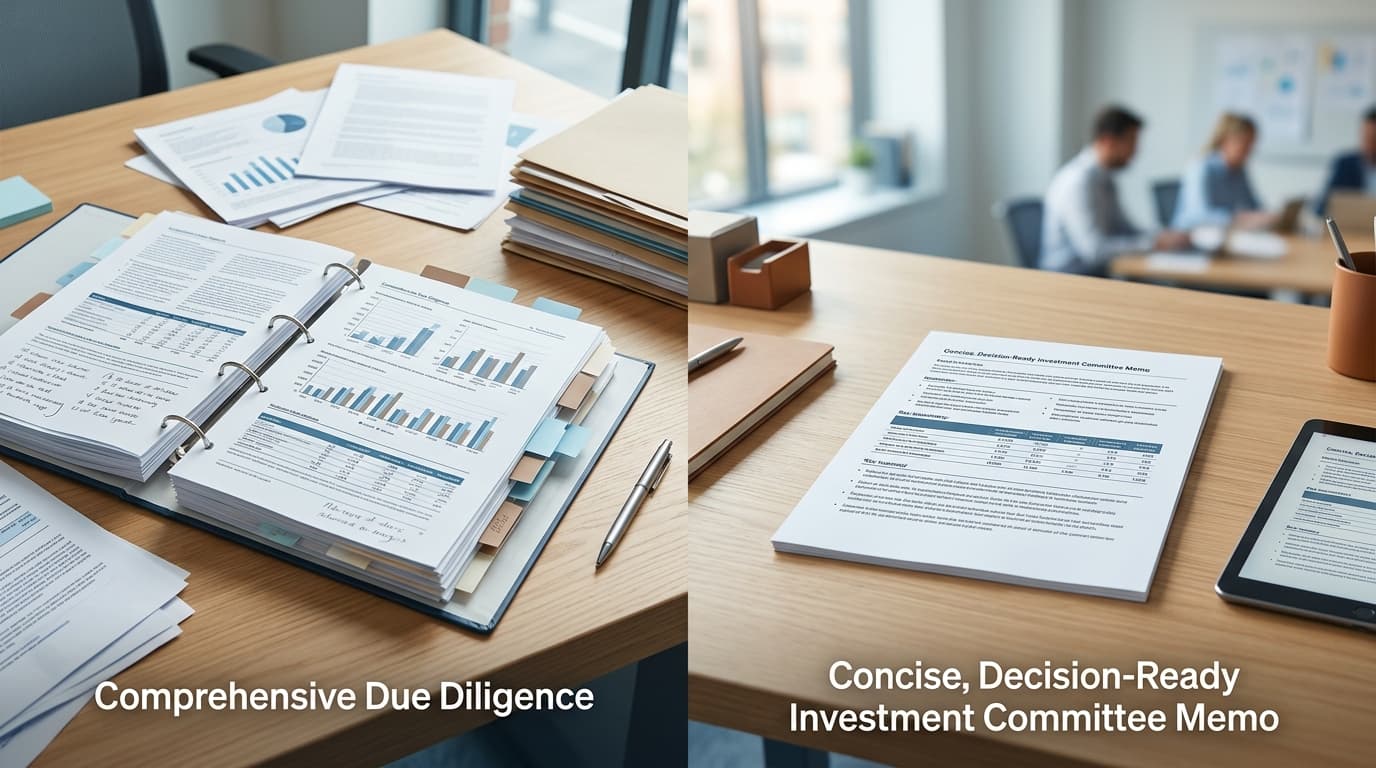
Speed is a competitive advantage in M&A. Traditional commercial due diligence for a mid-mercato transazione typically requires three to four settimane. By automating the operativo and analytical work, team di transaziones can compress these timelines significantly without sacrificing depth. A Big Four Advisory partner reported cutting their commercial due diligence timeline from three settimane to five giorni on a mid-mercato transazione using Plausity.
This compression is achieved through several key capabilities:
- Automated VDR Ingestion: Documentos are classified and structured as soon as they are uploaded.
- Parallel Processing: All 9 workstreams run concurrently rather than sequentially.
- Dynamic Report Generation: Investor-ready deliverables are built as the analisi progresses.
Reducing the time spent on revisione manuale allows the team di transazione to engage in more meaningful discussions with management and refine the post-acquisizione strategy. In a competitive bidding environment, the ability to reach a high-conviction decision faster can be the difference between winning and losing a deal.
Report Pronti per gli Investitori e Creazione di Valore
The final output of the due diligence process must be more than a list of risks; it must be a roadmap for the future. Modern due diligence piattaformas generate pronti per gli investitori reports, segnale d'allarme summaries, and executive briefings in formats like Word, PowerPoint, and PDF. These deliverables are dynamically structured based on the risultati, ensuring that the most critical information is presented clearly to the board and comitato di investimento.
Beyond the closing of the deal, the risultati from the due diligence process are converted into prioritized post-acquisizione roadmaps. These 100 giorni plans include financial impact estimates and specific remediation steps for identified risks. This ensures that the creazione di valore process begins the moment the transazione is finalized.
Security remains paramount throughout this process. Plausity maintains the highest standards of enterprise security, including SOC 2 Type II, ISO 27001, and ISO 42001 certifications. Client data is never used to train AI models, and all data is protected by AES-256 encryption at rest and TLS 1.3 in transit. This level of rigor ensures that sensitive transazione data remains confidential and secure.
Punti Chiave
- Modern pre-acquisizione due diligence requires an integrated, 9-workstream approach that runs simultaneously to identify cross-functional risks and opportunities.
- Source traceability is critical for auditability; every finding must be linked to the specific documento, page, and paragraph to ensure transparency and trust.
- AI-native workflows can compress due diligence timelines by up to 70%, allowing team di transaziones to move from three settimane to five giorni for complex mid-mercato transaziones.
Domande Frequenti
What are the most critical workstreams in pre-acquisizione due diligence?
The most critical workstreams include Commercial, Financial, Legal, Tax, Organisation & Conformità, Tech, Cybersecurity, ESG, and Website Conformità. Modern due diligence frameworks analyze all 9 workstreams simultaneously to ensure a comprehensive risk profile.
How does AI improve the due diligence process?
AI improves due diligence by automating documento classification, extracting structured data, and performing cross-documento reasoning. This identifies inconsistencies and risks across thousands of documentos in ore, which would take human teams settimane to process manually.
What is tracciabilità delle fonti in M&A due diligence?
Source traceability is the ability to link every finding in a due diligence report back to the exact documento, page, and paragraph in the virtual data room. This ensures that all insights are verifiable and provides a robust audit trail for investors and regulators.
Can AI replace human advisors in due diligence?
No, AI does not replace human advisors. Instead, it augments them by handling the repetitive analytical and operativo work. Human experts remain in control of the final conclusions, recommendations, and strategic deal decisions.