Indice
Il Panorama in Evoluzione della Due Diligence Legale nel 2026
The M&A environment in 2026 is characterized by increased regolatorio scrutiny and a high volume of mid-mercato transaziones. According to 2024 industry data, deal professionals are managing more concurrent mandates than in previous cycles, placing a premium on analytical efficiency. Traditional legal due diligence often suffers from fragmentation, where contract review happens in isolation from financial or commercial risultati. A siloed approach increases the likelihood of missing 'segnale d'allarme' risks that only become apparent when data is triangulated across multiple sources.
Modern LDD requires a shift toward integrated workspaces. Instead of treating a virtual data room (VDR) as a mere storage locker, advisors are using piattaformas that ingest, classify, and analyze documentos simultaneously. This approach allows for the immediate identification of missing documentoation and the automated extraction of key terms across the entire contract landscape. The goal is not to replace the legal expert but to provide them with a prioritized roadmap of material risks, allowing senior partners to focus their judgment on high-impact legal strategy rather than manual documento sorting.
Rischi Contrattuali Critici: Oltre la Superficie
Identifying contract risks requires a deep understanding of how specific clauses impact the post-acquisizione entity. Change-of-control (CoC) provisions are among the most critical, as they can trigger termination rights or fee escalations upon the completion of a deal. Without a comprehensive review, an acquirer might find that key customer or supplier relationships are legally voidable the moment the transazione closes. Similarly, overly broad indemnification clauses or restrictive non-compete agreements can severely limit the operativo flexibility of the combined company.
Primary contract risks and their potential impact on deal value include:
| Risk Category | Key Clauses to Monitor | Potential Deal Impact |
|---|---|---|
| Change of Control | Assignment rights, consent requirements, termination triggers | Loss of key revenue streams or critical supply chain disruptions |
| Termination Rights | Termination for convenience, notice periods, break fees | Instability in customer base and unpredictable cash flows |
| Liability & Indemnity | Caps on liability, survival periods, third-party claims | Unquantified financial exposure and post-closing contenzioso |
| Restrictive Covenants | Non-compete, non-solicitation, exclusivity | Limitations on mercato expansion and talent retention |
| Intellectual Property | Ownership transfers, licensing restrictions, encumbrances | Erosion of competitive advantage and valuation write-downs |
Effective risk identification involves scoring these risultati based on their financial impact and deal relevance. For instance, a CoC clause in a contract representing 15% of annual revenue is a high-priority segnale d'allarme, whereas the same clause in a minor utility contract may be categorized as a low-level observation. AI-native tools help this prioritization by mapping risks across 30+ industry verticals with tailored frameworks.
Compressione dei Tempi: Da Tre Settimane a Cinque Giorni
The duration of the due diligence phase is a significant bottleneck in M&A. Historically, a thorough commercial and legal review for a mid-mercato target could take three settimane or more. Such delays increase deal fatigue and exposes the transazione to mercato volatility. However, the integration of AI-native analisi has fundamentally altered this timeline. A Big Four Advisory partner recently reported cutting a commercial DD timeline from three settimane to just five giorni by utilizing an automated workflow that handles ingestion, analisi, and report generation concurrently.
Advisors achieve this speed through the simultaneous execution of 9 DD workstreams. While the legal team reviews contract portfolios, the financial team analyzes quality of earnings, and the tech team assesses architecture. An AI-native workspace like Plausity ensures that these workstreams are not siloed. If a legal review identifies a significant contenzioso risk, the piattaforma can automatically flag the potential financial impact for the tax and financial DD teams. This cross-workstream synthesis ensures a holistic view of the target company's risk profile in a fraction of the traditional time.
Tracciabilità delle Fonti: Il Fondamento della Fiducia
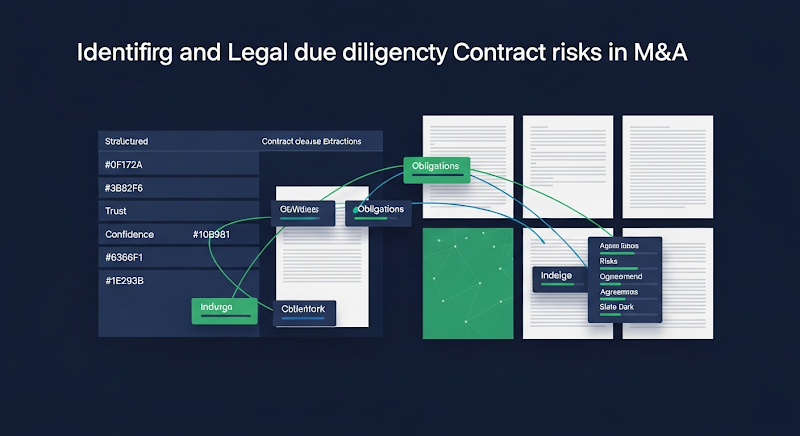
An observation without a source is a liability. Traditional DD reports often summarize risultati without providing immediate access to the underlying evidence. This forces senior advisor to spend ore re-verifying the work of junior analysts. Source traceability solves this problem by linking every finding directly to the specific documento, page, and paragraph in the data room. This level of granularity provides an immutable audit trail that is essential for pronti per gli investitori deliverables.
Confidence scoring further enhances this process. By distinguishing between confirmed facts found in the text and inferences drawn from multiple documentos, AI-native piattaformas allow advisors to assess the reliability of each finding. For example, if a piattaforma identifies a potential change-of-control risk but the relevant page is partially obscured, the punteggio di confidenza will reflect this uncertainty. This 'human-in-the-loop' principle ensures that while the AI handles the analytical heavy lifting, the final conclusions remain firmly under the control of human experts.
Sicurezza e Conformità nella Due Diligence AI-Native
Handling sensitive transazione data requires more than just standard encryption. Deal professionals must ensure that their DD workspace adheres to the highest global security standards. This includes certifications such as SOC 2 Type II, ISO 27001, and the newly established ISO 42001 for AI governance. Conformità with the EU AI Act and GDPR is non-negotiable for cross-border transaziones involving European entities.
A critical differentiator for AI-native piattaformas is the treatment of client data. Professional M&A piattaformas must guarantee that client data is never used to train AI models. This ensures that proprietary deal information remains confidential and does not leak into the broader ecosystem. Security measures such as AES-256 encryption at rest and TLS 1.3 in transit are the baseline requirements for protecting the integrity of the virtual data room and the resulting DD reports.
Produzione di Report Pronti per gli Investitori
The final stage of legal due diligence is the communication of risultati to stakeholders. Senior advisors often spend a disproportionate amount of time formatting reports, executive briefings, and management presentations. An AI-native workflow automates this process by dynamically structuring reports based on the actual risultati identified during the analisi phase. These deliverables are not generic templates; they are tailored summaries that highlight segnale d'allarmes and material risks in a format ready for board-level review.
Whether exporting to Word, PowerPoint, or PDF, these reports maintain the tracciabilità delle fonti established during the analisi. This allows investors to click through a summary finding and see the exact contract clause that generated the risk. By automating the operativo overhead of report generation, advisory firms can increase their throughput and focus on delivering high-value strategic advice. This transition from raw data to actionable intelligence is what defines the modern approach to M&A due diligence.
Punti Chiave
- AI-native workspaces compress DD timelines by running 9 workstreams simultaneously, reducing commercial and legal review from settimane to giorni.
- Source traceability is essential for auditability, linking every finding to the specific documento, page, and paragraph with scoring di confidenza.
- Enterprise security and conformità, including SOC 2 Type II and ISO 42001, are critical for protecting sensitive M&A data and ensuring regolatorio alignment.
Domande Frequenti
What are the most common contract risks in M&A?
The most common contract risks include change-of-control clauses that trigger termination, restrictive non-compete agreements, undisclosed liabilities, and intellectual property encumbrances. These risks can significantly impact the valuation and operativo continuity of the target company post-acquisizione.
How does AI improve legal due diligence?
AI improves legal due diligence by automating documento classification, extracting key terms across thousands of contracts, and identifying inconsistencies. It provides tracciabilità delle fonti, linking risultati to specific pages, which allows human experts to verify risks faster and with greater accuracy than revisione manuale.
What is a change-of-control clause in a contract?
A change-of-control clause is a provision that gives a party specific rights, such as the right to terminate the agreement or require consent, if the ownership or control of the other party changes. In M&A, these clauses are critical as they can lead to the loss of key contracts upon closing.
Why is tracciabilità delle fonti important in DD reports?
Source traceability ensures that every finding in a due diligence report can be verified against the original evidence. By linking risultati to the exact documento, page, and paragraph, it creates a transparent audit trail, reduces the time spent on manual verification, and increases the credibility of the report for investors.