The Evolution of the Due Diligence
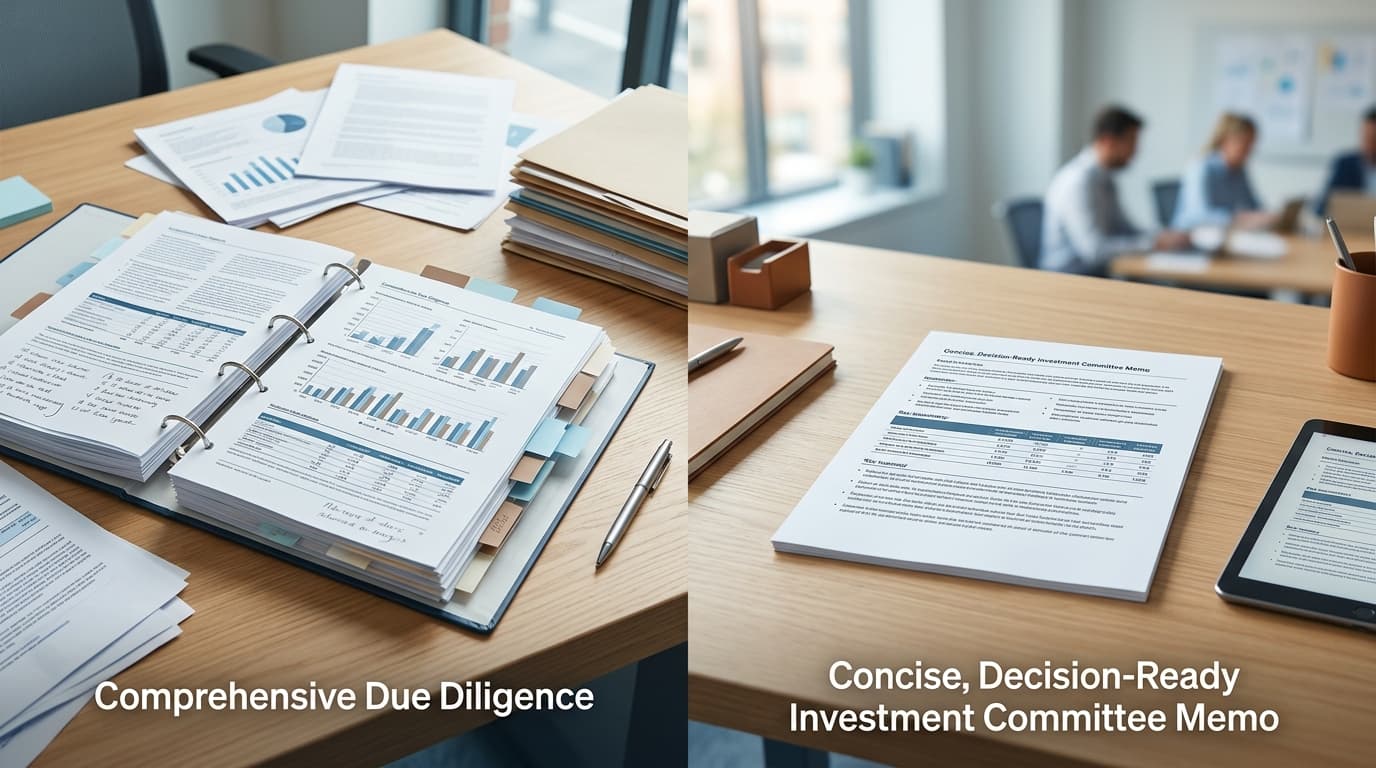
The methodology of due diligence has shifted from a purely defensive 'check-the-box' exercise to a proactive value-creation assessment. Historically, deal teams spent 70% of their time on data collection and document organization, leaving only 30% for high-level analysis. In 2026, the standard has inverted. Modern due diligence requires the simultaneous evaluation of multiple risk vectors, from cybersecurity posture to ESG compliance, all while under intense timeline pressure.
Traditional Virtual Data Rooms (VDRs) serve as repositories, but they do not provide intelligence. The transition to an AI-native workspace allows for the automated classification of documents and the extraction of structured data immediately upon ingestion. This shift enables senior advisors to focus on interpreting findings rather than searching for them. For instance, a Big Four Advisory partner recently reported that using an AI-native approach compressed a commercial DD timeline from three weeks to just five days on a mid-market transaction.
| Feature | Traditional Manual DD | AI-Augmented DD (Plausity) |
|---|---|---|
| Timeline | 4 to 8 weeks | 5 to 10 days |
| Workstream Coordination | Siloed and sequential | 9 workstreams simultaneously |
| Data Processing | Manual sampling | 100% document coverage |
| Traceability | Manual citations | Direct link to page and paragraph |
| Risk Identification | Expert-dependent | Automated scoring + Expert review |
The 9 Essential Workstreams of Modern Due Diligence
A comprehensive due diligence must address every facet of the target's operations. Siloed analysis often misses the 'inter-workstream' risks where a finding in one area impacts the valuation in another. An integrated platform analyzes these nine workstreams concurrently:
- Commercial DD: Validating market position, customer churn, and revenue quality.
- Financial DD: Normalizing EBITDA, analyzing working capital, and detecting accounting anomalies.
- Legal DD: Reviewing contract portfolios for change-of-control clauses and litigation risks.
- Tax DD: Assessing multi-jurisdictional exposure and transfer pricing.
- Organisation & Compliance: Mapping governance structures and regulatory adherence (GDPR, FCPA).
- Tech DD: Evaluating software architecture, technical debt, and scalability.
- Cybersecurity DD: Assessing vulnerability landscapes and security operations maturity.
- ESG: Scoring environmental and social risks against CSRD and SFDR frameworks.
- Website Compliance: Verifying privacy policies, cookie consent, and accessibility standards.
By running these workstreams in parallel, deal teams can identify cross-document inconsistencies. For example, if a management presentation claims a 95% customer retention rate but the underlying contract data shows high churn in the top ten accounts, an AI-native engine flags this discrepancy immediately for the human expert to investigate.
Source Traceability and Risk Scoring: The New Gold Standard
One of the greatest challenges in traditional reporting is the 'black box' problem: findings are presented without immediate access to the supporting evidence. In a high-stakes due diligence , every claim must be auditable. Modern platforms solve this by providing 100% source traceability. Every finding in a generated report is linked directly to the specific document, page, and paragraph in the VDR.
This level of precision is paired with automated risk scoring. Findings are categorized by materiality, financial impact, and deal relevance. This allows the deal lead to instantly see a 'Red Flag Summary' that prioritizes the most critical issues. The AI provides a confidence score for each finding, distinguishing between explicit facts found in the text and inferences drawn from multiple data points. This transparency ensures that the human-in-the-loop remains the final arbiter of the deal's conclusions, using the AI as a high-speed analytical assistant rather than a replacement for judgment.
A 10-Step Checklist for a Rigorous Due Diligence
To ensure no critical risks are overlooked, deal teams should follow a structured methodology that leverages both human expertise and automated analysis:
- Define the Scope: Select the relevant workstreams and industry-specific risk frameworks (Plausity supports 30+ verticals).
- VDR Ingestion: Connect the analysis engine to the data room for real-time document syncing.
- Automated Classification: Allow the AI to organize documents by workstream and type (e.g., Master Service Agreements, Audited Financials).
- Gap Analysis: Identify missing documents early based on the expected document list.
- Cross-Document Reasoning: Triangulate data points (e.g., comparing tax filings against reported net debt).
- Risk Scoring: Review automated red-flag alerts and materiality scores.
- Collaborative Review: Use a unified workspace for workstream leads to comment and validate findings.
- Deliverable Generation: Export investor-ready reports and executive briefings to Word or PowerPoint.
- Value Creation Mapping: Convert DD findings into a prioritized 100-day post-acquisition roadmap.
- Final Validation: Senior advisors conduct a final review of the AI-augmented findings to sign off on the report.
Security and Compliance in AI-Driven Due Diligence
When handling sensitive M&A data, security is non-negotiable. A professional due diligence must be conducted within a platform that meets the highest global standards. This includes SOC 2 Type II, ISO 27001, and ISO 42001 (AI governance) certifications. Furthermore, compliance with the EU AI Act and GDPR is essential for transactions involving European entities.
A critical differentiator for enterprise-grade tools is the treatment of client data. In a professional M&A context, client data must never be used to train AI models. Data should be encrypted using AES-256 at rest and TLS 1.3 in transit. This ensures that the competitive intelligence and proprietary data of the target company remain strictly confidential throughout the entire DD lifecycle.